AI SEO Services · Business perspective
GEO, AEO, LLM SEO, AI SEO: One Job, Five Names
And Which One You Are Actually Buying
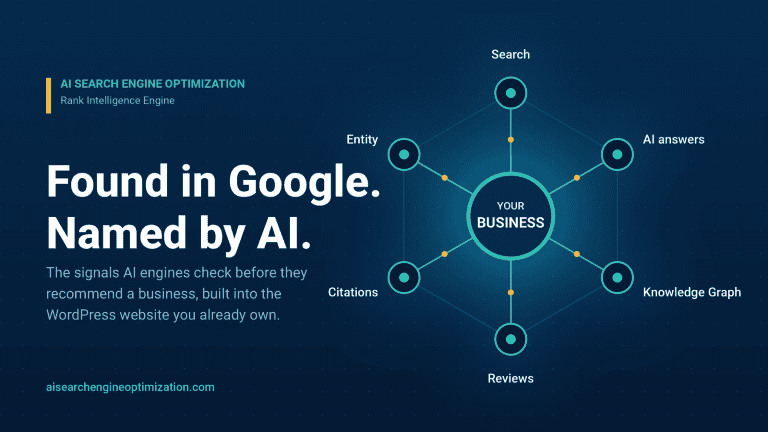
LLM SEO means making your website and business facts easy for ChatGPT, Gemini, Perplexity and Google's AI Mode to find, verify and quote when a buyer asks who to hire. GEO, AEO, LLM SEO, AI SEO: one job, five names, and which one you are actually buying comes down to this: every one of these terms describes the same work of being found in Google and named by AI. The acronym on a proposal matters far less than what gets built, installed and measured on your actual site.
Key Takeaways
- LLM SEO, GEO, AEO, AI SEO and AI search optimization all describe the same underlying work: being found in Google and named by AI.
- On October 18, 2026, search-demand data showed real but uneven interest across the five names, with "generative engine optimization" and "LLM SEO" leading.
- The top-ranking pages for all five terms, read the same date, describe identical deliverables: crawlable pages, clear answers, verifiable facts, structured data, consistent listings and measured citations.
- You do not need five strategies. You need one: visibility in Google's organic results, the map pack, and the AI answers, measured by counted citations and dated rankings.
- The right vendor question is "what gets built, installed and measured," never "which acronym do you specialize in."
- Traditional SEO and AI visibility work run together, not separately; you cannot skip one and win the other.
- Google itself treats this work as an extension of SEO, not a replacement for it [1].
As seen in

What's the actual difference between GEO and AEO
GEO and AEO describe the same outcome from two angles, not two different jobs. GEO, generative engine optimization, emphasizes being synthesized into a generated answer. AEO, answer engine optimization, emphasizes being the direct answer to a question.
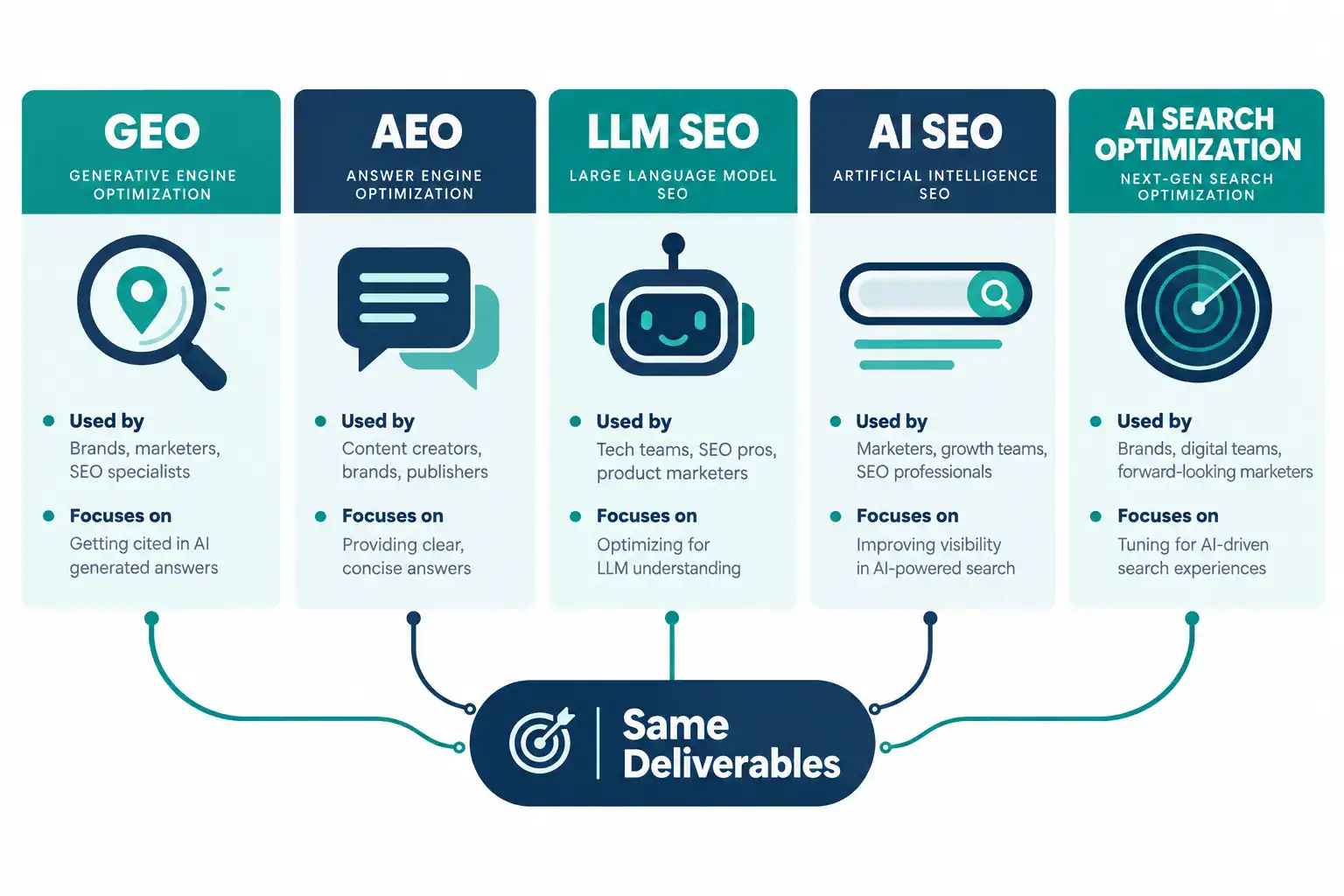
In practice, both rest on the same mechanics: clear entity facts, structured data, content written to be quoted, and off-site citations the engines trust. One industry overview sums up the overlap by treating SEO, AEO and GEO as a combined discipline rather than three competing ones [2]. If a vendor tells you GEO and AEO require separate roadmaps, ask them to show the two roadmaps side by side. In most cases, they will look nearly identical.
Is LLM SEO just another name for AI SEO
Yes. LLM SEO focuses on large language models specifically (ChatGPT, Gemini, Claude-style systems), while AI SEO is the broader umbrella covering any AI-driven search surface, including Google's AI Overviews and AI Mode. The deliverables overlap almost completely.
Writers who use "LLM SEO" tend to be speaking to a technical or product audience. Writers who use "AI SEO" tend to be speaking to business owners. Neither group is describing a fundamentally different scope of work. Our own breakdown of AI SEO versus traditional SEO covers how the newer AI-facing work sits on top of, rather than instead of, conventional ranking work.
Are GEO, AEO, and LLM SEO all the same thing
Functionally, yes, with minor emphasis differences. Each term was coined by a different corner of the industry at a different moment, but the top-ranking explainer pages for all five names, read on October 18, 2026, describe the identical set of deliverables: crawlable pages, clear direct answers, verifiable business facts, structured data, consistent business listings, off-site authority and citations, and measurement of mentions in AI answers.
That is not a coincidence. It reflects one underlying job: make a business's facts clear and trustworthy enough that any AI system, and Google's own ranking systems, can confidently name it.
Which one should you actually optimize for right now
You should optimize for the outcome, not the label: being found in Google and named by AI, measured by dated rankings and counted citations. Picking one acronym to chase and ignoring the others leaves gaps, because buyers use all of these surfaces in the same week.
A decision rule that works for most service business owners: if your buyers search Google and ask AI tools who to hire, which is most owners today, you need the full stack, not a single acronym's slice of it. This is why we built our AI SEO services to cover organic rankings, the map pack and AI citations together rather than selling GEO or AEO as a standalone product.
How much does it cost to implement AEO or GEO
Cost depends on your current site condition, competitive field and whether you need local, national, or both, not on which acronym is used on the invoice. A vendor quoting "AEO" at one price and "GEO" at another, for the same business, same market, is pricing the label, not the work.
Ask for the scope behind the number: what pages get rebuilt, what gets installed, what gets measured, and over what dated window. Our page on AI SEO pricing and proposals explains how to read a proposal so the number reflects real scope rather than a rebranded line item.
Common mistake: paying for a "GEO audit" and a separate "AEO audit" when a single combined audit, scored against real competitors, would answer both questions at once.
What's generative engine optimization exactly
Generative engine optimization (GEO) is the practice of making content and facts easy for generative AI systems to pull into a synthesized answer, with your business credited as the source. It leans on structured data, clear entity facts and content built to be lifted and quoted, not just ranked.
GEO is not a replacement for ranking well in Google; it depends on many of the same foundations, including topical authority and entity SEO that make a business recognizable in the first place. Academic framing of generative search treats it as a measurable discipline of its own, built on classic information retrieval [3].
Do you need a separate strategy for each term, or just one
Just one. Because the five names describe one job, a single strategy, covering entity clarity, structured data, content built to be quoted, off-site citations and measurement, covers GEO, AEO, LLM SEO and AI SEO at the same time.
Running five separate "strategies" from five vendors, or five line items from one vendor, multiplies cost without multiplying outcome. It also creates the exact problem service businesses hire us to fix: pages and signals that compete with each other instead of reinforcing one message.
Can you do traditional SEO and GEO at the same time
Yes, and you should. Traditional SEO and GEO are not sequential phases; they run on the same site, the same pages and often the same content. Google's own search guidance now explicitly frames AEO and GEO as "still SEO," not a separate specialty requiring a different site [1].
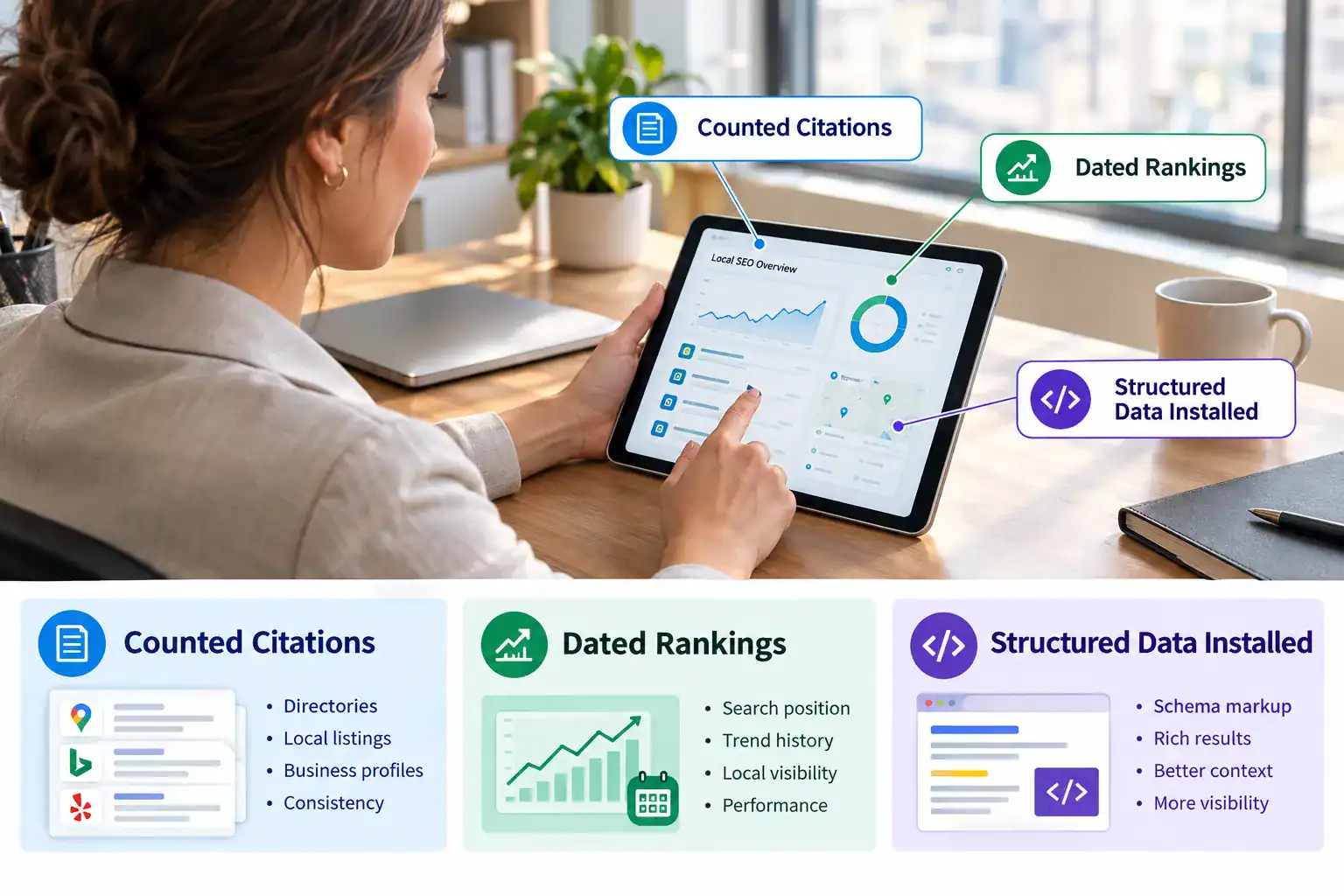
A business ranking well organically has a real head start on AI visibility, because the AI engines draw heavily from sites that already demonstrate authority and trust. Our competitor SEO analysis work is typically the first step precisely because it reveals where organic and AI gaps overlap.
What are the most common mistakes people make with LLM SEO
The most common mistake is treating LLM SEO as content formatting rather than entity clarity. Adding FAQ blocks or short paragraphs without fixing inconsistent business facts, missing structured data or thin off-site presence rarely moves AI citations.
Other frequent mistakes:
- Chasing "AI readiness scores" instead of counted, dated citations.
- Publishing content without checking it against an existing keyword map, creating pages that compete with each other.
- Ignoring outdated service details that quietly erode AI answer confidence, a problem covered in our piece on outdated service information and AI answer confidence.
- Assuming one AI platform's visibility represents all of them, when ChatGPT, Perplexity, Gemini and Copilot each cite differently.
Edge case: a business with strong Google rankings but inconsistent name, address and service details across the web can still be invisible to AI engines, because consistency, not just rank, decides citation.
Who actually needs answer engine optimization
Any business whose buyers ask an AI tool who to hire needs AEO, which today includes most local and national service businesses. Clinics, contractors, firms and consultancies all fall into this category once their buyers start typing questions into ChatGPT or Google's AI Mode instead of only clicking blue links.
If you are unsure whether this applies to you, the fastest way to find out is a real test of what AI engines say about your business today. See how that works in our AI visibility audit.
What tools do you use for AEO vs GEO
The underlying data needs are the same for both: entity and Knowledge Graph signals, backlink and keyword data, AI-answer citation tracking, crawler-log evidence and structured data validation. There is no separate "AEO tool stack" and "GEO tool stack" in practice; both rely on verifying facts, installing structured data and tracking citations across AI engines.
What differs is emphasis: GEO work weighs content synthesis signals slightly more; AEO work weighs direct-answer formatting slightly more. Both depend on the same foundation covered in our entity SEO work and E-E-A-T work.
Why do these all have different names if they're the same thing
The names emerged at different times from different corners of the industry, each coining a term for the piece of the job it noticed first. Search demand data shows this clearly: on October 18, 2026, "generative engine optimization" drew roughly 2,000 monthly searches for its definition alone, "LLM SEO" drew about 1,600, "answer engine optimization" about 1,300, "AI SEO" about 700, and "AI search optimization" trailed behind all four.
| Term | Monthly definition demand (Oct 18, 2026) | What it emphasizes | Who tends to use it |
|---|---|---|---|
| Generative engine optimization (GEO) | about 2,000 | Being synthesized into a generated answer | Industry analysts, early adopters |
| LLM SEO | about 1,600 | Visibility inside large language model outputs specifically | Technical teams, product marketers |
| Answer engine optimization (AEO) | about 1,300 | Being the direct quoted answer | Content and marketing teams |
| AI SEO | about 700 | The broad umbrella across all AI search surfaces | Business owners, general audiences |
| AI search optimization | behind all four | Same umbrella, plainer phrasing | General business audiences |
"The top-ranking pages for all five names describe the same deliverables: crawlable pages, clear answers, verifiable business facts, structured data, consistent listings, authority and citations, and measurement of mentions and citations in AI answers."
This is what is called "naming confusion," and it has been documented across industry commentary comparing the terms directly [4]. The practical lesson: the acronym tells you which audience wrote the page, not which job it describes.
Is GEO relevant if your traditional SEO is already working
Yes, because ranking well in Google does not automatically mean an AI engine will name your business when a buyer asks a conversational question. AI engines synthesize answers from entity facts, structured data and citation-worthy content, which overlaps with but is not identical to the ranking factors that put you on page one.
A business can hold a first-position ranking and still lose the AI answer to a competitor with clearer entity data. That is exactly the gap our AI local SEO services and GEO audit versus SEO audit comparison are built to find.
Which search engines actually care about AEO optimization
Google's AI Overviews and AI Mode, ChatGPT, Perplexity, Gemini and Copilot all draw on the same underlying signals: clear entity facts, structured data, off-site authority and content built to be quoted. None of these platforms is optional if your buyers use more than one search surface, which most do.
Enterprise guidance increasingly treats AEO and GEO as line items inside a broader SEO program rather than separate budgets, because the same foundational work feeds every platform at once [2]. Banking and other regulated sectors are already building this into agentic commerce planning, where AI agents complete transactions on a buyer's behalf and need verifiable facts to act on [5].
Conclusion
The acronym does not matter. The outcome does. Whether a vendor calls it GEO, AEO, LLM SEO, AI SEO or AI search optimization, you are buying the same thing: a business that gets found in Google, placed in the map pack, and named when a buyer asks an AI tool who to hire, measured by dated rankings and counted citations rather than a readiness score.
Before you sign anything, ask the vendor one question: what exactly gets built, installed and measured on your site, and when. If they answer with an acronym instead of a deliverable, keep asking. Our own AI SEO services are built around that exact answer, because the acronym changes depending on who is writing the page, and the job never does.
If you want to see where your business currently stands, and which competitors the AI engines are naming instead of you, book a call with Phil.
FAQ
What is LLM SEO in simple terms?
LLM SEO is making your business facts clear enough that ChatGPT, Gemini and similar AI tools can confidently name your business when someone asks who to hire.
What is AI SEO called now?
It goes by several names today, including GEO, AEO, LLM SEO and AI search optimization, all describing the same underlying work.
AEO vs GEO, which is more important?
Neither is more important; they describe the same job from different angles and are usually built together, not separately.
Does GEO replace traditional SEO?
No. GEO builds on traditional SEO foundations like structured data, clear entity facts and site authority rather than replacing them.
How do I know if I need AI SEO work?
If your buyers search Google and sometimes ask an AI tool who to hire, which describes most service businesses today, you need it.
Can one vendor handle both GEO and traditional rankings?
Yes, and it is more efficient than hiring separate vendors, since both rely on the same entity, content and structured-data foundations.
References
- Google's new AI search guide calls AEO and GEO 'still SEO'. Search Engine Journal.
- AI optimization guide. Google Search Central.
- GEO: Generative Engine Optimization. arXiv.
- Google says you don't need AEO or GEO to rank in AI Overviews. Search Engine Journal.
- Agentic commerce and banking. PwC.
Continue your research
How Long Does SEO Take? Eight Dated Records, Week by Week: the dated windows behind the job, whatever it gets called.
AI Mentions vs Citations: the two outcomes all five names are chasing.
Discuss what this means for your business
Our proprietary Rank Intelligence Engine connects 25 specialized analysis and implementation capabilities with commercial judgment, content, and WordPress implementation. Phil Belleville has worked in SEO since 1995 and brings that experience to the priorities and decisions behind the work.
Explore our AI SEO services to see the service behind this business perspective.
30 minutes with Phil. Written scope and pricing before paid work begins.
Found this useful? Add us to your Google Preferred Sources and our next guide will find you first.
Add us as a Google Preferred Source