B2B AI SEO Agency:
Get Ranked by Google and Named in the AI Shortlist

Last updated: October 14, 2026
Quick answer
A B2B SEO agency for AI search ranks the product, application, and problem pages a buying committee searches for in Google, while also making the company verifiable enough for ChatGPT, Perplexity, Gemini, and Google AI Overviews to name it in a shortlist. This matters most for manufacturers, technical consultancies, and professional services firms where a purchase is researched by multiple people over weeks before anyone fills out a contact form.
Key takeaways
- B2B SEO targets a buying committee (engineer, procurement, director), not a single consumer click, so one page has to answer several different searches for the same product.
- AI assistants only name companies they can verify from independent sources. A clean entity and Knowledge Graph record matters as much as page content.
- Google’s classic results still come first: the pages that rank there are the same pages AI Overviews and AI Mode retrieve from and cite.
- Keyword mapping for B2B needs to be organized by product family, vertical, and application, not by generic service terms.
- Technical SEO for B2B catalogs includes checking whether AI crawlers (not just Googlebot) can actually read the site.
- Results should be tracked in three layers: organic rankings, AI mentions/citations, and request-for-quote volume, read together rather than separately.
- B2B SEO pricing varies widely by scope. Smaller companies with a handful of product lines pay less than national manufacturers with large catalogs.
- Common mistakes include building one broad “services” page instead of separate product and application pages, and ignoring entity consistency across directories.
What is B2B SEO and how does it differ from B2C SEO?
B2B SEO is search optimization built around a multi-person buying committee researching a purchase over weeks or months, instead of a single consumer making an impulse decision. The difference shows up in the pages themselves: a B2C site needs one strong product or category page, while a B2B site needs separate pages for the engineer’s specification search, procurement’s comparison search, and the director’s trust search, because each person uses different vocabulary for the same product.
A growing share of that research now starts with an AI assistant rather than a Google search box. Across 26 buyer and research questions tested on six AI platforms in September 2026, the answers named a field of 18 firms total and cited Google’s own documentation in 21 of the 26 questions. That tells you two things about B2B buyers in 2026:
- They’re asking assistants for a shortlist before they ever type a query into Google.
- The assistants lean heavily on sources they can verify, which rewards companies with clean entity data over companies with the biggest marketing budget.
Choose B2B SEO over generic SEO if: your product is researched by more than one person, your sales cycle runs longer than a single session, or your buyers search using technical vocabulary (spec numbers, compliance terms, application names) rather than brand names.
A B2B GEO agency built for a buying committee, not a single click
A B2B GEO (generative engine optimization) agency has to do three jobs a consumer-focused agency doesn’t: rank the specific pages each committee member searches, make the company a verifiable entity the AI platforms can name, and connect both to a request path a technical buyer will actually use.
Each buyer on a committee searches differently:
- The engineer checks specifications and compatibility.
- The procurement lead compares three or more suppliers side by side.
- The owner or director asks whether the company can be trusted with a contract.
In the September 2026 benchmark, no agency or vendor website was cited in more than 7.3 percent of the 26 tracked answers. That pattern repeats across B2B categories: AI platforms name the companies they can verify from independent sources and cite the pages that answer the technical sub-question directly, not the page with the most marketing copy.
A B2B page that ranks but offers nothing beyond a contact form still loses the quote. The request path, whether it’s a spec sheet download, a quote form, or a direct phone number, has to sit right next to the page that answers the technical question.
How do B2B companies use SEO to generate leads?
B2B companies generate leads through SEO by ranking product-family, application, and problem pages that match what each committee member searches, then giving that visitor a clear next step once they land. Lead generation in B2B SEO is less about traffic volume and more about matching page intent to buyer role.
A practical lead-generation structure looks like this:
- Product pages that answer the specification question an engineer runs.
- Vertical pages that speak to an industry’s specific problem (e.g., “clock systems for hospitals” vs. “clock systems for schools”).
- Product-vertical combination pages that catch searches where both intersect.
- Compliance or application pages that answer the question a director or compliance officer asks.
Each page needs a request path suited to that buyer: a spec download for the engineer, a comparison chart for procurement, a case study or client list for the director. A single generic “request a quote” button on every page undersells all three.
Common mistake: publishing one broad service page and expecting it to rank for every product family. In a technical category, that page usually loses to a competitor’s narrower, deeper page built for the exact search.
What does an AI-powered SEO agency actually do?
An AI-powered SEO agency combines traditional ranking work (keyword research, on-page content, technical fixes) with entity verification and AI-platform measurement, so a company shows up in both Google’s results and AI-generated answers. This is a different scope of work than standard SEO, and specialist firms have built their positioning specifically around B2B and B2B SaaS companies needing this combined approach.
The actual work typically includes:
- Demand evidence: mapping the real vocabulary buyers use, not just the terms the company uses internally.
- Competitor field analysis: scoring the company against pages actually ranking and actually cited by AI platforms, not against directories or marketplaces.
- Entity and Knowledge Graph work: consolidating a company’s name, address, and description across the web into one verifiable record.
- Page build-out: product, vertical, and application pages written to out-depth the competing page, with answer blocks structured for AI retrieval.
- Technical access: checking that AI crawlers (not just Googlebot) can read the site, since firewall rules often block one and allow the other silently.
- Weekly AI measurement: tracking mentions and citations per platform, per question, per competitor.
Phil Belleville’s SEO experience since 1995 informs which product families get prioritized and what each page has to prove, which separates a strategy from a content calendar produced on autopilot.
Specialist depth within Rank Intelligence Engine
Rank Intelligence Engine brings together 25 analysis and implementation capabilities built specifically for sites that need to rank and get cited at the same time. The capabilities span demand evidence for product-family terms, competitor field analysis, keyword mapping so one page owns one search, entity and Knowledge Graph measurement, technical crawl review, structured data, internal linking, conversion review, per-platform AI measurement, and WordPress implementation.
The AI SEO services behind this system stay the same across clients. What changes is the application: a manufacturer gets a national architecture of product, vertical, and product-vertical pages with a compliance lane; a technical consultancy gets a page set mapped to the imprecise terms its buyers actually use to describe a service they can’t name correctly. In both cases, demand evidence comes first and the pages follow it, tracked daily from day one.
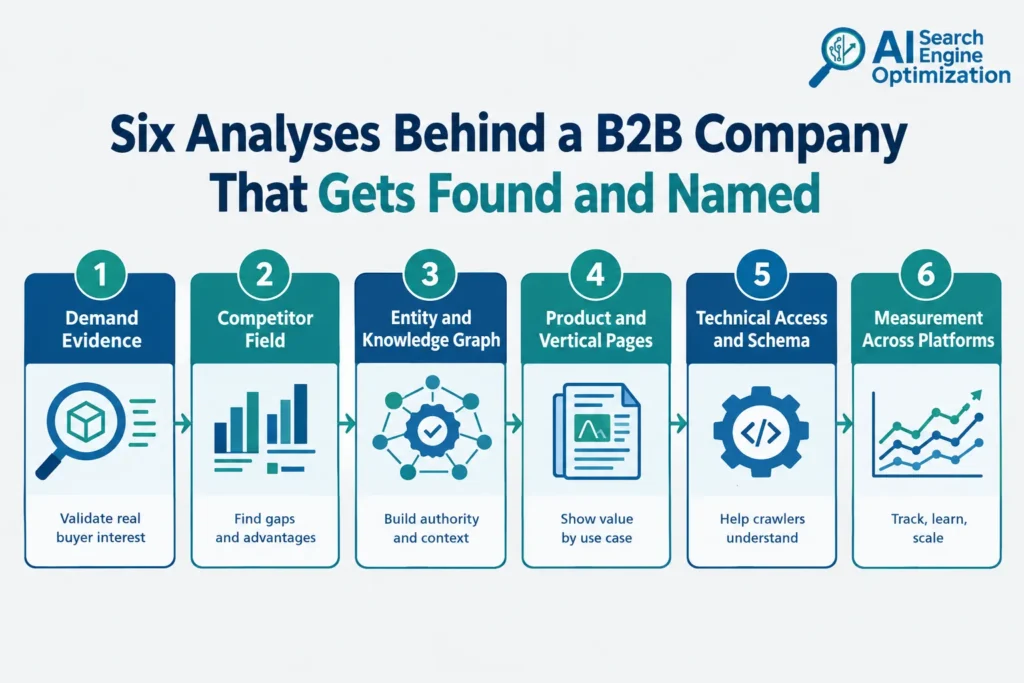
Six analyses behind a B2B company that gets found and named
A B2B page ranks when it answers the technical search better than competing pages and sits inside a site Google already trusts for that product family. A company gets named by AI platforms when it can be verified from independent sources and its pages answer the exact questions a committee asks. Six analyses check both conditions.
Demand evidence by product family and application
B2B demand hides in vocabulary mismatches: an engineer, a procurement lead, and an owner often use three different terms for the same product, and the volume usually sits in the terms the company itself doesn’t use. Mapping the full field before writing anything, and reading live results to see whether Google treats a term as a product search, a research question, or a supplier search, determines which page type wins.
What you get: a keyword map where every product family, application, and vertical owns one page, backed by measured demand.
The competitor field, by page type
Every product-family term gets scored against competitors already ranking for it, after directories, marketplaces, and listicles are stripped out of the field, so the real bar is a competing manufacturer’s page, not a distributor’s catalog listing. The same competitors are counted inside AI answers to buyer questions, because ranking second in Google while never being named by an assistant is a different problem than the reverse, and the work order reflects that.
What you get: a competitor field per page type with the specific content and AI-presence gap, and a priority order for closing it.
Entity, Knowledge Graph, and the sources AI verifies against
AI platforms name companies they can verify, and for most B2B firms that verification fails before the page content is even read: no Knowledge Graph record, a name appearing in four different forms across directories, or profiles that disagree on the address. Entity SEO work locks a single canonical record and rebuilds the profile and citation footprint AI answers actually read.
What you get: one verifiable company record across the site, its profiles, and the sources AI platforms cite, with Knowledge Graph measurement before and after.
Product, vertical, and application pages built to the bar
Each page is built to out-depth the page currently ranking: the specs a buyer compares, the compliance questions an engineer checks, the proof a director wants, and an answer block structured for AI lifting. Nothing publishes to hit a template word count; each page has to carry something the competing page doesn’t.
What you get: the product, vertical, and combination pages the map calls for, each with a stated reason it out-depths its competitor.
Technical access, structured data, and internal linking
A technical catalog on WordPress accumulates crawl waste over time: duplicate parameter pages, orphaned product pages, and firewall rules that quietly block AI crawlers while welcoming Google. Probing each platform’s crawler against the live site, fixing access, marking up products and FAQs with schema, and routing internal links toward pages that quote, closes that gap.
What you get: a site every AI crawler and search engine can read, with schema that agrees with the page content and links that carry authority to quote-earning pages.
Measured in rankings, AI answers, and requests for quotation
Product-family rankings get tracked daily. AI mentions and citations get counted weekly per platform, per question, per competitor. Both get read beside the quote requests the site produces in the same weeks, using a “how did you hear about us” field so buyers who researched in an AI assistant and typed the company name directly get counted correctly.
What you get: a dated baseline and weekly re-measure across Google and each AI platform, reported alongside quote volume rather than as a vanity number alone.
B2B SEO for technical products and services
Technical products and services need pages that answer the spec-level question a buyer runs before they’ll trust a supplier, because a generic overview page loses to a competitor’s page with real compliance detail. This applies directly to manufacturers, engineering firms, and consultancies where the service itself is hard for a buyer to name precisely.
What this looks like in practice:
- Specification depth: tolerances, materials, certifications, and compatibility data a procurement team actually compares.
- Compliance lanes: dedicated sections or pages addressing regulatory and industry-standard questions.
- Application pages: content mapped to the specific use case (industry, environment, or installation type) rather than the product alone.
- Imprecise-term mapping: buyers searching for a service they can’t name correctly still need to find the right page; this requires mapping colloquial and technical phrasing together.
Edge case: a service with very low search volume (a niche technical consultancy, for example) may need to build demand evidence around adjacent problem-based searches rather than the service name itself, since nobody is searching the formal term.
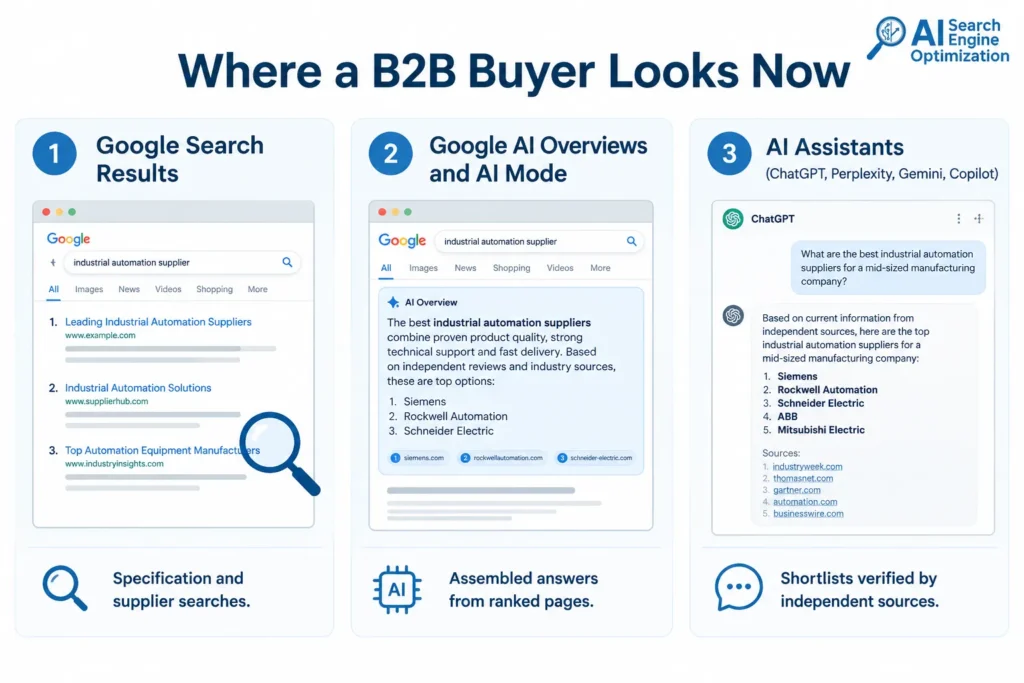
Where a B2B buyer looks now
A B2B buying committee spreads research across three environments: Google’s classic results, Google’s AI features, and AI assistants, and each reads the company’s site differently. Treating all three as one channel is a measurement mistake, because the September 2026 benchmark showed platforms disagreeing openly, with the same buyer question answered with a list of firms on one platform and a table of software tools on another.
Google search results
Engineers and procurement leads still run specification and supplier searches through Google’s classic results, and these are the same pages AI features retrieve from, as Google’s guidance on succeeding in AI search confirms. This is why product-family and application page work comes first in any sequencing decision.
Google AI Overviews and AI Mode
Google’s AI answers break a research question into sub-questions and assemble the response from pages it already ranks, citing whichever page answers each part most directly, per Google’s AI features documentation. In the September 2026 benchmark, Google’s own documentation was the most-cited source, with video the second, ahead of every agency and vendor site. A B2B page earns a citation by answering the sub-question a competitor’s page leaves out.
ChatGPT, Perplexity, Gemini, and Copilot
AI assistants recommend companies they can verify from independent sources and cite pages they can read cleanly; Perplexity’s own crawler documentation spells out how its bots fetch and index pages. A company with a clean entity record and one well-built application page gets named over a company with a bigger site and a muddled record. This is the core argument for entity SEO work being treated as equal priority to page content, not an afterthought.
B2B SEO agency pricing and costs
B2B SEO agency pricing typically scales with catalog size, number of product families, and whether entity/AI-visibility work is included alongside traditional ranking work. As a general industry estimate (not a quoted price from this agency; Search Engine Land’s guide to setting an SEO budget maps the same range structure), smaller B2B companies with a limited product line and a handful of target verticals usually land at the lower end of agency retainers, while national manufacturers with large catalogs and multi-vertical architectures sit at the higher end, because the number of pages, verticals, and compliance lanes multiplies the work.
Factors that move the price:
- Number of product families and verticals needing dedicated pages.
- Whether the engagement includes Knowledge Graph and entity work or just page content.
- Whether AI-platform measurement (weekly mentions/citations across multiple assistants) is part of reporting.
- Technical complexity of the existing site (legacy CMS cleanup, crawl issues, schema gaps).
Decision rule: choose a broader, higher-cost engagement if your company sells across multiple verticals or states; choose a narrower engagement if you have one or two product lines and a regional buyer base.
See AI SEO pricing proposals and AI SEO investment and ROI for a deeper breakdown of how agencies structure cost against scope.
Best B2B SEO agencies compared
The strongest B2B SEO and GEO agencies in 2026 combine traditional ranking work with AI-platform visibility, but they differ in how they specialize. Several firms focus on B2B SaaS specifically, others on enterprise-scale B2B marketing, and others fold AI optimization into a broader PR or marketing retainer. Search Engine Land’s guide to hiring an SEO agency covers the criteria worth checking before any shortlist.
| Agency | Primary focus | Differentiator |
|---|---|---|
| AI Search Engine Optimization | Manufacturers, technical consultancies, professional services on WordPress | Founder-led, published dated case studies, entity + GEO + traditional SEO combined |
| SaaS-specialist agencies | AI SEO specifically for B2B software companies | Narrow vertical focus on software; less depth on physical products, compliance-heavy catalogs, or multi-vertical businesses |
| Enterprise B2B agencies | Enterprise-scale B2B SEO and GEO | Large engagements, usually folded into broader marketing programs |
| Full-service marketing agencies | AI optimization as one capability | AIO and GEO added to an existing marketing retainer rather than run as search-first work |
| PR-led firms | B2B AI optimization | Positioned within PR and communications services |
Choose a narrow, vertical-specific agency (like a SaaS-only firm) if your company sells only software. Choose a WordPress-native, entity-focused agency if your company sells physical products, technical services, or operates across multiple verticals where compliance and specification depth matter more than software feature comparisons.
How long does it take to see results from B2B SEO?
Early ranking movement in a technical category can show up within four to six weeks for product-family terms already close to page one, while entity and AI-citation changes typically take longer to register because they depend on third-party sources updating. One published record shows a national manufacturer’s product-family terms in Google’s top ten rising from 52 to 89 over a five-week tracked window, with top-twenty terms rising from 83 to 138 in the same period.
What affects the timeline:
- Starting position: terms already ranking 11-20 move faster than terms with zero visibility.
- Site technical health: a site with crawl waste or blocked AI crawlers needs cleanup before new pages can earn trust.
- Entity cleanup: consolidating a messy multi-directory name/address record can take longer than publishing a page.
Common mistake: expecting AI citation gains on the same timeline as Google ranking gains. They move on different clocks because AI platforms depend on verification signals that update less frequently than search indexes.
Is B2B SEO worth it for small companies?
B2B SEO is worth it for small companies when their buyers research online before contacting a sales team, even if the company has only one or two product lines. Scale doesn’t disqualify a company from SEO value; it changes the scope of work needed.
A small technical consultancy, for example, doesn’t need a 50-page national architecture. It needs a smaller set of pages mapped to the exact imprecise terms its buyers search, plus a clean entity record so AI assistants can name it confidently against larger competitors. One tracked case shows a cell tower lease consultancy moving from zero tracked terms in Google’s top ten to 30, with its average position across a tracked keyword set improving from 82.8 to 25.0.
Choose B2B SEO even as a small company if: your buyers research for days or weeks before contacting you, your competitors are already ranking for the terms your buyers use, or you’ve never had a Knowledge Graph record established.
Common B2B SEO mistakes to avoid
The most common B2B SEO mistake is publishing one broad service page and expecting it to rank for every product, application, and vertical search a buying committee runs. This single mistake usually explains why a technically strong company loses visibility to a less-qualified competitor with narrower, deeper pages.
Other frequent mistakes:
- Ignoring entity consistency: letting the company name, address, or description vary across directories and profiles, which blocks AI verification.
- Blocking AI crawlers accidentally: firewall or bot-management rules that allow Googlebot but silently block AI platform crawlers.
- Measuring only rankings: tracking Google position without tracking AI mentions, citations, or quote requests in the same window.
- Writing to a word count instead of a competitive bar: publishing thin pages that don’t out-depth the competitor already ranking.
- Treating local Map Pack results loosely: counting any Map Pack appearance instead of only the visible top three positions.
Edge case: a company that has been acquired, rebranded, or changed addresses recently is especially prone to entity conflicts across directories, and this needs a dedicated cleanup pass before new content work will show full results.
How to measure B2B SEO success and ROI
B2B SEO success should be measured across three layers at once: organic rankings, AI mentions/citations per platform, and request-for-quote volume tied back to source, rather than any single metric alone. Search Engine Land’s GEO measurement analysis maps which of the AI-layer metrics are actually trackable today. Measuring only one layer hides real problems; a company can rank well in Google while being invisible in AI answers, or vice versa.
A practical measurement structure:
- Rankings: daily tracking of product-family and application terms in Google’s top ten and top twenty.
- AI visibility: weekly counts of mentions and citations across ChatGPT, Perplexity, Gemini, and Google AI Overviews, broken out by question and competitor.
- Lead attribution: a “how did you hear about us” field on every quote form, specifically capturing AI-assistant-driven inquiries that arrive as a direct name search.
See the AI answer benchmark for an example of how this measurement gets published with dated, named results rather than summarized claims.
B2B SEO for industries like SaaS and software
SaaS and software companies need B2B SEO built around feature comparison searches, integration questions, and category-defining terms, which differs from a manufacturer’s spec-driven search pattern. Buyers in software categories often compare tools directly against named competitors, so comparison and alternative pages carry more weight than they do for physical products.
Key differences for SaaS SEO:
- Comparison and “alternative to” pages matter more, since buyers actively search for direct competitor comparisons.
- Integration and API documentation often gets cited by AI platforms as a trust signal, similar to how compliance documentation works for manufacturers.
- Free trial or demo paths replace the quote-request path that technical manufacturers use.
Some agencies build their entire positioning around this SaaS-specific pattern, which is a reasonable choice if software is the only product line involved.
When should a B2B company hire an SEO agency?
A B2B company should hire an SEO agency when its buyers are already searching online for its product category and competitors are capturing that visibility instead, or when the company has never measured its AI-platform visibility at all. Waiting until sales decline is the most expensive time to start.
Signals it’s time to hire:
- Competitors consistently outrank the company for product-family or application terms.
- The company has no Google Knowledge Graph record, or has never checked.
- Sales reports buyers mentioning competitor names the company didn’t know were competitors.
- The company has never measured whether ChatGPT, Perplexity, or Gemini mention it at all.
See how to choose an SEO agency for AI search and in-house SEO vs agency for AI search for a fuller decision framework before committing to a retainer.
B2B SEO strategy for decision makers and researchers
A B2B SEO strategy needs separate content tracks for the researcher gathering technical facts and the decision maker evaluating trust and risk, because serving both with one generic page satisfies neither. The researcher (often an engineer or specifier) wants specification depth; the decision maker (often an owner or director) wants proof the company can deliver.
Practical structure:
- Researcher-facing pages: specifications, compliance detail, application notes, technical comparisons.
- Decision-maker-facing pages: case studies, client lists, certifications, company background, and E-E-A-T signals that establish credibility.
- Shared entry points: product and vertical pages that link out to both tracks depending on what the visitor needs next.
Quick example: a procurement lead comparing three suppliers might start on a spec page, then click through to a case study page before requesting a quote. If that case study page doesn’t exist or isn’t linked from the spec page, the procurement lead often leaves to check a competitor instead.
AI tools for B2B SEO and content optimization
AI tools help B2B SEO teams move faster on demand research, content drafting, and AI-visibility tracking, but they don’t replace the entity and verification work AI platforms require before naming a company. The original GEO research paper quantified that gap: verifiable, citation-rich content is what generative engines surface. Tools can speed up page production; they can’t fix a Knowledge Graph record or a conflicting directory listing.
Where AI tools genuinely help:
- Demand and competitor research: speeding up the process of mapping search terms against ranking competitors.
- Content optimization checks: reviewing whether a draft page covers the sub-questions a buyer or AI platform is likely to ask.
- AI-visibility tracking: automated weekly checks of mentions and citations across multiple assistants, which would be impractical to run manually at scale.
See AI SEO automation and best AI for SEO content for more detail on which tasks are safe to automate and which still need direct human judgment, particularly entity consolidation and competitive page strategy.
WordPress delivery: installed on the site you own
Every page, schema block, internal link, and technical fix gets installed directly on the company’s own WordPress site, not described in a report and left for someone else to implement. After each change, the live page gets read back from the server and checked at desktop and phone widths before it’s reported as finished, since a specification page that renders poorly on a phone loses the engineer who just found it.
This matters because work that lives only in a report doesn’t move rankings or AI citations. The engagement stays tied to what the company actually sells: you supply the product facts, the commercially important verticals, and the questions sales hears before a quote closes; the work supplies the analysis, the pages, the data, and the measurement, written directly into the site.
Published records: B2B results measured daily
Two of the eight published case studies on this site are B2B companies sold through research-heavy buying cycles, and every figure is tracked daily, averaged over seven days at each measurement endpoint.
Manufacturing (sells across the United States, WordPress site):
- Product-family terms in Google’s top ten: 52 → 89 over a five-week window.
- Terms in Google’s top twenty: 83 → 138 over the same window.
- Work included a national architecture of product, vertical, and product-vertical pages with a compliance lane, a new Knowledge Graph record, and a schema entity graph AI platforms can verify.
Technical consultancy (property owners nationwide, WordPress site):
- Tracked terms in Google’s top ten: 0 → 30.
- Average position across the tracked keyword set: 82.8 → 25.0.
- Work included mapping an imprecisely-named service to the terms buyers actually use and cleaning the backlink profile.
The same measurement discipline applies to the agency’s own AI visibility, tracked weekly across 26 buyer questions on six AI platforms and published on the AI answer benchmark page with every question, firm, and source listed.
FAQ
What is the difference between B2B SEO and B2C SEO?
B2B SEO targets a multi-person buying committee researching over weeks, requiring separate pages for different roles and vocabularies. B2C SEO typically optimizes for a single consumer making a faster decision.
How much does B2B SEO cost?
Costs scale with catalog size and scope. Companies with a few product lines generally need smaller engagements than national manufacturers with large, multi-vertical catalogs. Ask any agency to break down pricing against specific deliverables, not a flat monthly number.
How long until B2B SEO shows results?
Ranking movement for terms already near page one can appear in four to six weeks. AI citation gains often take longer because they depend on entity verification and third-party source updates.
Do AI assistants actually recommend B2B companies?
Yes, when asked for a shortlist, AI assistants name companies they can verify from independent sources. A clean entity record matters as much as page content for getting named.
Is B2B SEO worth it for a small company?
Yes, if buyers research online before contacting sales. Small companies need a smaller page set mapped precisely to buyer vocabulary rather than a large national architecture.
What’s the biggest B2B SEO mistake companies make?
Publishing one broad service page instead of separate product, vertical, and application pages for each distinct buyer search.
Can AI tools replace a B2B SEO agency?
AI tools speed up research and content drafting but don’t replace entity verification, Knowledge Graph consolidation, or competitive page strategy, which still require direct human judgment.
How do I measure B2B SEO ROI?
Track three layers together: organic rankings, weekly AI mentions/citations per platform, and quote requests attributed through a “how did you hear about us” field.
References
- Google Search Central Blog: Succeeding in AI search
- Google Search Central: AI features and your website
- Perplexity documentation: Perplexity bots and crawlers
- GEO: Generative Engine Optimization, arXiv
- Search Engine Land: What is AI SEO?
- Search Engine Land: How to hire an SEO agency, the definitive guide
- Search Engine Land: Setting and overseeing an SEO budget
- Search Engine Land: Measuring GEO, what’s trackable now and what’s still missing