Answer Engine Optimization · Business perspective
Google AI Mode: How It Picks Businesses
And What Changes on Your Site
Google AI Mode SEO comes down to one shift: AI Mode breaks a buyer's question into several smaller searches, called query fan-out, and picks businesses that answer those smaller searches clearly and consistently across the web. It does not rank one page against another the way classic search did. It checks whether your site, your business profile, your reviews and your video presence all agree on who you are, what you do, and where you work, and it rewards the business that narrows the buyer's decision fastest.
Key Takeaways
- Google AI Mode SEO means optimizing for sub-questions, not a single keyword or ranking position.
- AI Mode asked buyers to narrow by business type, goal, budget or location in 16 of 18 tracked answers between October 4 and October 16, 2026.
- AI Mode pulled 32 percent of its citations from Reddit, LinkedIn and YouTube in the same test, versus 19 percent for Google AI Overviews.
- SEO is not dead after AI Mode. It is the entry ticket; without it, AI Mode has nothing credible to cite.
- Small and local businesses can appear in AI Mode if their facts are consistent everywhere the AI looks.
- You track brand visibility in AI Mode by running the same buyer questions on a schedule and counting how often your business is named.
As seen in

What exactly is Google AI Mode and how does it work
Google AI Mode is a conversational search experience that answers a question directly, then invites follow-up questions, instead of handing back a page of blue links. It appears as a button on the Google homepage and inside the search bar, and it can lead a user through an entire research and decision process without them ever leaving Google [1][2][3].
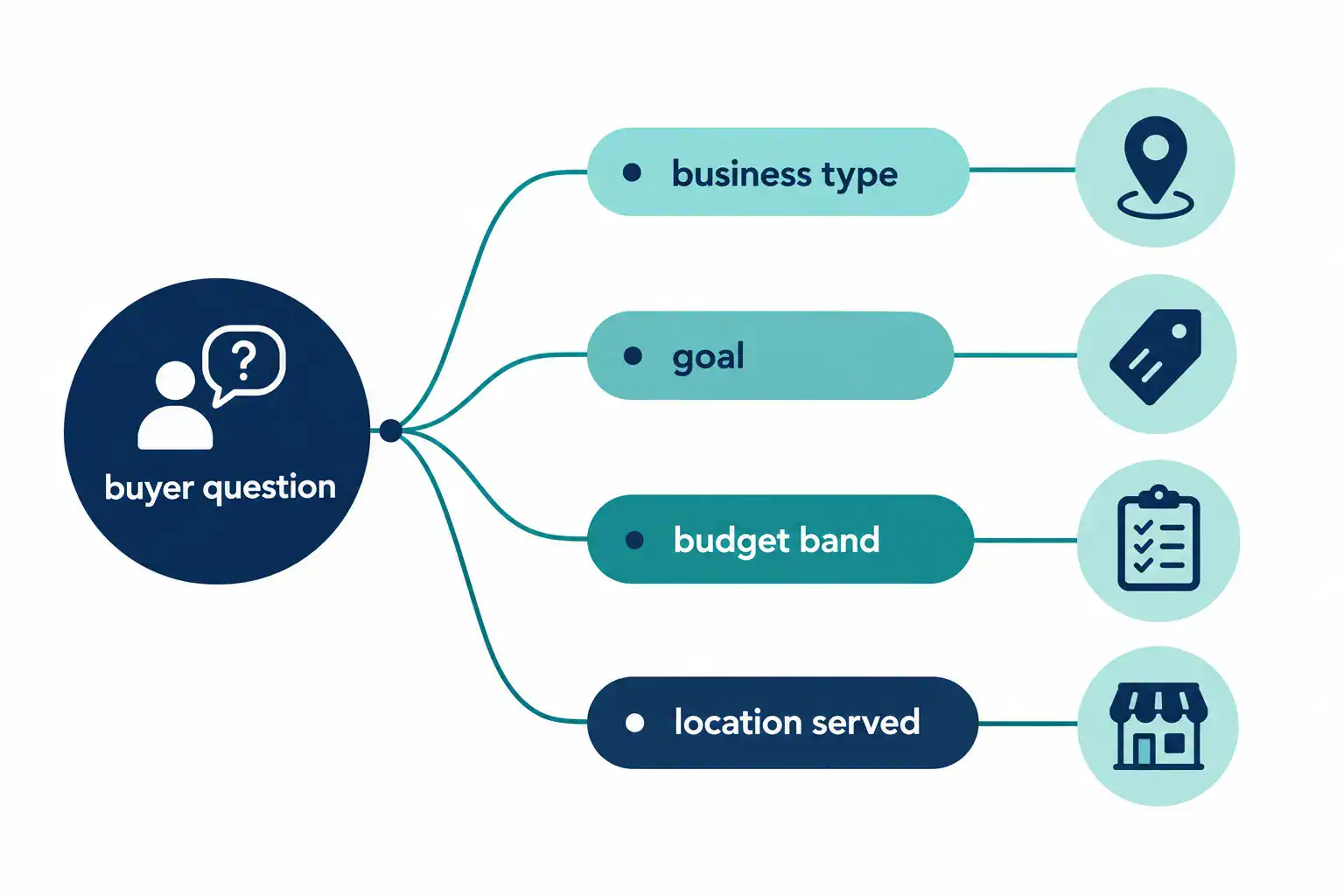
Behind that conversation, AI Mode does not run one search. It runs several, a process Google itself calls query fan-out: it splits the buyer's question into related sub-searches, pulls sources for each one, and composes a single answer out of all of them [4]. If a buyer asks "who should I hire to fix my site's SEO," AI Mode might separately check what SEO service costs, which agencies serve the buyer's city, what reviewers say about results, and what a comparable business claims to deliver. Your business is judged sub-question by sub-question, not by one ranking.
Google's own product announcements add a further layer: AI Mode can check live local availability, pricing, and appointment openings, and when that information isn't published clearly online, it can fill out a form or place a call to a business on the user's behalf to confirm details [6]. That means a business with outdated or missing information risks being skipped entirely, not just ranked lower.
How does Google decide which businesses to show in AI Mode
Google decides by cross-checking a business's Google Business Profile, Maps data, and third-party directories against what AI Mode finds across the open web, then favoring businesses that look real, nearby, topically relevant, and well reviewed [5]. There is no application process and no approved list. It is a synthesis of public signals.
In our own tracked tests of 18 buyer questions about hiring SEO help, run October 4 to October 16, 2026, AI Mode pulled 74 citations and sent 24 of them, or 32 percent, to Reddit, LinkedIn and YouTube. Google AI Overviews, tested on the same questions, sent only 19 percent of citations to those platforms. The gap matters: a business invisible on community and professional platforms is invisible to a meaningful share of what AI Mode actually reads before naming anyone.
AI Mode also behaves like a cautious advisor. In 16 of those 18 answers, it asked the buyer to narrow by business type, goal, budget or location before recommending anyone, compared with 13 of 18 for ChatGPT with web search and only 3 of 18 for Gemini. If your site never states those four facts plainly, AI Mode has nothing to match the buyer's narrowing answer against.
)
What changes on my website with Google AI Mode
The biggest change is that a single optimized page is no longer enough. Your site needs a page, or a clearly marked section, for every sub-question a buyer actually asks on the way to hiring someone.
Practical changes that follow from this:
- Build pages around real sub-questions: cost, service area, specialization, turnaround time, not just your main service term.
- State plainly who you serve (business type), what outcome you deliver (goal), roughly what it costs (budget band), and where you work (location served). One sentence each is enough on a given page.
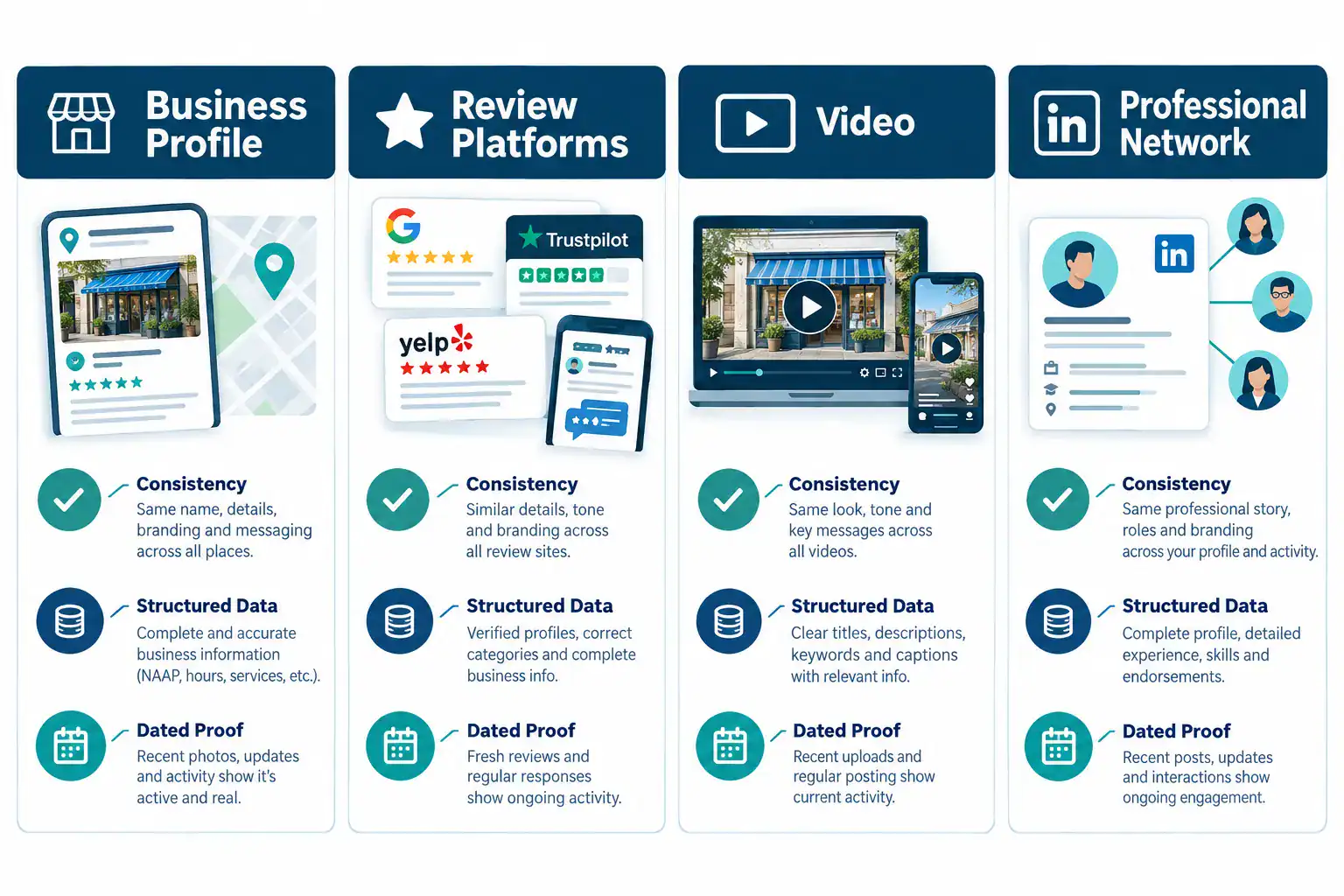
- Match your site's claims with your business profile, review platforms, YouTube channel, and professional network presence, because AI Mode checks all of them against each other.
- Add structured data that mirrors exactly what the page says, so there's no mismatch for the AI to catch.
- Keep dated proof on key pages: a result with a date is more citable than a vague promise.
Businesses with scattered, mismatched facts across their website, profile, and review platforms are the ones AI Mode quietly skips, even when the website itself looks fine.
Do I need to optimize my site to get picked by Google AI Mode
Yes, if your buyers already use AI tools to shop for your service, which is increasingly the default behavior. Optimization here isn't about keyword tricks. It's about removing every reason an AI system would hesitate to name you.
A decision rule worth using: if your website, Google Business Profile, and review platforms don't all say the same service area, the same specialties, and the same business type, fix that mismatch before anything else. It's the single most common reason a qualified business gets skipped in favor of a less-qualified one with cleaner, consistent facts. For a structured look at what needs fixing first, a site architecture audit shows exactly where a site competes with itself instead of answering clearly.
Which types of businesses benefit most from Google AI Mode
Local and regional service businesses with clear specialties benefit most, because AI Mode's fan-out process rewards specificity over generic claims. A plumber who states "emergency water heater repair in [city], typically same-day" answers more sub-questions than one who simply says "plumbing services."
Businesses that already have entity clarity, meaning Google and AI systems can verify who they are without guessing, have an edge. If you're unsure whether your business reads as a clear, verifiable entity to AI systems, reviewing business entity clarity in Google and AI search is a useful first check.
How is Google AI Mode different from regular search results
Regular search results hand back a ranked list of pages for one query. AI Mode runs multiple queries behind the scenes and composes one answer, often inside Google's own interface, so the user may never click through to a website at all [1][7].
Google has also started testing AI Mode buttons directly inside the search bar, not just the homepage, and is expanding specialized "supplier and aggregator" result units that pull in local business data [8]. That means AI Mode increasingly draws from structured local modules rather than the broader organic results list when it recommends a business [7][8]. A business that only optimizes for classic organic rankings is optimizing for a shrinking share of what actually decides who gets named.
Can small businesses appear in Google AI Mode
Yes. AI Mode does not favor large businesses by default. It favors consistent, verifiable facts, which a small business can usually produce faster than a large one with multiple locations and inconsistent records.
A small business with an accurate Google Business Profile, a handful of specific reviews, and a website that states its service area and specialty plainly has a real shot at being named. Google's own guidance to marketers emphasizes clear, structured, trustworthy content over sheer size or budget. The checklist in signs your business is ready for AI search optimization is a good gut-check for where a smaller business stands today.
Why isn't my business showing up in Google AI Mode yet
The most common cause is mismatched or missing facts across the places AI Mode checks: your website, your business profile, your reviews, and platforms like YouTube or LinkedIn. If any of those disagree on what you do or where you work, AI Mode has reason to skip you for a competitor whose story is consistent everywhere.
A second common cause: your site never states the four narrowing facts, business type, goal, budget band, and location served, clearly enough for AI Mode to match them against a buyer's answer. If a buyer says "I need help in [city] for under [budget]," and your page never mentions a city or a price range, you simply aren't a match, regardless of how good your work actually is.
Is Google AI Mode going to replace traditional search results
Not entirely, but it is taking over more of the result page. AI Overviews are increasingly feeding users into full AI Mode conversations, and Google has added more AI Mode entry points directly in the search bar [1][7][8]. Traditional blue-link results still exist, but AI Mode is absorbing a growing share of research-heavy and decision-heavy searches, which includes most "who should I hire" queries.
That shift compresses the buyer's funnel: by the time a user clicks through to a website, the AI has often already summarized the options and the user is confirming a choice rather than still shopping [1]. Being the business named in that summary matters more than it used to.
What are common mistakes businesses make with Google AI Mode
The most common mistake is treating AI Mode like a ranking problem instead of an answering problem. A page can rank well in classic search and still be skipped by AI Mode if it doesn't answer the specific sub-question a buyer's fan-out search generates.
Other frequent mistakes:
- Ignoring review platforms and video, which AI Mode cites heavily, our own tracked test found 32 percent of AI Mode's citations went to Reddit, LinkedIn and YouTube combined (October 4 to October 16, 2026).
- Letting the Google Business Profile drift out of sync with the website's stated services and service area.
- Writing vague service pages with no stated budget range, location, or specific outcome.
- Skipping structured data, so there's a gap between what a page says and what a machine can confirm it says.
A keyword cannibalization problem compounds all of this: when two pages compete for the same sub-question, AI Mode has no clean answer to cite from your site at all.
)
Does Google AI Mode work in all countries and regions
AI Mode's rollout and capabilities vary by market. In India, for example, Google has introduced advanced multimodal AI Mode features powered by newer Gemini models, with localized launches handling regional queries and content formats. Some regions receive newer model versions and features, like expanded monitoring tools, before others [9].
For a business that serves multiple regions, this means AI Mode exposure may not be identical across every market you operate in, and it's worth checking how AI Mode behaves for your specific buyer locations rather than assuming uniform behavior everywhere.
What should I change on my website to rank in Google AI Mode
Start with the structural fix, not the writing fix: make sure every important service has its own clear page, and that page states the business type, goal served, budget band, and location served in plain sentences, with structured data that matches. From there, build out pages that answer the real sub-questions buyers ask, pricing, turnaround, service area limits, specialization, before expanding into supporting content.
This is really answer engine optimization services work: structuring a site so that every page is a direct, citable answer to one sub-question, backed by consistent facts off-site. Entity work matters here too. If AI systems can't confirm who you are through Google's own records, see knowledge graph SEO for what that confirmation actually requires.
What other options do I have if Google AI Mode doesn't feature my business
If AI Mode isn't naming you yet, the fastest-growing alternative is a broader answer engine optimization approach, because ChatGPT, Perplexity, Gemini and Copilot don't all behave like AI Mode, and a business invisible in one can still be visible in another. Our tracked test found Gemini only asked narrowing questions in 3 of 18 cases, far fewer than AI Mode's 16 of 18, meaning Gemini may name a business faster with less qualifying information.
Running a full GEO audit against your current site shows exactly which engines already see you clearly and which ones don't, so effort goes where the gap actually is instead of guessing.
How long does it take to appear in Google AI Mode results
There's no fixed timeline Google has published, and AI Mode itself is still evolving, including features like information monitoring that are rolling out gradually to all users after starting with paying subscribers [9]. What determines your timeline is how quickly your facts become consistent across your site, your business profile, and the platforms AI Mode cites.
In practice, a business that fixes mismatched facts and builds sub-question pages can see citation activity shift within weeks, because AI Mode re-crawls and re-synthesizes frequently. A business with structural problems, like pages competing with each other or an out-of-date profile, often needs that fixed first, which takes longer but produces a more durable result.
Is SEO dead after AI Mode in Google
No. SEO is the entry ticket, not a relic. AI Mode still needs real pages, real structured data, and real off-site signals to cite, it simply changes what "ranking" means. A business with no SEO foundation has nothing for AI Mode to find, read, or quote, no matter how well it tells its own story elsewhere.
How to track brand visibility in Google's AI Mode
Run the same set of buyer questions your prospects would actually ask, on a fixed schedule, and count how often your business gets named and cited versus your competitors. This is exactly how our own tracked numbers in this article were produced: 18 buyer questions, run across a defined window, with every citation counted by source.
Doing this consistently tells you three things: whether you're being named at all, which sources AI Mode is citing instead of you, and whether that's changing month to month. For a deeper look at what a proper tracking report should actually contain, see AI search visibility metrics and KPIs.
FAQ
What is Google AI Mode in simple terms?
It's a conversational version of Google Search that answers questions directly and lets you keep asking follow-ups, instead of showing a list of links to click through.
Does Google AI Mode use a different model than regular search?
Yes, it's partially powered by Gemini, with newer versions like Gemini 3.8 Flash available to paying AI Pro and Ultra subscribers for more advanced reasoning [7][10].
Can AI Mode call my business directly?
Yes. Google's documentation confirms AI Mode can fill out forms or place a call on a user's behalf to confirm details like appointment availability or stock, when that information isn't clearly published online [5].
Will AI Mode replace my Google Business Profile?
No, but AI Mode relies heavily on it. An inaccurate or incomplete profile is one of the most common reasons a business gets skipped.
Is Google AI Mode available everywhere?
Rollout and feature sets vary by country, with some regions getting newer capabilities first [8].
How is this different from Google AI Overviews?
AI Overviews are shorter summaries shown above regular results; AI Mode is a full conversational experience and increasingly the destination AI Overviews push users into [1].
Conclusion
Google AI Mode SEO isn't a new trick layered on top of old SEO. It's a shift toward answering the real sub-questions your buyers already ask, with facts that stay consistent everywhere an AI system looks, your website, your business profile, your reviews, and your video presence.
The businesses that win here aren't the ones with the flashiest pages. They're the ones whose facts never contradict themselves and whose sites narrow a buyer's decision the way AI Mode already tries to, by business type, goal, budget and location. If you want a clear look at where your current site stands against that bar, our answer engine optimization services start with exactly that diagnosis. From there, the next step is simple: book a call with Phil and find out, before a competitor does, whether AI Mode is already naming someone else in your place.
References
- Google steers more search users into AI chat as websites face fewer clicks. TIME.
- Get AI-powered responses with AI Mode in Google Search. Google Search Help.
- Google AI Mode guide. 9to5Google.
- AI features and your website. Google Search Central.
- How to improve your local ranking on Google. Google Business Profile Help.
- I/O 2026: welcome to the agentic Gemini era. blog.google.
- September 2026 Google webmaster report. Search Engine Roundtable.
- Search recap: September 18, 2026. Search Engine Roundtable.
- Google rolls out AI Mode info monitoring to all users globally. Search Engine Journal.
- Google Search AI Mode gets Gemini 3.8. Search Engine Roundtable.
Continue your research
How Google AI Overviews Choose Their Sources: the companion surface that feeds AI Mode.
What an AI Search Audit Should Deliver: the measured read on what AI Mode currently says about you.
Discuss what this means for your business
Our proprietary Rank Intelligence Engine connects 25 specialized analysis and implementation capabilities with commercial judgment, content, and WordPress implementation. Phil Belleville has worked in SEO since 1995 and brings that experience to the priorities and decisions behind the work.
Explore our answer engine optimization services to see the service behind this business perspective.
30 minutes with Phil. Written scope and pricing before paid work begins.
Found this useful? Add us to your Google Preferred Sources and our next guide will find you first.
Add us as a Google Preferred Source