
Ecommerce AI SEO Services:
Get Found in Google and Recommended by AI
Last updated: October 14, 2026
Quick answer
Ecommerce AI SEO combines traditional search engine optimization (rankings in Google and Google Shopping) with the structured data, product feeds, and review signals that AI platforms like ChatGPT, Perplexity, Gemini, and Google AI Overviews need to recommend a product by name. A store needs both because shoppers now start with a question to an AI assistant as often as they start with a search box, and losing visibility in either channel costs sales before a shopper ever reaches checkout.
Key takeaways
- Ecommerce AI SEO covers two separate jobs: ranking in Google's organic and Shopping results, and getting named in AI-generated answers on ChatGPT, Perplexity, Gemini, and Google AI Overviews.
- AI platforms verify product claims against structured data, the merchant feed, and customer reviews before naming a brand, so copy alone doesn't earn a citation.
- Product feed errors (price, availability, or identifier mismatches) are one of the most common reasons AI shopping answers drop a product.
- WordPress and WooCommerce stores need fixes installed directly in the theme, feed, and schema, not just described in a PDF report.
- Results from ecommerce AI SEO typically show in ranking and AI-mention tracking within weeks, with revenue impact building over two to four months as pages reindex and reviews accumulate.
- Paid ads and AI SEO solve different problems: ads buy placement now, AI SEO builds the product data and content that earns organic rankings and AI citations over time.
- The most common mistakes are treating AI tools as copy generators, ignoring feed-to-page data mismatches, and measuring traffic instead of orders.
As seen in

What is ecommerce AI SEO and how does it work
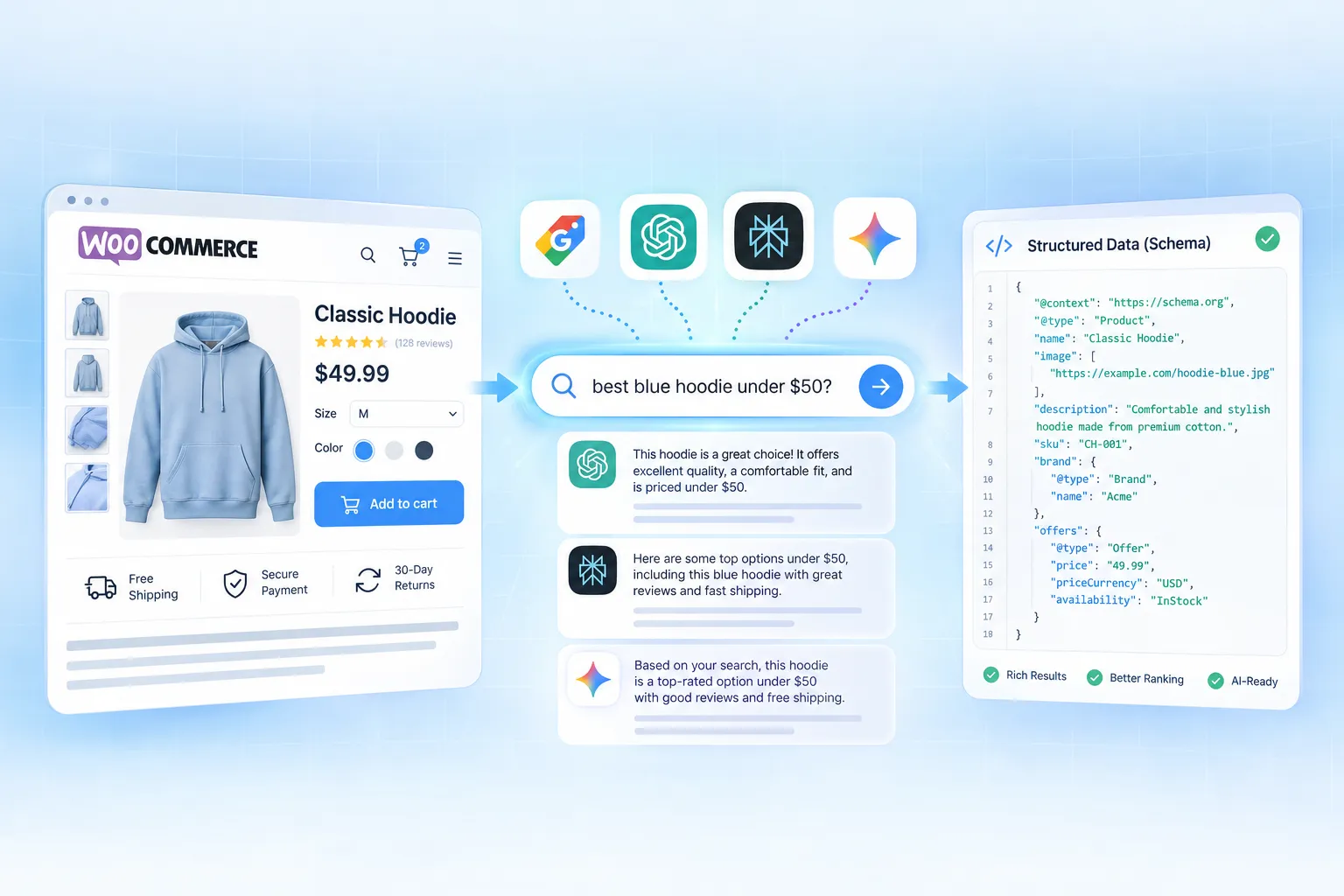
Ecommerce AI SEO is the work of making product and category pages rank in Google while also making the underlying product data verifiable enough for AI platforms to recommend the brand. It works by aligning three things that AI systems cross-check: the product page, the structured data, and the merchant feed.
A growing share of buying decisions now start with a question to an AI assistant rather than a search box: which one should I buy, what's the difference, is this brand any good. According to Search Engine Land's guide to ecommerce AI, AI-assisted shopping behavior is expanding fast enough that retailers who ignore it risk losing visibility even when their Google rankings hold steady.
AI platforms answer shopping questions from:
- Product pages they can read and extract facts from
- Review sites and third-party sources they already trust
- Retailer listings and merchant feeds they can verify against the page
A store invisible to those three sources loses the sale before the shopper ever sees a traditional search result. That's the gap most "AI SEO" tools don't close, because they generate copy instead of fixing the data AI systems actually check.
Ecommerce SEO vs traditional SEO: what's different
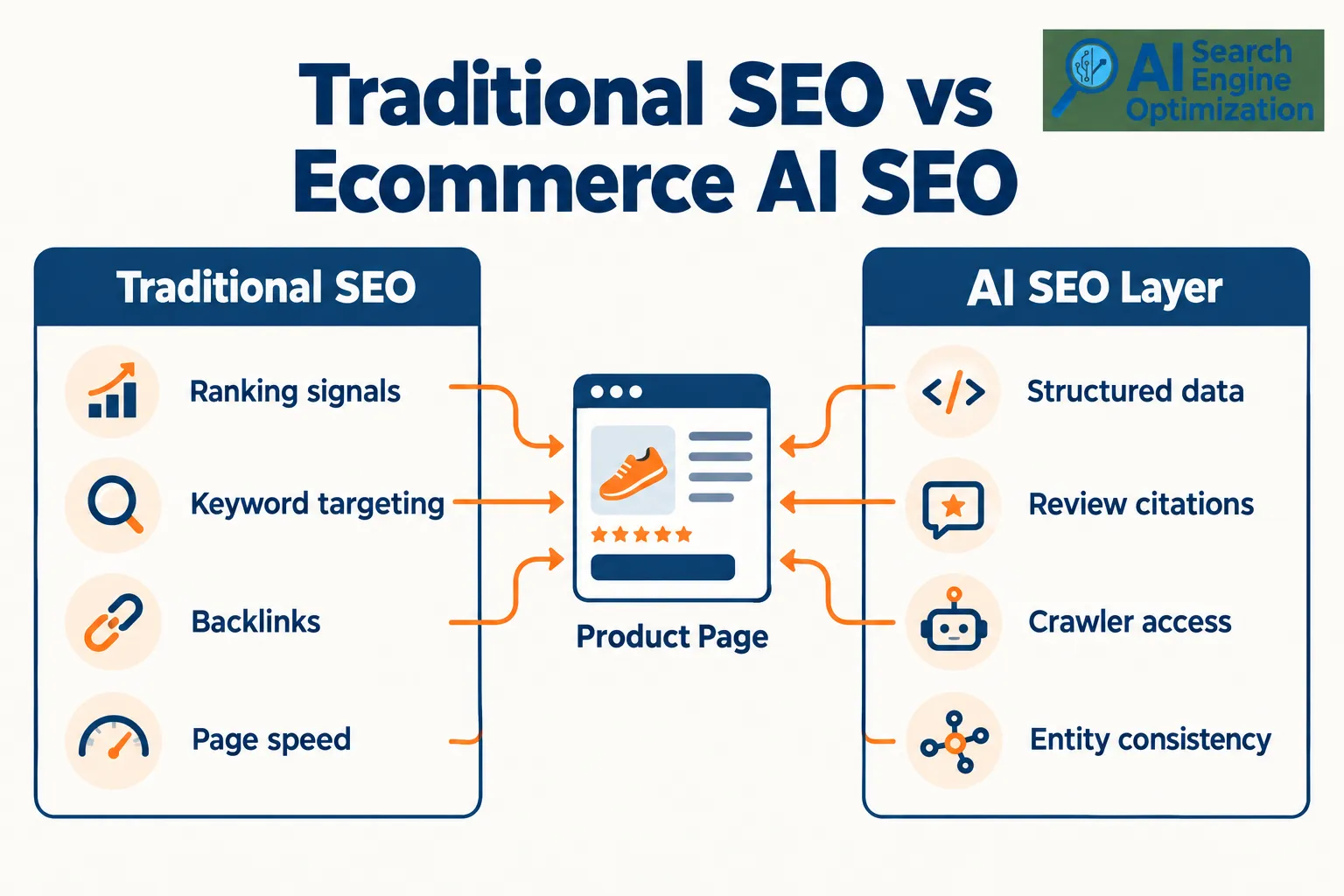
Traditional ecommerce SEO earns rankings through keyword targeting, backlinks, page speed, and content depth. AI SEO adds a verification layer: structured data, feed accuracy, and review signals that AI platforms check before naming a product in an answer.
The practical differences:
| Factor | Traditional SEO | Ecommerce AI SEO |
|---|---|---|
| Goal | Rank in Google's search results | Rank in Google AND get named in AI answers |
| Core signal | Keywords, links, page experience | Structured data, feed accuracy, review mentions |
| Measured by | Position tracking, organic traffic | Position tracking plus AI mention and citation tracking |
| Content focus | Category and product copy | Buying guides, comparisons, extractable answer blocks |
| Fails when | Page lacks relevance or authority | Feed and page facts disagree, or AI crawlers are blocked |
Neither replaces the other. Our AI SEO vs traditional SEO breakdown covers the mechanics in more detail, but for ecommerce specifically: Google Shopping and AI Overviews now sit on the same results page, so both have to be won together.
How does Google's AI affect ecommerce search rankings
Google AI Overviews and AI Mode pull shopping answers from Google's index, its Shopping Graph, and the product structured data on the page itself, not from a separate ranking system. A product that already ranks organically has a better shot at appearing in the AI summary above it, but only if its feed, page, and reviews agree.
Google's product structured data documentation describes how retailers are expected to supply machine-readable product data so AI systems can match intent to inventory accurately, rather than guessing from unstructured text. That's the same requirement AI Overviews apply at the consumer search level.
For store owners, this means:
- AI Overviews quote pages Google already ranks, so ranking work comes first.
- Structured data that contradicts the merchant feed gets a product dropped from the summary, not corrected.
- AI-written summaries change as Google's models change, so a one-time fix doesn't hold indefinitely.
Best AI SEO tools for online stores
The best tools for ecommerce AI SEO combine technical crawling, structured data validation, and AI mention tracking, rather than copy generation alone. Treat any tool that only writes product descriptions as incomplete.
Useful categories to evaluate:
- Structured data validators: confirm schema matches the live page and the merchant feed.
- AI crawler access checkers: verify that GPTBot, PerplexityBot, and Google-Extended can actually reach product pages.
- AI mention and citation trackers: log whether a brand is named in ChatGPT, Perplexity, or Gemini answers for relevant shopping queries.
- Feed management platforms: catch price, availability, and identifier mismatches between the page and Google Merchant Center.
Search Engine Land's analysis of GEO measurement and its step-by-step guide to AI search content both note that tooling alone rarely moves rankings without someone deciding which products and collections get attention first. That editorial judgment, not the tool, is usually the limiting factor for small stores.
Can AI SEO improve my product rankings
Yes, when it's implemented correctly: structured data accuracy, feed consistency, and verified reviews all contribute to the same ranking signals Google already uses for Shopping results, in addition to improving AI citation odds.
A product page ranks when it matches the shopping search and the intent behind it better than competing pages, and sits inside a store search engines trust. It gets recommended by AI platforms when, on top of that, the systems can read the page, verify its facts against the feed and reviews, and find the brand mentioned on sources they already cite.
Decision rule: if your product pages already rank on page one but your brand never shows up in AI-generated shopping answers, the problem is usually structured data or feed mismatch, not content quality.
Common mistake: rewriting product descriptions with AI tools without fixing the underlying schema or feed. The copy reads better to a human but AI platforms still can't verify it against anything, so nothing changes in citation rates.
How to optimize product descriptions for AI search
Optimizing a product description for AI search means writing the specifications, suitability answers, and comparison facts a shopper would ask about, in a format an AI system can lift directly into an answer. Marketing adjectives don't get quoted; verifiable facts do.
A description built for both Google and AI platforms should include:
- The specifications a shopper compares (size, material, compatibility, capacity)
- Suitability guidance (who the product is for, what it's not suited for)
- Delivery and availability facts that match the merchant feed exactly
- A short answer block that directly addresses a common buying question
- A rating or review summary, when available, stated in plain text near the data
Example: instead of "premium durable material for everyday use," a quotable version reads: "Made from 304 stainless steel, dishwasher safe, rated for daily use by the manufacturer's 2-year warranty." The second version gives an AI system something it can verify and repeat.
What's the difference between AI SEO and regular keyword research
Regular keyword research identifies which search terms to target on a page. AI SEO keyword work goes further, mapping the follow-up questions AI platforms generate around a shopping search, and the comparison and suitability angles those answers draw on.
A traditional keyword map assigns one page to one search term, as covered in our guide to keyword mapping. AI search expands that single search into a cluster of related questions: what's the difference between X and Y, is X good for beginners, how long does X last. Ecommerce AI SEO builds content that answers the full cluster on one page or a linked set of pages, because that's how AI platforms assemble an answer in the first place.
How much do ecommerce AI SEO services cost
Ecommerce AI SEO pricing typically scales with catalog size, platform complexity, and whether implementation happens in-house or through the agency. Expect project-based pricing for an initial audit and build phase, followed by a monthly retainer for ongoing measurement and content work.
Factors that move the price:
- Number of SKUs and collections needing structured data and page rewrites
- Whether the merchant feed needs a full rebuild or minor corrections
- Volume of review data to mine and incorporate
- Frequency of AI mention tracking across platforms
Search Engine Land's guide to setting an SEO budget and the Google's own overview of SEO work and costs both make clear that pricing varies widely from one engagement to the next, largely because scope varies so much by catalog size. Get a written scope with collection order, implementation responsibility, and price before signing anything. See how pricing proposals are typically structured in our AI SEO pricing guide.
How long does it take to see results from AI SEO
Ranking and AI-mention changes usually show up within four to eight weeks of implementation, while revenue impact from new or recovered citations tends to build over two to four months as pages reindex and review volume grows.
Timeline by milestone:
- Weeks 1 to 2: technical fixes (crawler access, structured data, feed corrections) go live.
- Weeks 3 to 6: rankings begin shifting for targeted collections; AI mention tracking establishes a baseline.
- Months 2 to 4: AI citations increase as reviews accumulate and comparison content gets indexed.
- Months 4+: revenue by collection becomes measurable against the baseline.
One published example: a synchronized clock manufacturer saw product-family terms in Google's top ten rise from 52 to 89 in five weeks, documented in our case studies. Results vary by catalog size and starting position, so treat any faster promise with caution. Our AI SEO progress timeline covers what a realistic month-by-month rollout looks like.
Common mistakes in ecommerce SEO to avoid
The most expensive mistake is treating AI content tools as a substitute for fixing product data, because AI platforms discount generic copy and check the feed instead.
Other frequent mistakes:
- Letting the feed and page disagree. Price or availability mismatches get products dropped from both Google Shopping and AI answers.
- Blocking AI crawlers by accident. A firewall rule that welcomes Googlebot can silently block GPTBot or PerplexityBot.
- Measuring traffic instead of orders. A traffic spike during a promotion doesn't prove the SEO work paid off.
- Ignoring faceted navigation and duplicate variants. Ecommerce platforms generate crawl waste by default, which wastes crawler budget on pages that don't convert.
- Skipping review mining. Reviews are weighted heavily by AI platforms, and buying questions buried in review text rarely make it onto the product page.
Search Engine Land's guide to hiring an SEO agency covers similar ground on what separates agencies that fix these issues from ones that only generate reports.
Is AI SEO worth it for small online businesses
Yes, for most small ecommerce businesses, because AI shopping assistants are a growing discovery channel and the cost of being invisible to them compounds over time as competitors fill that gap first.
Choose AI SEO now if:
- Your store already has a baseline of reviews and organic traffic to build on
- You sell products with comparison or suitability questions (most products do)
- Competitors are showing up in AI Overviews or chatbot answers for your category
Wait or scope smaller if:
- Your catalog is under active redesign and pages will change again soon
- You don't yet have Google Search Console or Merchant Center set up
- You can't commit to supplying current product facts for the implementation team to work from
Our guide to AI SEO investment and ROI walks through how to judge payback period against catalog size.
Do I need ecommerce AI SEO if I already use paid ads
Paid ads and AI SEO solve different problems, so running ads doesn't replace the need for AI SEO. Ads buy placement immediately; AI SEO builds the organic rankings and AI citations that keep showing up after the ad budget stops.
Ads also don't influence whether ChatGPT, Perplexity, or Gemini name your brand in a conversational answer. Those platforms pull from verified product data and trusted third-party sources, not from ad spend. A store running ads with no AI SEO foundation is paying for visibility it loses the moment the budget pauses, while competitors with stronger product data keep showing up in AI answers for free.
Ecommerce AI SEO for beginners: a starting checklist
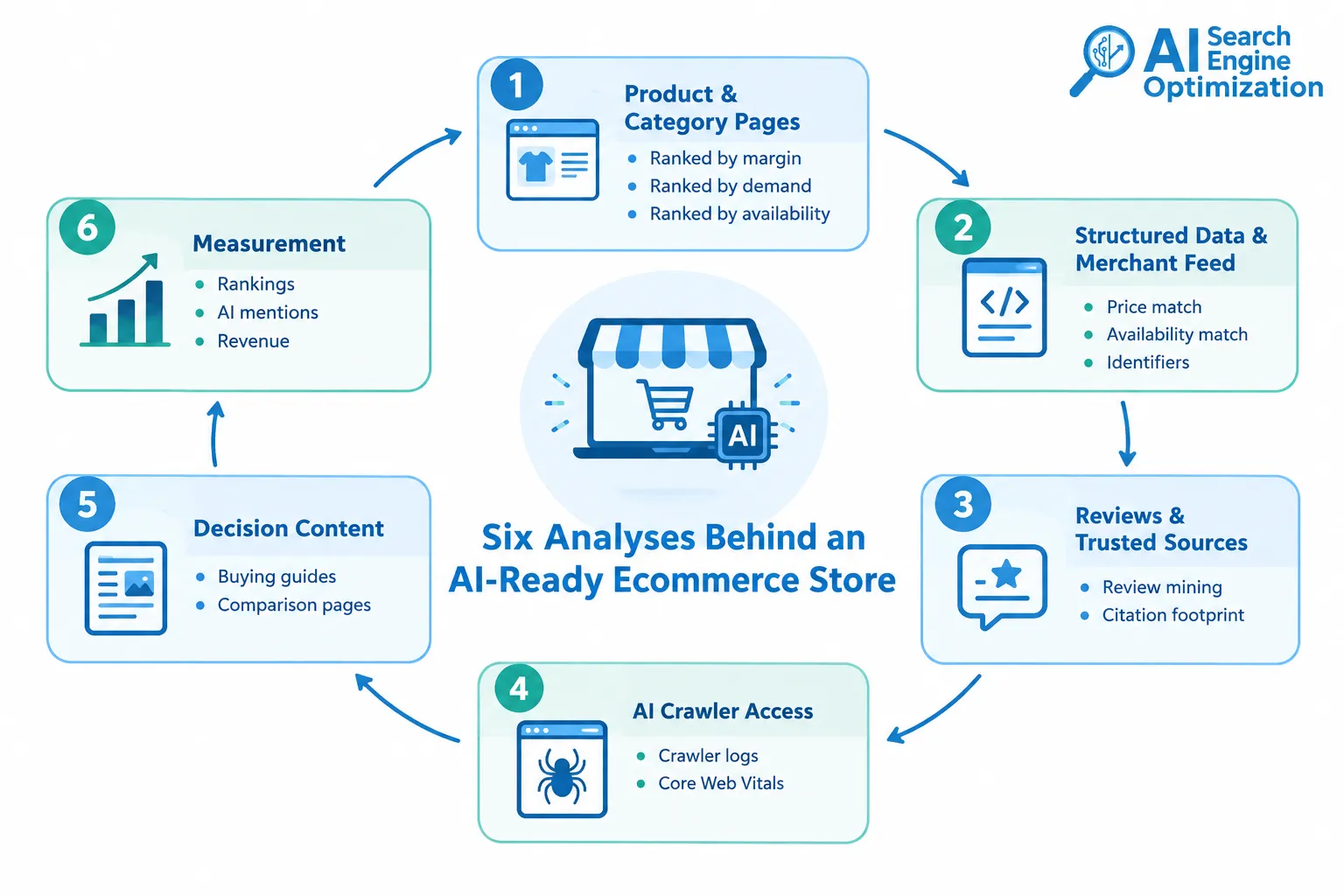
Beginners should start with crawler access and feed accuracy before touching content, because content improvements don't matter if AI systems can't read the page or verify the facts on it.
A practical starting sequence:
- Confirm Google Search Console and Google Merchant Center are both connected and clean.
- Check whether AI crawlers (GPTBot, PerplexityBot, Google-Extended) can access product pages without being blocked.
- Validate that structured data on each product page matches the merchant feed exactly.
- Audit top 20 products by margin and search demand; fix those pages first.
- Mine existing reviews for buying questions and add direct answers to product pages.
- Set a baseline for rankings and AI mentions before making further changes.
- Re-measure on a fixed schedule, not just after a promotion.
This sequence mirrors how Rank Intelligence Engine approaches new ecommerce engagements, starting with technical access before content or feed work.
What metrics matter most for ecommerce AI SEO success
The metrics that matter most are shopping search rankings, AI mentions and citations per platform, and orders or revenue by collection, tracked separately so a rise in one is never mistaken for a rise in another.
Track these on a fixed schedule:
- Organic rankings for the shopping searches tied to each collection
- AI mentions and citations per platform (ChatGPT, Perplexity, Gemini, Google AI Overviews), logged with date and question
- Feed accuracy rate: percentage of products with matching price, availability, and identifiers across page and feed
- Orders and revenue by collection, compared against the baseline period
Our comparison of AI mentions vs citations explains why these two terms get confused and why tracking them separately matters for ecommerce specifically. For broader metric definitions, see AI search visibility metrics.
Built into the store you already own
Implementation only counts when it happens directly in the WordPress or WooCommerce store, not in a report describing what should change. Product templates, structured data, the feed, and technical fixes all need to be checked in a browser at desktop and mobile widths before they're marked complete.
The engagement stays tied to the products actually being sold. The store owner supplies current product facts, priority collections, and common customer questions; the implementation team supplies the analysis, the pages, the data, and the measurement. Our approach to AI SEO for WordPress covers how this works specifically on WordPress-built stores.
An engagement judged on revenue quality
A rise in visits is never reported as a rise in sales. Progress reviews should show shopping search rankings, AI mentions and citations per platform, and orders and revenue by collection, measured against a dated baseline.
Search Engine Land's guidance on measuring brand visibility in AI search reflects a broader shift: agencies across the industry are adding AI measurement to existing SEO retainers rather than treating it as a separate product. That's the right structure: one engagement, two outcomes, both measured on the same schedule.
Business perspectives on ecommerce AI SEO
Explore the questions that help you assess this service, understand its value, and choose an appropriate next step.
- AI SEO automation: which SEO tasks AI can automate, and which still need a person.
- Keyword mapping: why one search, one page, no exceptions comes before any content gets written.
- Internal link audit: the ranking gain most ecommerce sites have never taken.
- How to choose an SEO agency for AI search: questions to ask before signing a retainer.
FAQ
What is ecommerce AI SEO in simple terms?
Ecommerce AI SEO is search engine optimization that also prepares product data, structured data, and reviews for AI platforms like ChatGPT and Google AI Overviews to read and recommend accurately.
Does ecommerce AI SEO replace traditional SEO?
No. Traditional SEO still earns most of a store's organic traffic and Google Shopping visibility. AI SEO adds the verification layer AI platforms need on top of that foundation.
How do I know if AI crawlers can access my store?
Check server logs or use a crawler access tool to confirm bots like GPTBot, PerplexityBot, and Google-Extended aren't blocked by firewall rules or robots.txt settings that only account for traditional search crawlers.
Can a small store with a limited catalog benefit from AI SEO?
Yes. Smaller catalogs often see faster results because fewer pages need fixing, and competitors in niche categories frequently haven't addressed feed or structured data accuracy yet.
What's the biggest ranking factor AI platforms check first?
Structured data that matches the merchant feed. Mismatched price, availability, or identifiers are among the most common reasons a product gets dropped from both AI answers and Google Shopping results.
Do reviews actually affect AI search visibility?
Yes. AI platforms weigh customer reviews and third-party review sites more heavily than a store's own product copy when deciding which brand to name in an answer.
How often should I re-measure AI mentions?
On a fixed schedule, ideally monthly, tracked per platform and per question, so changes in AI mentions can be tied to specific fixes rather than random fluctuation in model behavior.
References
- Search Engine Land: How ecommerce brands actually get discovered in AI search
- Google Search Central: Product structured data
- Google Search Central: Do I need SEO?
- Search Engine Land: Measuring GEO, what's trackable now and what's still missing
- Search Engine Land: How to optimize content for AI search engines, a step-by-step guide
- Search Engine Land: Setting and overseeing an SEO budget
- Search Engine Land: How to hire an SEO agency, the definitive guide
- Search Engine Land: How to measure brand visibility in AI search