Generative Engine Optimization · Business perspective
How to Get Cited by AI
Why ChatGPT, Google AI Overviews, Perplexity, Gemini and Copilot Recommend Different Businesses
How to get cited by AI comes down to three things: being verifiable as a real business entity, having content structured so engines can lift and quote it, and showing up on third-party sources the engines already trust. About 83% of AI citations come from sources other than the brand's own website, so your website alone will not get you cited. Third-party authority does the heavy lifting.
Key Takeaways
- Traditional Google rankings and AI citations are not the same contest; a business can rank first-position on Google and still be invisible to ChatGPT or Perplexity [2].
- About 83% of AI citations come from sources other than the brand's own site: reviews, directories, and editorial coverage carry the recommendation [2].
- Google says there is no special "AI schema", a page must already be indexed and eligible for a normal snippet to appear in AI Overviews or AI Mode [3].
- Google AI Mode passed 1 billion monthly users as of May 2026 [4].
- OpenAI requires sites to allow OAI-SearchBot and permit its published IP ranges, or ChatGPT cannot reliably cite your pages [5].
- Google's October 15, 2026 update gives official business websites more prominent placement for pricing, policy, and booking questions [7].
- Content structure, entity clarity, and off-site citation sources matter more than keyword density for AI search visibility.
- Small businesses can get cited by AI faster than they can outrank national brands on Google, because AI engines reward specificity and verifiable data over domain authority alone.
As seen in

Why Your Google Rankings Don't Predict AI Citations
A number-one Google ranking tells you almost nothing about whether ChatGPT, Perplexity, or Google AI Overviews will name your business. These are different systems, built on different retrieval logic, reading different signals [2].
Traditional SEO rewards backlinks, domain age, and keyword relevance tied to a single search result page. Generative engine optimization, often shortened to GEO, rewards something else: whether an engine's answer-generation process can find, verify, and quote your business when it fans out a query into several sub-searches [3]. Google itself confirms AI Overviews and AI Mode can issue multiple related searches before composing an answer [3]. That means a business with ten narrow, specific pages answering ten narrow questions often beats a business with one broad, well-ranked homepage.
This is the uncomfortable truth most owners miss: your organic rankings are a prerequisite, not a guarantee. Google says a page must already be indexed and eligible for a normal search snippet to even be considered for AI Overviews [3]. But eligibility is the floor, not the finish line. The content gets cited only when the engine's retrieval layer decides your passage answers the question better than a competitor's.
Decision rule: if your business ranks well on Google but you've never checked ChatGPT, Perplexity, or Gemini for your own name, you don't actually know your visibility. You're measuring half the picture.
How Does ChatGPT Decide Which Business to Suggest?
ChatGPT leans heavily on third-party corroboration rather than a brand's own marketing content. Our September 2026 answer benchmark found the sources AI engines cite most are third parties: independent reviews, comparison sites, forums, and editorial coverage, not the vendor's own website [1].
Practically, this means ChatGPT is reading the web the way a skeptical buyer would: it trusts what other people say about you more than what you say about yourself. OpenAI's technical requirement is also non-negotiable, your site must allow OAI-SearchBot and your CDN must permit OpenAI's published crawler IP ranges, or ChatGPT cannot reliably retrieve your current pages at all [5].
OpenAI's October 7, 2026 release of GPT-6 and its new Intelligent UI changed how search results and sources surface inside conversations, adding richer interactive responses [6]. That shift means citation patterns are not fixed; what got your business named last quarter may not work next quarter, so continuous prompt testing matters more than a one-time fix.
- Allow OAI-SearchBot in robots.txt and server configuration.
- Earn mentions on review sites, forums, and comparison articles, since those dominate ChatGPT's citation pool [1].
- Track UTM parameters (
utm_source=chatgpt.com) on referral traffic so ChatGPT visits stay visible as their own channel in analytics.
How Does Google AI Overviews Choose Businesses Differently Than Perplexity?
Google AI Overviews pulls almost exclusively from pages already indexed and eligible for standard search snippets, while Perplexity builds its answers from retrieved third-party sources rather than a brand's own pages [2]. The two engines are solving different problems.
Google's documentation is explicit: there's no separate technical standard for AI features. The same crawlability, structured data, Business Profile accuracy, and content quality that earn a regular snippet also earn an AI Overview citation [3]. Google rejects the idea of a hidden "AI schema" entirely [3]. If your page can't rank normally, it can't get cited by Google's AI either.
Perplexity builds its answers from outside sources, so a brand's own pages matter less there than the coverage around the brand [2]. In plain terms, Perplexity is less forgiving of isolated, keyword-stuffed paragraphs. It wants a passage with enough surrounding evidence to prove a claim is true, not just present.
| Factor | Google AI Overviews | Perplexity |
|---|---|---|
| Entry requirement | Must be indexed and snippet-eligible [3] | Must be crawlable and backed by third-party coverage [2] |
| Core signal | Traditional SEO + E-E-A-T [3] | Third-party retrieval with supporting evidence [2] |
| Query behavior | Fan-out into subqueries [3] | Broader contextual synthesis |
| Source variety | Heavy weight on official sites after Oct 2026 update [4] | Strong weight on third-party corroboration |
Google's October 15, 2026 update added dedicated sections for official websites, inline links, news carousels, and clickable creator profiles inside AI Mode [4]. That's a meaningful shift: being the specific source chosen for a claim now matters more than simply appearing somewhere in the results.
What's the Difference Between Being Cited and Recommended by AI?
Being cited means an AI engine names your business as a source for a fact. Being recommended means the engine tells a buyer to choose you over a competitor. The two overlap but aren't identical, and most GEO advice conflates them.
A citation can be neutral: "according to [Business Name], hours are 9 to 5." A recommendation carries intent: "I'd go with [Business Name] because they specialize in X." Google AI Overviews mostly produces citations tied to factual claims [3]. ChatGPT and Perplexity more often produce recommendation-style answers when a user asks "who should I hire" or "what's the best," pulling from review aggregates and comparison content [1][2].
For a service business, recommendations are worth more than citations, because they occur at the exact moment a buyer is choosing. This is the same logic behind business entity clarity in Google and AI search, an engine won't recommend what it can't confidently verify.
Common mistake: chasing citation volume while ignoring whether those citations ever appear in a recommendation context. Ten neutral citations in obscure answers are worth less than one citation inside a "best contractor in [city]" response.
How Can I Get My Business Recommended by AI Search Engines?
Getting recommended by AI search engines requires three layers working together: a verifiable business entity, content built for extraction, and a visible footprint on third-party sources the engines already trust. Skipping any one layer caps your visibility, no matter how good the other two are. That three-layer build is what our generative engine optimization services deliver as one engagement.
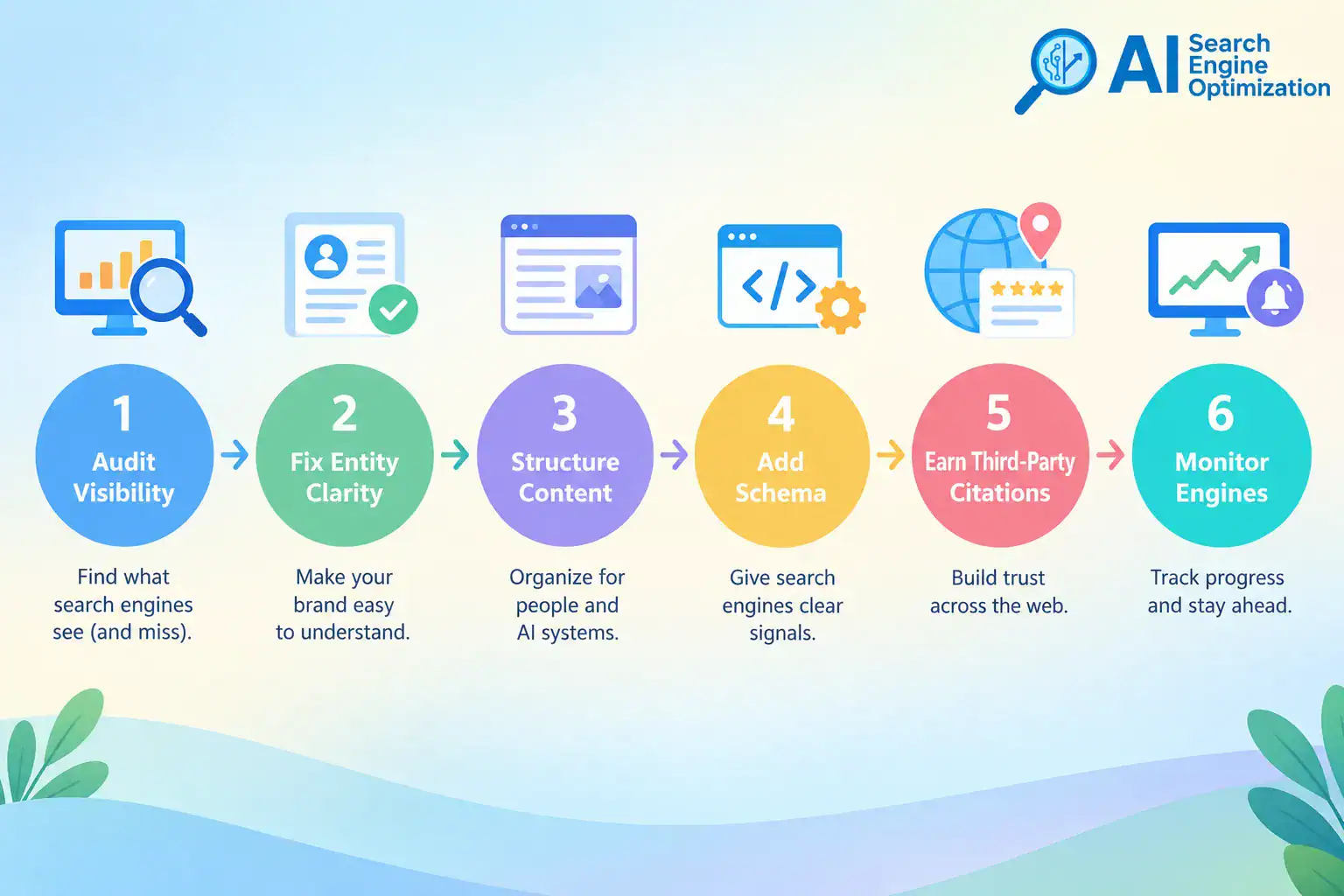
Here is the practical sequence:
- Get your entity straight. Make sure your name, address, services, and founder details are consistent everywhere, including your Knowledge Graph presence and entity SEO signals.
- Write answer blocks, not essays. A passage an engine can lift and quote needs to stand alone: state the fact, name the business, give the specific number or detail. Rebuilding existing pages into passages like this is what AI content optimization does.
- Build E-E-A-T signals. Real credentials, dated results, named case studies. See our breakdown of E-E-A-T in SEO for the specifics.
- Earn third-party citations. Reviews, directories, press, best-of lists. Remember: about 83% of AI citations come from sources other than the brand's own site [2].
- Check your schema. Not an "AI schema" (there isn't one), just accurate, complete structured data supporting normal search eligibility [3].
- Monitor and repeat. AI engines change weekly. What worked last quarter under GPT-5 may shift under GPT-6's Intelligent UI [6].
If you're unsure where you stand today, an AI visibility audit will show you exactly which questions competitors are winning instead of you.
Why Isn't My Business Showing Up in AI Recommendations?
Your business usually isn't showing up because it's either invisible to the crawler, invisible as a verified entity, or invisible on the third-party sources engines actually trust. Each cause has a different fix, and most owners guess instead of testing.
- Crawler access problem. If you've blocked AI bots or your CDN rejects OpenAI's published IP ranges, ChatGPT literally cannot read your site [5].
- Entity confusion. If your name, address, or service list is inconsistent across your site, Google Business Profile, and directories, the engine isn't confident enough to name you.
- No third-party footprint. If nobody else online talks about your business, there's nothing for ChatGPT or Perplexity to synthesize into a recommendation [1][2].
- Content too thin or too broad. A homepage that says everything in general terms rarely gets lifted; a page answering one specific question usually does.
Edge case: a business can have excellent content and still lose visibility simply because a competitor published a more specific, more recently updated answer to the same question. Content refresh matters as much as initial creation.
If you suspect this is you, read signs your business is ready for AI search optimization before spending on a fix you may not need yet.
Does It Cost Money to Be Recommended by AI Like ChatGPT or Gemini?
There's no fee to pay ChatGPT, Gemini, or any AI engine for a citation; recommendations are earned through content and authority signals, not purchased placements. The cost comes from the work required to build and maintain those signals, not from a line item on an invoice to the AI company.
That said, the work isn't free in time or resources. Building entity clarity, writing extractable answer content, earning third-party citations, and monitoring across five engines takes either in-house effort or a specialized AI SEO agency. Compare this to traditional SEO, where backlink building and content production have always carried real cost, AI search optimization adds a new layer (crawler access, structured data accuracy, citation tracking) on top of the existing SEO budget rather than replacing it.
If you're deciding whether to build this in-house or outsource it, our comparison of AI SEO vs traditional SEO lays out what to compare before you hire anyone.
Which AI Engine Gives the Best Business Recommendations?
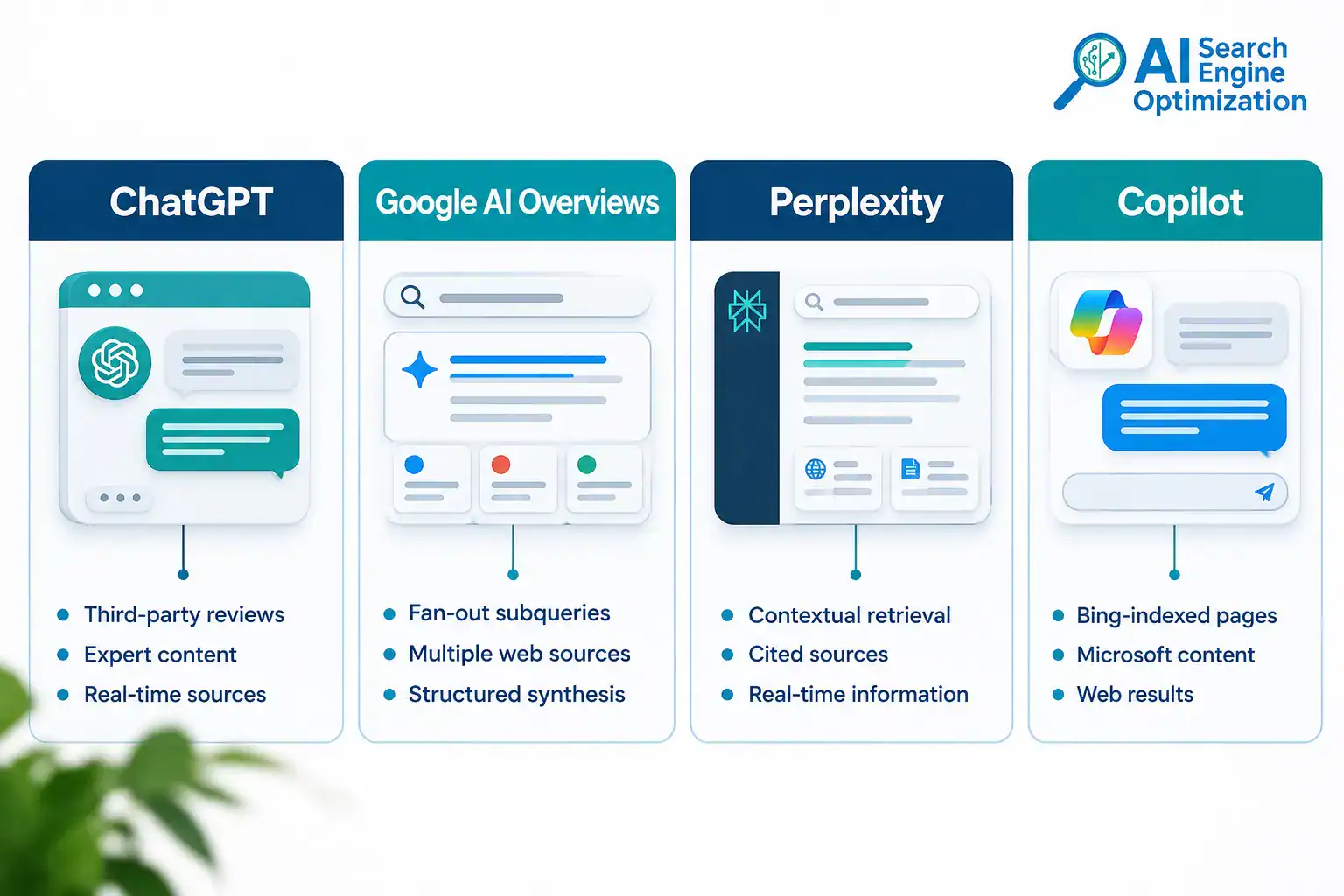
There's no single "best" engine; each one weighs different signals, so the right answer depends on where your buyers actually search. B2B buyers researching software lean on ChatGPT and Perplexity, while local service buyers increasingly use Google AI Overviews and AI Mode directly inside search [4].
- ChatGPT: best for buyers doing comparison research; rewards third-party corroboration heavily [1].
- Google AI Overviews / AI Mode: best for buyers already inside Google search; tightly tied to traditional SEO eligibility [3]. With over 1 billion monthly AI Mode users as of May 2026 [4], this is the highest-volume channel for most service businesses.
- Perplexity: best for research-heavy queries; built on retrieved third-party sources [2].
- Gemini: integrated across Google's ecosystem, often surfacing similar sources to AI Overviews.
- Copilot: built on Bing's index, so Bing-level technical SEO fundamentals still apply.
A CMO or owner evaluating where to focus limited effort should start by checking actual prompt volume and citation presence per engine with an AI visibility audit rather than assuming one engine dominates.
Can Small Businesses Get Recommended by AI or Just Big Brands?
Small businesses can get recommended by AI engines, and in some cases faster than large national brands, because AI engines reward specificity and verifiable local data over sheer domain size. A specific, well-documented local answer often beats a generic national page.
This matters because AI engines are not simply replaying Google's domain-authority hierarchy. ChatGPT's heavy reliance on third-party corroboration [1] actually favors small businesses with strong local reviews and niche authority sites over large brands with thin third-party presence. A plumber with twelve detailed Google reviews and a clear service-area page can out-cite a national franchise with vague, templated content.
Decision rule: choose to invest in AI search optimization now if your buyers already search with specific intent ("best [service] in [city]") rather than generic category terms, specificity is exactly what small businesses can win on.
Do You Need a Website to Be Recommended by AI Tools?
A website isn't strictly mandatory for every mention, but it's practically required for consistent, verifiable recommendations. Engines need somewhere to confirm your facts, and a Google Business Profile alone doesn't carry enough detail for most AI retrieval systems.
Google's own guidance lists Business Profile information as one input among several, alongside crawlability, structured data, and Merchant Center data where relevant [3]; for an online store, that product feed is central to ecommerce AI SEO. Without a website, you're relying entirely on third-party sources to carry your facts correctly, with no canonical page to correct errors or add detail. For multi-location businesses, this becomes even more critical, see our guide on multi-location AI SEO and business consistency for how inconsistent location data undermines citations.
How Long Does It Take Before AI Starts Recommending Your Business?
There's no fixed timeline, but most businesses see initial citation movement within a few content and crawl cycles once entity clarity and third-party signals are in place; sustained recommendation parity with established competitors typically takes longer. Google added more prominent official-website links to AI answers in its October 15 update [7], meaning the window for intervention is now, not later.
Several factors affect speed: how fast engines recrawl your pages, how quickly new third-party citations get indexed elsewhere, and how competitive your query category is. A niche local service question may show movement within weeks of a content fix. A competitive national category with entrenched incumbents will take months of sustained third-party citation building.
Example: a regional HVAC company that fixes entity consistency, publishes specific answer-block content, and earns five new review-site mentions might see ChatGPT citations shift within one to two months, while ranking first in a Google AI Overview for a competitive national term could take considerably longer.
What Mistakes Do Businesses Make Trying to Get AI Citations?
The most common mistake is treating AI citation work as a technical checklist instead of a trust-building exercise, chasing a mythical "AI schema" that doesn't exist. Google explicitly states there is no special machine-readable file or markup required beyond standard SEO fundamentals [3].
Other frequent mistakes:
- Ignoring third-party sources entirely. Since about 83% of AI citations come from sources other than the brand's own site, a business that only optimizes its own pages is optimizing the smaller slice of the pie [2].
- Writing vague, marketing-heavy copy. Answer blocks need specific, standalone facts, not brand language.
- Blocking AI crawlers by accident. A misconfigured robots.txt or CDN rule can silently cut off OAI-SearchBot [5].
- Assuming one-time fixes last. GPT-6's October 2026 Intelligent UI rollout changed how sources surface inside answers [6]; businesses that don't monitor continuously fall behind.
- Confusing impressions with citations. Google's generative-AI performance report, expanded October 2026, mostly shows impressions, not full attribution [4]. Treat it as a visibility signal, not a conversion report.
Many businesses trying this without a dedicated process end up stuck between an SEO audit and ongoing SEO decision, fix this choice first before investing further.
Does Copilot Recommend Businesses Differently Than Google Overviews or Perplexity?
Copilot is built on Bing's search index, so it weighs traditional Bing-level technical SEO signals more heavily than Google AI Overviews' fan-out retrieval or Perplexity's contextual embedding model. If your site is optimized for Bing crawlability, you're already partway toward Copilot visibility.
Practically, this means businesses that have neglected Bing Webmaster Tools in favor of Google Search Console alone may be invisible to Copilot even while performing well elsewhere. The fix is straightforward: confirm Bing indexation, verify structured data, and check that your business profile data syncs correctly across both ecosystems.
Are There Downsides to Being Recommended by AI Search Engines?
Yes, the main downside is reduced click-through, since an AI answer can fully satisfy a buyer's question without sending them to your site at all. Google itself says AI-powered Search sends billions of clicks to websites weekly [4], but that figure doesn't identify which specific businesses benefit, and some service categories see fewer click-throughs when the answer is fully resolved in the AI response.
A second downside: once named, you have less control over how your business is described compared to your own marketing copy. If your third-party sources contain outdated pricing or incorrect service details, the AI engine may repeat that error confidently. This is why consistent, monitored entity data matters more than one-time optimization, see our answer engine optimization benefits piece for how to manage this tradeoff.
Frequently Asked Questions
Can I use AI to generate citations?
You can use AI tools to help draft content and identify citation-worthy claims, but AI cannot manufacture legitimate third-party authority for you. Real citations come from independent reviews, directories, and press coverage. AI-generated content still needs to be fact-checked, specific, and genuinely useful to earn a place in another source's writing.
How to get cited by ChatGPT?
Allow OAI-SearchBot in your crawler settings, publish specific answer-block content with verifiable facts, and build presence on third-party review sites and forums, since about 83% of AI citations come from sources other than the brand's own website [2]. Monitor prompts regularly, since citation patterns shift with each model update.
Is it okay to use ChatGPT for citations?
It's fine to use ChatGPT to research what's currently being cited for your category, but you should verify every claim independently before publishing it. ChatGPT reflects existing web sources rather than creating new authoritative facts, so treat its output as a starting point for research, not a final, citable source itself.
How to get your brand cited by AI?
Make your business a verifiable entity with consistent facts everywhere, publish extractable answer content, and earn mentions on the third-party sites engines already trust, since most citations across ChatGPT, Perplexity, and Google AI Overviews come from outside sources rather than brand-owned pages [1][2]. Then monitor and refresh regularly.
The Bottom Line
AI search optimization isn't a side project anymore. With Google AI Mode past 1 billion monthly users [4] and ChatGPT pulling the majority of its business recommendations from third-party sources [2], the businesses getting named today are the ones that treated entity clarity, content structure, and third-party authority as one connected job, not three separate tasks handled by three different vendors.
This is exactly the kind of work we built AI Search Engine Optimization to do. Founder Phil Belleville has ranked websites since 1995, and our proprietary fulfillment system runs the entity work, the content structure, the third-party citation campaigns, and the AI visibility tracking under one roof. We don't sell a readiness score. We count citations, we date them, and we show you exactly which questions your competitors are winning instead of you.
If your business isn't showing up when a buyer asks ChatGPT, Perplexity, or Google AI Overviews who to hire, that's a measurable problem with a measurable fix. Start with an audit, see where you stand against your actual competitors, and decide from there.
References
- AI Answer Benchmark: who the AI engines actually name. AI Search Engine Optimization.
- AI mentions vs citations. AI Search Engine Optimization.
- AI features and your website. Google Search Central.
- I/O 2026: Welcome to the agentic Gemini era. blog.google.
- OpenAI bots and crawlers. OpenAI.
- GPT-6 and Intelligent UI for everyone. OpenAI.
- More ways to connect with the web from Search. blog.google.
Continue your research
The Rank Intelligence Engine: the measurement system behind the citation counts this article describes.
The AISEO Process: How AI SEO Works: all 81 topics in 11 learning areas, in one interactive guide.
Discuss what this means for your business
Our proprietary Rank Intelligence Engine connects 25 specialized analysis and implementation capabilities with commercial judgment, content, and WordPress implementation. Phil Belleville has worked in SEO since 1995 and brings that experience to the priorities and decisions behind the work.
Explore our generative engine optimization services to see the service behind this business perspective.
30 minutes with Phil. Written scope and pricing before paid work begins.