AI SEO Agency:
Get Your Business Mentioned by ChatGPT, Perplexity, and Google AI Overviews
Last updated: October 14, 2026
Quick answer
An AI SEO agency optimizes your website and business facts so AI systems like ChatGPT, Gemini, Perplexity, and Google's AI Overviews name your business when buyers ask who to hire. For an established business with a WordPress site, that work means fixing data inconsistencies, building a single verified business record, and restructuring content so AI can read, trust, and quote it, while still improving your Google rankings.
Key takeaways
- Getting "mentioned" by AI means your business appears in an AI generated answer, with or without a clickable link, when someone asks a buying question.
- AI systems favor businesses whose facts (name, address, phone, services, credentials) match across the web. Contradictions are the most common reason a business gets skipped.
- AI SEO and traditional SEO overlap heavily. Keyword research, technical SEO, and on-page content still matter, but AI SEO adds fact verification, structured data, and answer tracking across AI platforms.
- Costs for AI SEO agencies typically start around $1,000 a month for a WordPress-focused engagement, scaled to the size and complexity of the site.
- Results on technical and content fixes often show up within six weeks, with ranking movement building over 12 weeks and AI citation growth over three to six months.
- Established businesses with existing Google rankings usually see faster AI SEO results than brand-new sites, because the trust signals already exist and mainly need correcting.
- Mentions and backlinks are different metrics. A backlink is a hyperlink from another site. A mention or citation is your business named in an AI answer, sometimes without any link at all.
- You can tell an AI SEO agency is working when more AI answers name your business. The agency should log each question and date, and your Google rankings should be moving in the right direction as well.
As seen in

What does an AI SEO company do to get your business mentioned online
Getting mentioned online means an AI system names your specific business, by name, when someone asks a question your buyers actually ask. That's different from ranking in a list of blue links. It's the AI telling someone "call this firm" or "this clinic handles that" without the person ever clicking through to compare options.
Many buyers now get an answer or shortlist before they visit a website. AI Overviews and chat tools have made that behavior routine. Google's own guidance on brand authority in the AI search era notes that the practices behind strong traditional SEO (clear entity signals, authoritative content, consistent facts) are largely the same practices that earn visibility in generative search. Good SEO is the foundation of good GEO (generative engine optimization). AI systems then place additional weight on a few other signals:
- Fact consistency. Your name, address, phone number, and service list need to match everywhere they appear, including directories, review sites, and your own pages.
- Verifiable claims. Credentials, awards, and certifications need a public source an AI model can check. Claims it can't verify get ignored or flagged.
- Structured, quotable content. Short, direct passages that answer a specific question are easier for an AI model to lift and cite than long narrative copy.
A business can rank on page one of Google and still never get mentioned by AI, because ranking and being cited are measured differently. Ahrefs' review of AI visibility tracking tools is a useful place to see how AI citation counts are tracked separately from search rankings.
How does AI help with business mentions and citations
AI models decide what to mention by cross-checking facts about a business against multiple sources, then favoring the business whose data is most consistent and verifiable. Duplicate listings, outdated service pages, and unsupported claims give an AI model reasons to choose a competitor instead.
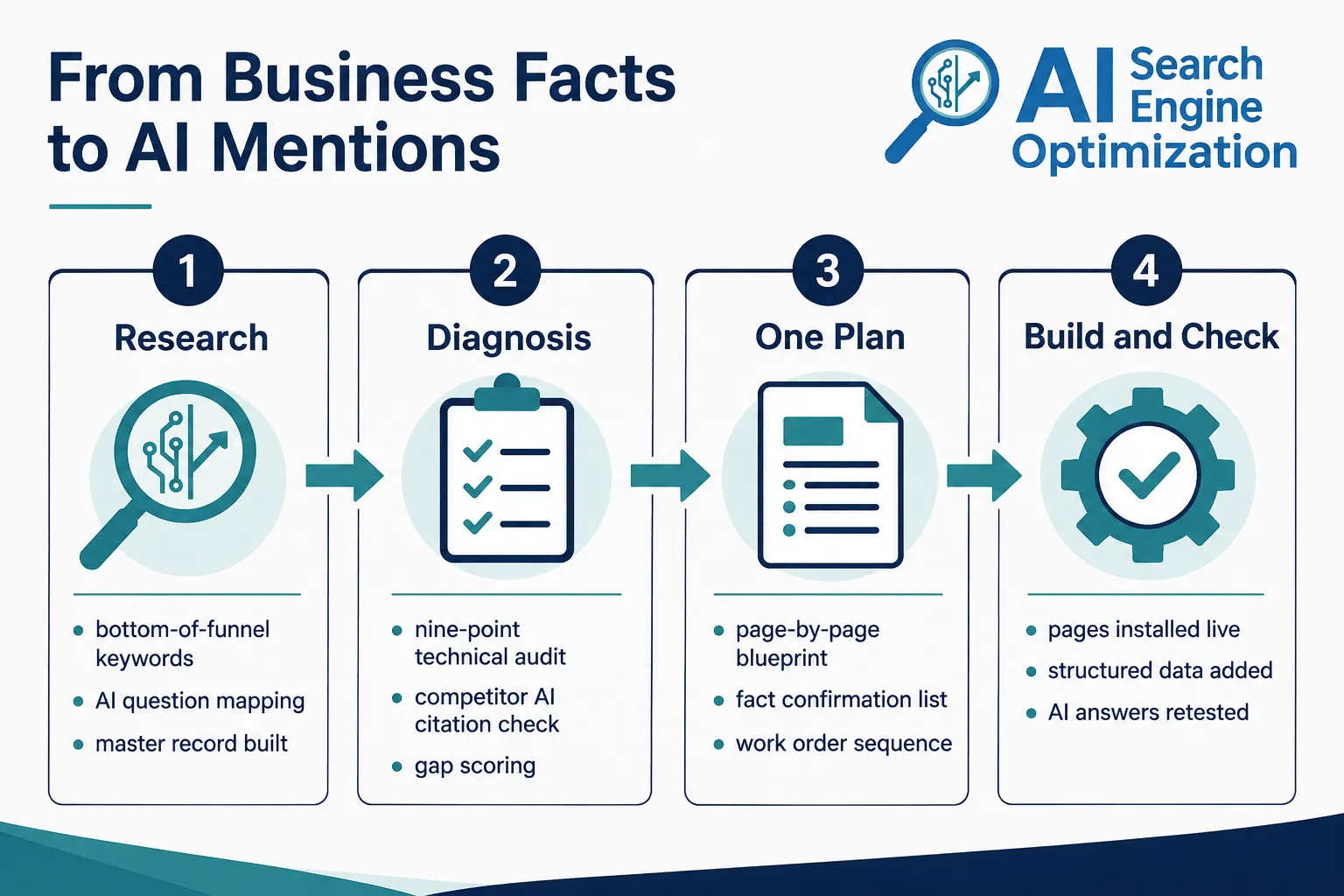
That is why the first job is usually to verify the business, not produce more content. It's an audit of your business facts, often called entity SEO or knowledge graph SEO. The process typically looks like this:
- Audit every place your business is listed. Google Business Profile, directories, your own site, review platforms, and any partner or association pages.
- Merge duplicate or conflicting records into one master record. Every page, listing, and profile should then pull from that single source.
- Remove unverifiable claims. Awards or certifications with no public backing get dropped or sourced properly.
- Add structured data (schema markup) so AI crawlers can parse your services, location, and credentials without guessing.
- Re-test AI answers on the specific questions your buyers ask, and track whether your business starts appearing.
A pain management clinic in Missoula had 12 separate business records scattered across directories and old listings. Once those were merged into one record over two days in August 2026, Google's Knowledge Graph confidence score for that business jumped from 29 to 75 within 24 hours. That kind of jump reflects how much weight AI systems place on consistency, not just content volume.
Google's own local ranking guidance makes a similar point: businesses that keep their location and service information complete, accurate, and consistent everywhere it appears are more likely to surface in local results, including AI generated local answers.
Best AI SEO agency for WordPress websites: what to look for
The best AI SEO agency for a WordPress site is one that works directly inside your CMS, not just hands you a document of recommendations. Look for an agency that installs changes on your live site, tests them, and shows you a dated log of what changed.
WordPress specifically matters because a large share of AI SEO work depends on plugin configuration, schema markup, and page speed, all of which behave differently on WordPress than on other platforms. Guides on AI SEO for WordPress generally cover the same checklist:
- Clean, crawlable site architecture (no duplicate pages competing for the same search)
- Schema markup for your business type, services, and FAQs
- Fast load times, since both Googlebot and AI crawlers deprioritize slow pages
- A content structure that separates clear, quotable answers from long supporting detail
Choose a WordPress-focused AI SEO agency if your team doesn't have an in-house developer who can safely install and test schema and structural changes. Skip it if your site runs on a custom platform or another CMS, since the specific technical steps won't transfer directly.
A common mistake here: hiring an agency that writes recommendations but never touches the site. If nobody on the team can log into WordPress and ship the change, the audit sits in a PDF and nothing moves.
AI SEO vs traditional SEO agency: what's the difference
Traditional SEO focuses on rankings and organic clicks from search engine results pages. AI SEO adds a second target: appearing by name inside AI generated answers, whether or not that produces a click. The technical foundation (site speed, crawlability, keyword research, backlinks) is shared by both.
Here's a practical breakdown of where they diverge, drawn from the kind of comparisons covered in AI SEO vs traditional SEO analysis:
| Factor | Traditional SEO | AI SEO |
|---|---|---|
| Primary goal | Rank in search results, earn clicks | Get named in AI generated answers, with or without a click |
| Main lever | Keywords, backlinks, page authority | Fact consistency, structured data, verifiable credentials |
| Measurement | Rankings, organic traffic, click-through rate | AI citation counts, answer accuracy, rankings and traffic together |
| Content style | Long-form articles optimized for keywords | Short, direct, quotable passages alongside long-form depth |
| Risk if ignored | Lower rankings, less traffic | Competitor gets named instead, even if you still rank |
Both disciplines need keyword research and technical fixes like resolving keyword cannibalization. The difference is that AI SEO also tracks whether AI platforms cite you by name, which SEOFOMO's 2026 survey on AI search optimization found most marketing teams are still not measuring at all.
How much does an AI SEO agency cost
AI SEO agency pricing typically starts around $1,000 a month for a small to mid-sized business on WordPress, with no setup fee, and scales based on the number of locations, services, and pages involved. Agencies that work this way usually set a fixed scope and price on an initial call rather than publishing a flat rate card, since two websites rarely need the same amount of work.
What usually drives the price up or down:
- Number of locations. A single-location business costs less than a firm with five offices across different states, since each location needs its own verified facts and local pages.
- Size of the existing site. A 20-page site needs less initial cleanup than a 300-page site with years of outdated content.
- How many business records need merging. Businesses with duplicate listings, old franchise pages, or inconsistent NAP (name, address, phone) data take longer to consolidate.
- Content production volume. More new pages or FAQ sections mean more writing, editing, and installation time.
Be cautious if an agency quotes a price before looking at your site. If they want a 90-day or 12-month contract with a steep termination clause, understand that as a pricing choice, not a sign of better work. More detail on structuring and evaluating these proposals is covered in guidance on AI SEO pricing proposals and AI SEO investment and ROI.
Can AI SEO agencies help established businesses rank better
Yes. Established businesses often see faster results because they already have trust signals: an older site, backlinks, reviews, and a body of content. The work starts by correcting and connecting those assets rather than building authority from nothing.
An established site mainly needs its existing assets corrected and connected. A new site still has to build those assets.
- Established businesses often have the right domain authority already. For an established business, that usually means merging duplicate listings, removing unsupported claims, resolving page conflicts, and adding structured data.
- New businesses need all of that plus the baseline content and backlink profile that takes months to build regardless of AI SEO.
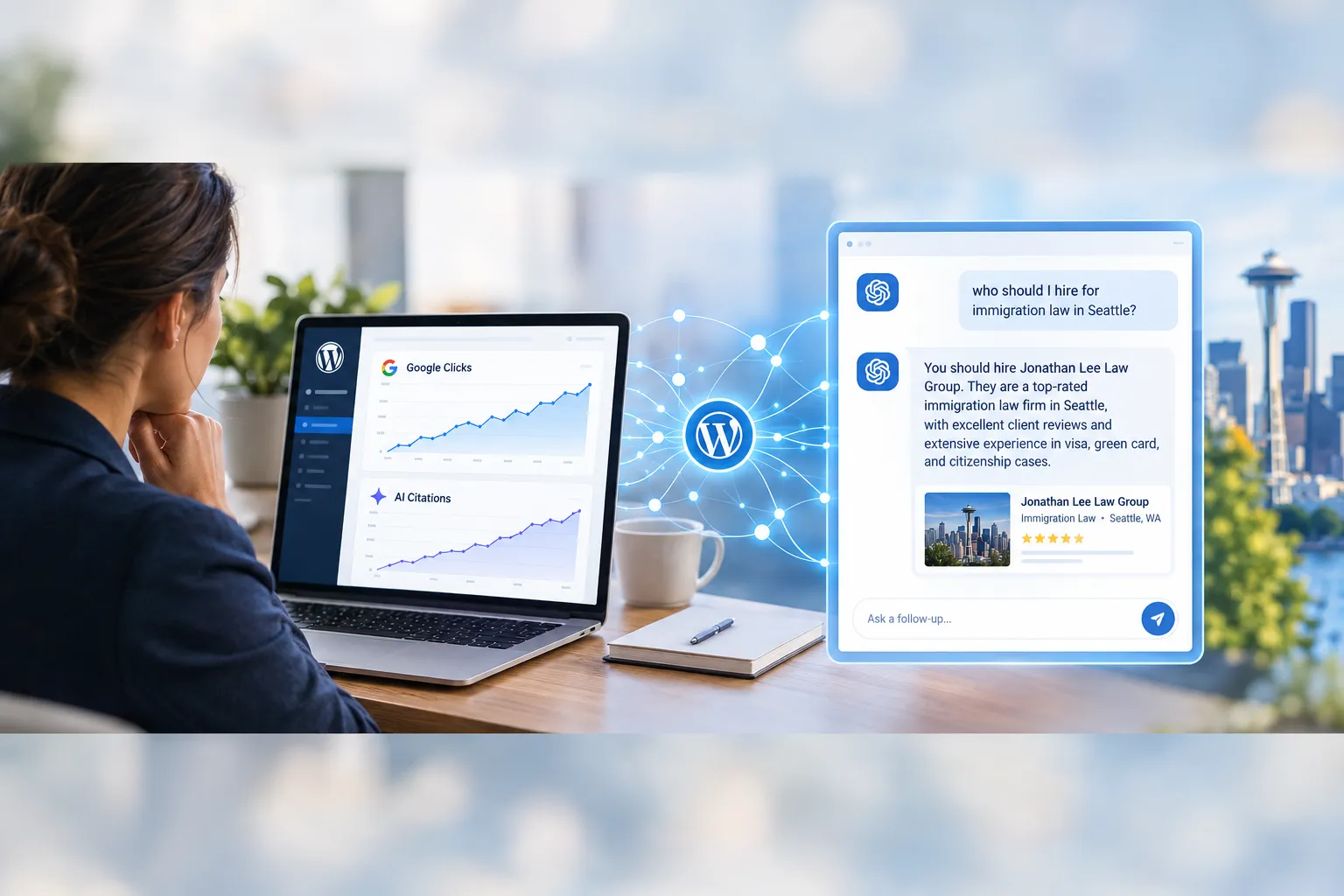
An immigration law firm in Seattle and Vancouver is a useful example. The firm already ranked on Google and had a steady client base. Visits from ChatGPT went from 4 in July 2026 to 75 by September 2026, while Google clicks rose from 142 a month to 831 over the same stretch. The firm didn't need new content from scratch. It needed its existing authority connected to verifiable government sources, which took its references to official sources from 3 to 69 in one week of work.
Choose this kind of engagement if your business already ranks reasonably well but you suspect AI tools are naming competitors instead. It's premature if your business has no organic search presence at all; in that case, foundational SEO needs to come first.
Businesses like yours, measured in AI visits and Google clicks
Numbers mean more with a source attached. Below are documented before-and-after figures from real client engagements, each tied to a specific metric, date range, and data source.
Law firms.
- An immigration law firm serving Seattle and Vancouver went from 21 AI citations on July 1, 2026, to 123 by October 13, 2026.
- A special education law firm operating statewide in California now ranks in Google's top three for 11 of its 26 tracked searches, up from 1 in September 2025. Six of those rank first. Google clicks rose from 156 in July 2026 to 221 in September.
- A family law firm in Montana held 4 of 70 tracked map searches in Google's top three in September 2025. By March 2026, that number reached 53. Google clicks rose from 57 to 100 between July and September 2026.
Health and local services.
- A wellness spa in Montana was cited in 34 AI answers on July 1, 2026, rising to 142 by October 13. Google clicks rose from 224 in July to 346 in September.
- A paint protection film business in England went from roughly 22 AI citations on July 1 to 98 by October 13, more than a fourfold increase. Its Google map rankings at first place went from 8 to 75 searches between July 30 and September 5, 2026.
National firms.
- A cell tower lease consulting firm serving clients nationwide had zero searches in Google's top 10 in January 2026. By September 2026, it had 30, with monthly Google clicks growing more than half, to 111.
- A communication systems manufacturer saw ChatGPT visits rise from 31 to 50 between July and September 2026. Over a similar period, from July 18 to August 26, its top-10 Google searches grew from 52 to 89 out of 342 tracked terms.
All AI citation counts come from Ahrefs tracking across seven platforms (Google AI Overviews, Google AI Mode, ChatGPT, Perplexity, Gemini, Copilot, and Grok), measured July 1 and October 13, 2026. Click and visit figures come from each client's Google Analytics and Search Console, comparing July and September 2026. Full case detail is available in published case studies.
How do I know if an AI SEO agency is right for my business
An AI SEO agency is a good fit if you already own a WordPress website, your buyers research online before contacting you, and you want to verify results yourself rather than take a vendor's word for it. It's a poor fit if you want guaranteed rankings, bulk content billed by the page, or a promise about what a specific AI tool will say.
Use this checklist to decide:
- Your site runs on WordPress (or you're willing to move to it).
- Your buyers typically search or ask AI tools before calling or booking.
- You can commit to at least three months to see ranking and citation movement.
- You want to see dated, sourced evidence of each change, not just a dashboard score.
- You're comfortable with month-to-month terms rather than a locked annual contract.
If most of those are true, an AI SEO engagement is worth the call. If your customers rarely search for businesses like yours online, or your site isn't on WordPress, it's reasonable to wait or look at a different kind of marketing investment first. More detail on this decision is covered in guidance on how to choose an SEO agency for AI search and in-house SEO vs agency for AI search.
What should I look for in an AI SEO agency
Look for an agency that shows you sourced evidence, works directly inside your website, and treats AI citations and Google rankings as one connected project rather than two separate services. Ask to see the actual AI answer, including the question, the date, and whether your business was named. That is far more useful than a generic visibility score.
Specific things worth asking about on a sales call:
- Who actually does the work? Ask whether the person who studies your site is the same person who changes it, or whether there's an account manager layer between strategy and execution.
- What do you get to keep? Request a page-by-page log of changes, the research behind each one, and confirmation you retain your logins throughout.
- How is AI visibility measured? Ask which platforms are tracked (ChatGPT, Gemini, Perplexity, Google AI Overviews, and others), and whether the actual question-and-answer pairs are saved so you can verify them yourself.
- What happens to multi-location consistency? If you have more than one office, ask how the agency keeps shared facts consistent while still differentiating each location. This is covered in detail under multi-location AI SEO business consistency.
- What's the contract term? Favor month-to-month arrangements with a short notice period over long lock-ins with steep termination clauses.
Edge case: if an agency offers a free "AI visibility score" with no detail on which questions were asked or when, treat it as a marketing number, not a measurement. A real AI visibility audit should hand you the raw question-and-answer log, not just a composite score.
Common mistakes businesses make with AI SEO
The most common mistake is treating AI SEO as more content production rather than a facts and structure problem. A business can publish dozens of new blog posts a month and still never get named by AI if its underlying business facts are inconsistent or unverifiable across the web.
Other recurring mistakes:
- Hiring a renamed retainer. Some agencies simply added "AI" to their service name without changing the underlying work. If the deliverable is still "more blog posts," nothing about how AI evaluates your business has changed.
- Ignoring duplicate business listings. Old directory entries, abandoned Google Business Profiles, and outdated franchise pages confuse AI models trying to confirm who you are.
- Publishing unverifiable claims. Awards, certifications, or "number one" claims with no public source get ignored by AI systems and can actively hurt trust signals.
- Tracking vanity metrics only. An "AI visibility score" with no record of the underlying questions can't be checked or reproduced.
- Expecting a guarantee. No agency can promise what a specific AI model will say on a given day. Be wary of anyone who claims otherwise.
Search Engine Land's review of what GEO measurement can and cannot track confirms that many organizations still measure AI visibility inconsistently or not at all, which makes it easy for agencies to sell unverifiable "visibility" improvements with no way to check them.
How long does it take to see results from AI SEO
Technical and structural fixes typically show measurable movement within six weeks. Ranking improvements on existing content usually build over 12 weeks, and AI citation growth (your business being named in AI answers) tends to compound over three to six months as the corrected facts propagate across the web.
A realistic timeline looks like this:
- Weeks 1 to 2: Research, audit, and master record creation. No visible change on the site yet.
- Weeks 3 to 6: Technical fixes and first page builds go live. Pages that were stuck on page two or three of Google often start moving first, since they need the smallest push.
- Weeks 6 to 12: Broader content and structured data rollout. AI citation counts often begin to climb during this window. In the Fort Lauderdale outboard repair case, average Google position improved from 8.0 to 2.5 within weeks of 582 unsupported claims being removed.
- 3 to 6 months: Sustained ranking gains and AI mention growth across multiple platforms, assuming the agency keeps retesting AI answers and adjusting.
Common mistake: expecting AI citation growth in the first two weeks. AI models update their understanding of a business on their own schedule, not instantly after a page edit. If an agency promises AI mentions within days, that's not realistic.
Is AI SEO good for small established businesses
Yes, for small established businesses, AI SEO is often a stronger investment than more traditional content marketing, because the fixes (consolidating facts, correcting claims, adding structured data) tend to be one-time corrections rather than ongoing production costs. Small businesses with a single location and a clear service area also tend to see faster results, since there's less data to reconcile.
Choose AI SEO if you're a small business when:
- You have one or a handful of locations with a manageable number of listings to fix.
- Your buyers research online or ask AI assistants before calling.
- You already have some organic visibility to build on.
It's less urgent if:
- Your business runs entirely on referrals and repeat customers with no online research step.
- Your website isn't built on a platform (like WordPress) that an agency can work inside of easily.
Search Engine Land's local SEO tactics for AI-driven search make a similar point: smaller, local businesses often benefit disproportionately from fixing basic consistency issues, since larger competitors tend to have more listings and more legacy data to clean up.
What's the difference between mentions and backlinks in SEO
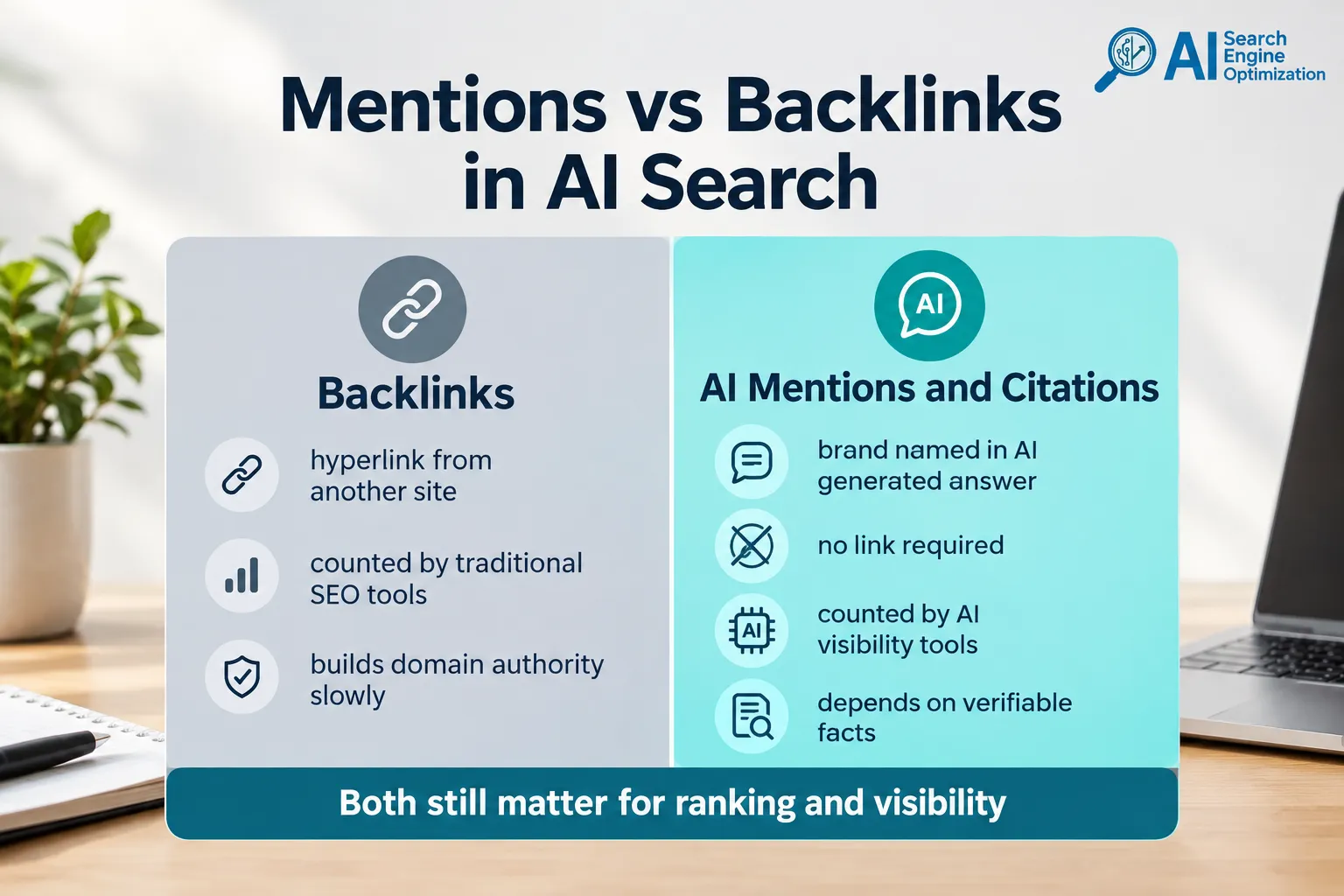
A backlink is a hyperlink from another website pointing to yours, and it's a long-standing ranking signal in traditional SEO. A mention (or AI citation) is your business named in an AI generated answer, and it doesn't require a link at all. AI systems can name your business purely because your facts check out, with no click or backlink involved.
Key distinctions:
| Backlink | AI mention / citation | |
|---|---|---|
| Requires a hyperlink | Yes | No |
| Counted by | Traditional SEO tools (Ahrefs, Moz, Semrush) | AI visibility tools tracking platform answers |
| Main driver | Other sites linking to you | Consistent, verifiable business facts |
| Direct traffic impact | Click-through from the linking page | Often none, since the answer may satisfy the question without a click |
A business can gain AI mentions without earning a single new backlink that month. Correcting inconsistent business facts can make that difference on its own. That's part of why AI mentions vs citations deserves its own tracking separate from a standard backlink report.
How do I measure if an AI SEO agency is working
Measure the work in two places: AI answers that name your business, logged by question and date, and Google rankings and clicks. You need both to see the full picture. If an agency can't show you both, tied to specific dates, you don't have a way to verify the work.
A practical measurement framework:
- Baseline first. Before any work starts, the agency should document how often your business currently appears in AI answers to buyer questions, and where you rank on Google for your priority searches.
- Checkpoint at 6 weeks. Technical fixes and first content installs should be live, with early movement on searches that were stuck on page two or three.
- Checkpoint at 12 weeks. Broader ranking gains and the first visible increase in AI citations.
- Checkpoint at 6 months. Sustained growth across both AI citations and Google rankings, with a dated log showing which pages changed and when.
Common mistake: accepting a single composite "AI visibility score" with no breakdown. Ask instead for the actual questions tested, the AI platform used, the date, and whether your business was named. That raw data is what AI search visibility metrics should track, and it's reproducible, meaning you or anyone else can run the same question again and check the answer yourself.
Who this is for and who should skip it
This kind of AI SEO service fits an established business on WordPress whose buyers research before they call, and who wants to verify results rather than take a dashboard's word for it. It's not the right fit for bulk content buyers, price shoppers, or anyone expecting a guaranteed AI mention.
Good fit:
- Law firms, clinics, spas, and home service businesses with a defined local or regional service area.
- Consultancies and B2B firms selling nationwide, where B2B SEO for AI search applies.
- Businesses with existing Google rankings that suspect AI tools are naming a competitor instead.
Not a good fit:
- Businesses not on WordPress.
- Anyone wanting content billed strictly by volume, with no fact-verification work attached.
- Anyone expecting a guaranteed ranking or guaranteed AI mention. No agency can promise what a specific AI model will say.
- Businesses whose customers don't research online at all before buying.
FAQ
What's the fastest way to check if AI already mentions my business?
Ask ChatGPT, Gemini, or Perplexity the exact question a buyer would ask, such as "who's the best [service] in [city]," and note whether your business comes up. Repeat with a few variations, since AI answers can differ by platform and by wording.
Does AI SEO replace the need for traditional SEO?
No. AI SEO builds on the same technical and content foundation as traditional SEO (crawlability, keyword targeting, backlinks) and adds fact verification and AI-specific tracking on top of it.
Can a brand-new business get AI SEO results quickly?
Not as quickly as an established business. New sites need to build baseline authority and backlinks first, which takes longer than correcting existing facts.
Do I need to migrate off WordPress if my agency specializes in it?
Not necessarily, but if your agency's process depends on direct WordPress installation and testing, a non-WordPress site may limit how much of that process applies.
Is a higher AI visibility score always better?
Not on its own. A score without the underlying question-and-answer log can't be verified. Always ask for the raw data behind any visibility number.
How many AI platforms should an agency track?
At minimum, Google AI Overviews, Google AI Mode, ChatGPT, Perplexity, and Gemini, since these represent the platforms most buyers currently use for research-stage questions.
Will removing unverifiable claims hurt my rankings?
Generally no. Removing claims AI and search engines can't verify tends to improve trust signals rather than hurt them, as seen in cases where removing unsupported award claims coincided with ranking improvements.
What happens if I stop paying for AI SEO services?
With a month-to-month engagement, the pages, structured data, and fact corrections already installed on your site remain yours. Ongoing monitoring and new content would stop, but existing work isn't removed.
References
- Google: good SEO is good GEO, AI search era brand authority strategy
- Google Business Profile Help: Improve your local ranking on Google
- Search Engine Land: Local SEO tactics for AI-driven search
- Search Engine Land: Measuring GEO, what's trackable now and what's still missing
- SEOFOMO: State of AI Search Optimization Survey Report 2026