AI Content Optimization:
Give Google, ChatGPT, and Perplexity a Reason to Cite You

Last updated: October 14, 2026
Quick answer
AI content optimization means rebuilding your website pages around verifiable facts, your own data, and your buyers’ actual language so that Google, ChatGPT, Gemini, and Perplexity have a reason to cite your business instead of a competitor’s. It works alongside traditional SEO, not instead of it, because Google’s AI Overviews and AI Mode still draw from the same indexed, ranked pages that regular search results use. The fastest way to see movement is to rebuild your highest-intent pages first, with research, fact-checking, and testing built into the process, rather than publishing more generic content.
Key takeaways
- AI content optimization rewrites existing pages around original facts, pricing, results, and sourced claims. Generic AI-written content rarely earns a citation because every competitor’s tool produces the same average answer.
- Google has stated that “appropriate use of AI or automation is not against our guidelines,” but it penalizes content made mainly to manipulate rankings, regardless of who or what wrote it (Google Search Central, 2023).
- Google’s current AI optimization guidance tells site owners to write “non-commodity content that your readers will find helpful and reliable” (Google Search Central AI optimization guide).
- AI content optimization and traditional SEO overlap heavily. Both depend on crawlable, fast, well-structured pages, but AI optimization adds a layer of sourced facts and structured data that answer engines can quote directly.
- Monthly AI content optimization services for small businesses typically start around $1,000 per month, scaling with the number of pages and the competitiveness of the market.
- Visible movement in AI citation counts commonly shows up within 60 to 90 days of a page rebuild, based on before-and-after tracking across clients, though Google ranking movement can take longer depending on competition.
- Businesses that depend on local, high-consideration purchases (law firms, home services, clinics, specialty retailers) tend to need this work most, because their buyers research heavily before contacting anyone.
- You can audit your own content for AI readiness, but testing it against competing pages across multiple AI platforms is time-intensive work that most owners end up outsourcing.
As seen in

What is AI content optimization and why does it matter?
AI content optimization is the practice of rebuilding a web page so it earns a Google ranking, a citation in AI-generated answers, and a buyer’s trust, all from the same draft. It matters because buyers increasingly ask ChatGPT, Gemini, or Google’s AI Overviews about a trade before they visit any website at all.
If your page reads like every other page in your industry, neither Google’s algorithm nor an AI answer engine has a reason to single it out. Generic AI content writing services make this worse: a prompt goes in, a draft comes out, and the result is the statistical average of everything already published on the topic.
The fix is specificity. A page built from your own prices, outcomes, client names, and sourced claims gives an answer engine something no other site has. That is the difference between content that fills space and content that gets quoted.
How do you optimize content for AI search engines like ChatGPT?
You optimize content for AI search engines by giving each page original facts, clear sourcing, and direct answers to the exact questions buyers type, then checking how AI platforms respond before and after you publish. ChatGPT, Gemini, Perplexity, and Google AI Mode all pull from indexed web content and weigh trust signals like citations, specificity, and consistency across the web.
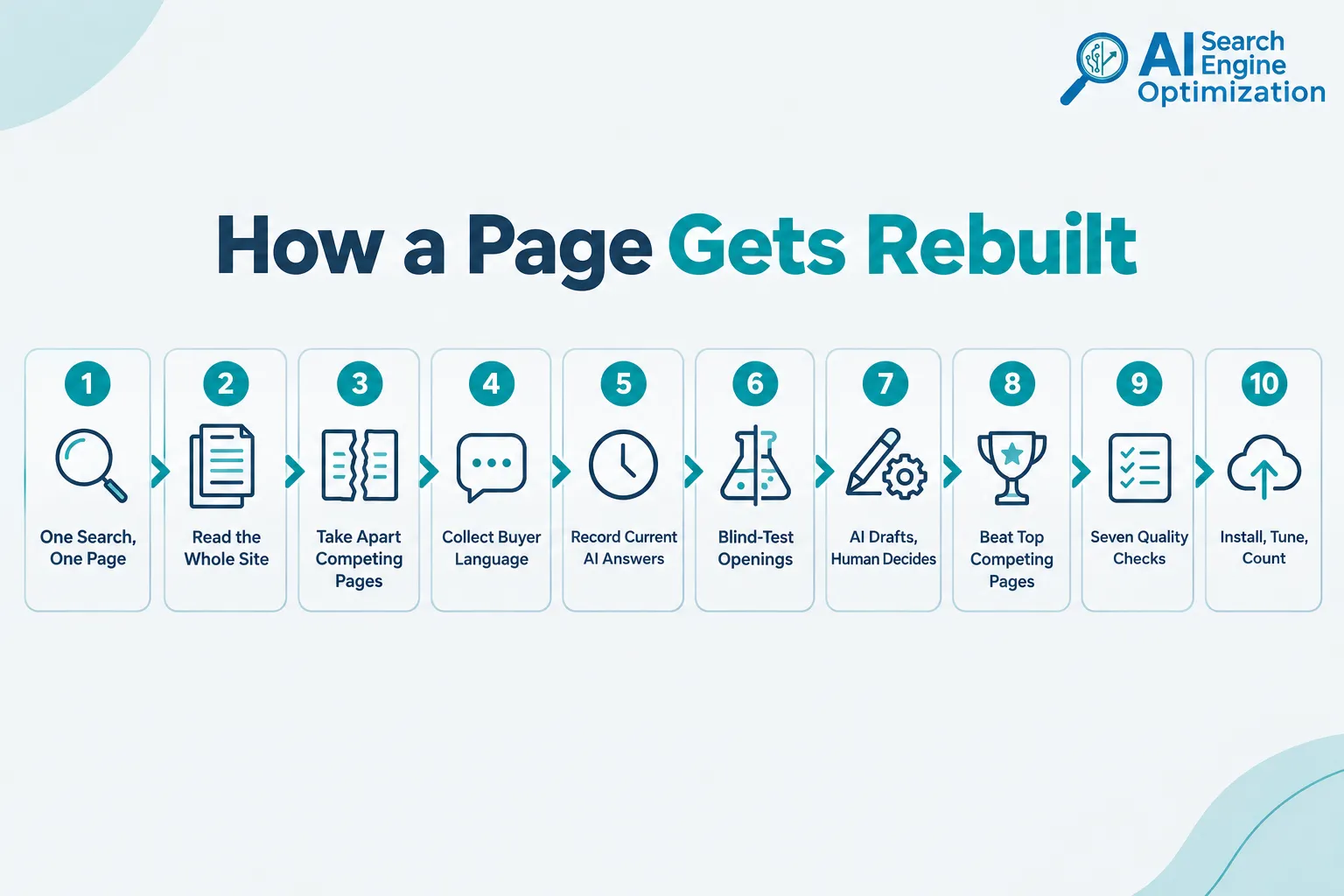
A practical sequence looks like this:
- Identify the exact search each page should own, so pages on your own site stop competing with each other.
- Audit your existing content for buried facts: results, dates, pricing, and terminology that never made it onto the page.
- Analyze the pages currently ranking and the pages AI platforms already cite, to find what none of them says.
- Pull buyer language from reviews, forums, and search queries, so the page answers real doubts in real words.
- Record a baseline of current AI citations before you change anything, so later results are measurable.
- Draft and fact-check every claim against a named, dated source.
- Test the draft against the top two or three competing pages before publishing.
- Install structured data so search engines and answer engines can parse facts cleanly.
This is close to the process described in Google’s SEO best practices for AI features, which emphasizes clear structure, factual accuracy, and content that answers a query directly rather than burying the answer in marketing language.
What’s the difference between SEO and AI content optimization?
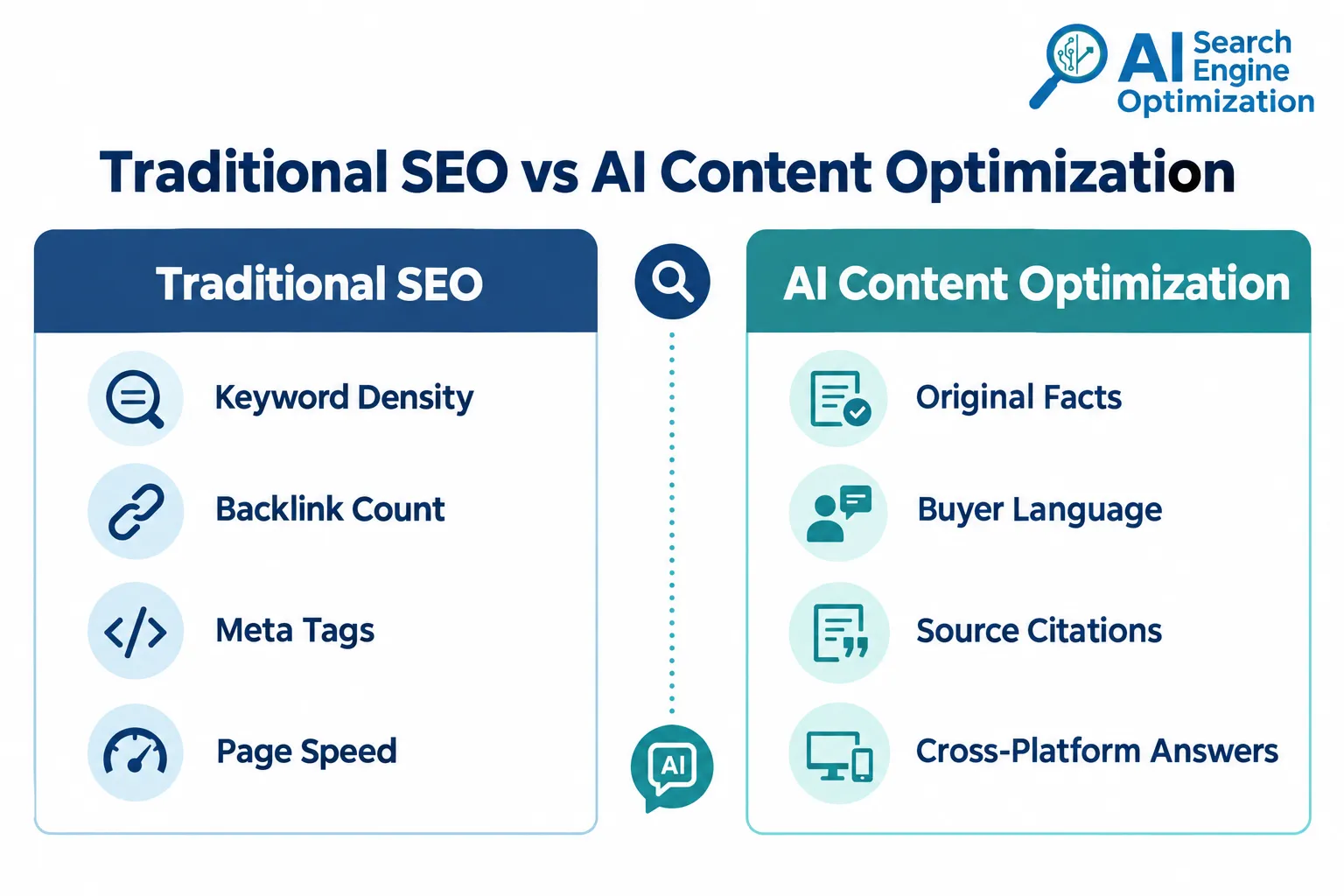
Traditional SEO optimizes a page to rank in Google’s organic results. AI content optimization adds a second target: getting that same page quoted or summarized inside an AI-generated answer, which depends on different signals than ranking position alone.
The two disciplines share a foundation. Both need:
- Fast, mobile-friendly, crawlable pages
- Clear headings and logical structure
- Keyword alignment with real search intent
- Internal linking that tells search engines what each page is about
Where they diverge:
| Factor | Traditional SEO | AI content optimization |
|---|---|---|
| Primary goal | Rank in the 10 blue links | Get cited or summarized in an AI answer |
| Core signal | Backlinks, on-page keywords | Original facts, sourced claims, buyer language |
| Content style | Keyword-focused copy | Direct answers with named sources and dates |
| Measurement | Position tracking | Citation counts by platform and date |
| Risk of failure | Low rankings | Zero citations even with good rankings |
A page can rank well in Google and still never get cited by ChatGPT, because answer engines favor content with clear, extractable facts over content optimized purely for keyword density. For a deeper breakdown, see how AI SEO compares to traditional SEO.
How do you get your business cited by AI search results?
Getting cited by AI search results starts with giving an answer engine a fact it cannot find anywhere else, backed by a source it can verify. Citations go to pages with specific, checkable information, not to pages that simply describe a service in general terms.
Steps that consistently move the needle:
- Publish real numbers. Prices, timelines, before-and-after results, and dates. A page that says “fast turnaround” gets skipped. A page that says “average turnaround of 11 days across 40 jobs in 2026” gets quoted.
- Name your sources. Government pages, studies, your own analytics. Answer engines favor content that links out to verifiable backing.
- Cover what competitors don’t. Read the pages currently ranking for your target search and the pages AI tools already cite, then fill the gap they leave.
- Match buyer phrasing. Use the exact words people type into search bars and ask AI chatbots, pulled from reviews and forums, not internal jargon.
- Keep structured data clean. Schema markup that correctly labels prices, reviews, and FAQs gives both Google and AI crawlers an easier path to your facts.
One immigration law firm saw its references to government sources rise from 3 to 69 after one week of fact-checking work in August 2026. Its ChatGPT referral visits went from 4 in July to 75 in September. That kind of jump tracks directly with the volume of sourced, citable facts added to the page, not with word count.
What are the best practices for optimizing content for SGE and AI Mode?
Best practices for AI Mode and generative search features center on answering the query in the first few sentences, then backing that answer with structured, scannable detail. Google’s guide to succeeding in AI search specifically warns against commodity content that adds nothing beyond what already exists online.
Practical guidelines that hold up across clients:
- Open each section with a direct answer before adding supporting detail.
- Use descriptive subheadings that match how people phrase questions out loud.
- Break up dense paragraphs with short lists and tables where comparison matters.
- Keep factual claims traceable to a source and a date.
- Avoid stuffing keywords; instead, cover the topic’s natural follow-up questions in the same page.
The original GEO research paper and Search Engine Land’s step-by-step guide to AI search content both point to the same conclusion: content written to be extracted and quoted performs better in AI Mode than content written purely to rank.
What content works best for AI search engines versus Google?
Content that performs well in both Google’s organic results and AI-generated answers tends to be specific, well-sourced, and structured so a machine can lift a sentence out of context without losing meaning. The overlap is large, but AI engines place extra weight on verifiable detail.
- For Google rankings: keyword alignment, backlink profile, page speed, mobile usability, and topical depth still matter.
- For AI citations: named figures, dated claims, direct comparisons, and clear sourcing matter more than keyword placement.
- For both: clean structure, fast load times, and content that fully answers the query without forcing a click-through just to get the basics.
Wikipedia’s overview of generative engine optimization notes that AI-driven search results are compressing the gap between ranking and citation, meaning pages increasingly need to satisfy both audiences in a single draft rather than writing separate versions.
How long does it take to see results from AI content optimization?
Most businesses see measurable movement in AI citation counts within 60 to 90 days of a page rebuild, though Google ranking changes can take longer depending on how competitive the search term is. Citation counts tend to move faster than organic rankings because AI platforms re-crawl and re-index cited content frequently.
Examples from tracked client work:
- A paint protection film specialist went from 9 AI-cited pages on July 1, 2026, to 24 on October 7, 2026, a roughly three-month window.
- A wellness spa’s citations rose from 13 to 45 pages over the same period.
- A bathtub reglazing company’s average Google position for four target searches improved from 5.0 in February 2026 to 1.75 by August 2026, a six-month timeline for competitive local rankings.
Decision rule: if you need AI citation movement quickly, prioritize rebuilding your highest-traffic or highest-intent pages first rather than spreading effort evenly across the whole site. If your goal is sustained Google ranking improvement in a competitive market, expect a longer runway, closer to four to six months.
What are common mistakes businesses make with AI content optimization?
The most common mistake is publishing more content without first checking whether the existing content already covers the topic adequately. Volume without specificity rarely earns a citation.
Other recurring mistakes:
- Treating AI content optimization as a one-time project. AI platforms re-check sources regularly, so pages need periodic fact updates, not a single rebuild.
- Skipping competitor analysis. Without reading the pages currently cited by AI tools, it’s impossible to know what gap to fill.
- Leaving claims unsourced. A page with impressive but unverifiable numbers gets ignored by answer engines that prioritize trust.
- Ignoring structured data. Pages without clean schema markup make it harder for crawlers to parse prices, FAQs, and reviews correctly.
- Assuming AI-written equals low quality, or assuming AI-written equals automatically good. The quality depends entirely on what facts the draft was built from, not on whether AI touched it.
Can you do AI content optimization yourself, or do you need an agency?
You can do basic AI content optimization yourself if you’re willing to spend time auditing your own site, researching competing pages, and checking AI platforms for citations regularly. An agency becomes worth the cost when you need that work done across many pages, tracked consistently over time, and tested against competitors before publishing.
DIY works reasonably well if:
- You have one or two priority pages, not a full site rebuild.
- You’re comfortable reading competitor pages and pulling buyer language from reviews yourself.
- You can check ChatGPT, Gemini, Perplexity, and Google AI Mode manually on a regular schedule.
An agency or specialist makes more sense if:
- You have a multi-page site and no time to audit it page by page.
- You want before-and-after citation counts tracked by platform and date.
- You want drafts tested against competing pages before they go live, which requires tools most owners don’t have access to.
Guides like Search Engine Land’s AI SEO overview and its guide to measuring brand visibility in AI search outline the scope of the work well, but most small business owners find the ongoing monitoring across five or six AI platforms harder to sustain than the initial rewrite.
What do AI content optimization services cost?
For a small business, AI content optimization often starts around $1,000 per month on a month-to-month engagement. The price then depends on the number of pages, market competition, and whether technical SEO and AI crawlability are included. Larger sites or highly competitive industries, like legal or medical services, often run higher because competing pages require deeper research to beat.
What typically affects price:
- Number of pages being rebuilt or newly created each month
- How many competing pages need to be analyzed per target search
- Whether structured data and technical fixes are included
- Whether ongoing citation tracking and monthly reporting are part of the scope
See a detailed breakdown of AI SEO pricing structures for how these variables typically play out across different business sizes.
Who needs AI content optimization services most?
Businesses where buyers research extensively before contacting anyone need AI content optimization most, because those buyers are the ones most likely to ask an AI assistant for a recommendation first. This includes legal services, home improvement contractors, medical and wellness providers, and specialty retailers with higher-ticket purchases.
Businesses that benefit least:
- Impulse-purchase retail with low research intent
- Hyperlocal businesses where foot traffic, not search, drives most volume
- Businesses already dominating both Google rankings and AI citations in their market
Edge case: a business with strong Google rankings but zero AI citations still has a visibility gap. Ranking well in traditional search no longer guarantees being mentioned when a buyer asks ChatGPT or Gemini the same question.
How do you know if your content is optimized for AI?
You know your content is optimized for AI when it gets cited by name in response to the exact questions your buyers ask, across more than one AI platform, and the citation count holds or grows over time. Ranking in Google alone isn’t proof; citation tracking is.
A quick self-check:
- Ask ChatGPT, Gemini, and Perplexity the top five questions your buyers would ask about your trade.
- Note whether your business is named, and whether a link to your site is included.
- Repeat the same questions a month later and compare.
- Check whether your page includes dated figures, named sources, and buyer-specific language, since pages lacking these rarely get cited consistently.
A simple AI visibility audit establishes this baseline before you change anything, so later improvement is measurable rather than assumed.
AI content optimization for small business versus enterprise
Small businesses generally need fewer pages rebuilt but tighter focus on local, high-intent searches, while enterprise sites need AI content optimization applied at scale across hundreds or thousands of pages with consistent brand and entity signals. The core method is the same; the scope and tooling differ.
- Small business: typically 5 to 20 priority pages, direct owner involvement in fact-checking, faster turnaround on individual pages.
- Enterprise: requires systems for consistency across locations, brands, or product lines, often tied to multi-location business consistency and broader entity SEO work so AI platforms recognize the same business across many pages and sources.
Choose the small-business approach if you have under 50 pages and one clear set of buyer searches to win. Choose the enterprise approach if you’re managing brand consistency across multiple locations, product lines, or subsidiary sites.
What tools help audit and improve content for AI search?
Reliable AI content auditing combines citation-tracking tools, which show whether and how often your pages appear in AI-generated answers, with traditional SEO tools for keyword and competitor analysis. No single free tool covers everything, so most serious audits combine two or three sources.
Commonly used categories:
- Citation tracking: platforms like Ahrefs now track AI Overviews, AI Mode, ChatGPT, Gemini, Perplexity, and Copilot citations by date, useful for building the kind of before-and-after record referenced throughout client case work. See a comparison of AI visibility tools for how these stack up.
- Traditional SEO fundamentals: Google’s overview of core SEO work and Search Engine Land’s GEO measurement analysis cover keyword and ranking analysis that still matters alongside AI-specific tracking.
- Manual checks: directly asking ChatGPT, Gemini, and Perplexity your buyers’ top questions on a recurring schedule, logging the date and the answer.
For a full view of how this fits into a broader strategy, see what our AI SEO services include and the case studies showing tracked results over time.
A short checklist before you hire anyone
- Does the provider show dated, before-and-after citation counts, not just promises?
- Does the process include reading your existing site for buried facts before writing anything new?
- Does the draft get tested against your actual competing pages, blind, before it goes live?
- Does the provider name a real source for every number in their own case studies?
- Do you keep your own logins, accounts, and WordPress access throughout the engagement?
If the answer to any of these is no, treat the proposal with caution. Phil Belleville, who has worked in search since 1995, structures every engagement around this checklist, and you can review the approach directly on a free strategy call.
FAQ
Does AI-written content hurt Google rankings?
No. Google has stated that appropriate use of AI or automation is not against its guidelines. What gets penalized is content made mainly to manipulate rankings, regardless of who or what wrote it.
Is AI content optimization the same as answer engine optimization (AEO)?
They overlap heavily. AEO focuses specifically on earning citations in AI-generated answers, while AI content optimization covers that goal plus traditional Google ranking and on-page conversion.
Can a page rank well in Google but still get zero AI citations?
Yes. Ranking position and citation frequency are measured differently. A page can hold a strong Google position while never appearing in a ChatGPT or Gemini answer if it lacks sourced, specific facts.
How often should AI-cited pages be updated?
Quarterly fact checks are a reasonable baseline for most small businesses, since AI platforms re-crawl and re-evaluate sources regularly and outdated figures can drop a page from citation.
Does this work for local businesses without a strong online presence?
Yes, though local businesses often benefit from pairing content work with local AI SEO services to strengthen location-based trust signals alongside page content.
What’s the biggest factor in getting cited over a competitor?
Specificity. A page with named prices, dated results, and sourced claims consistently outperforms a page with generic claims, even if the competitor’s page is longer or better designed.
Do I need a new website to do this, or can existing pages be rebuilt?
Existing pages can almost always be rebuilt in place. A full website rebuild is rarely necessary; the priority is usually a handful of high-intent pages, not the entire site.
How is success measured month to month?
Through citation counts by AI platform and date, Google ranking position for target searches, and standard analytics like organic clicks and referral visits from AI platforms, each tied to a named source like Ahrefs or Google Search Console.
References
- Google Search Central: Optimizing your website for generative AI features
- Google Search Central: AI features and your website
- Google Search Central Blog: Google Search’s guidance about AI-generated content
- Google Search Central Blog: Succeeding in AI search
- Google Search Central: Do I need SEO?
- GEO: Generative Engine Optimization, arXiv
- Generative engine optimization, Wikipedia
- Search Engine Land: What is AI SEO?
- Search Engine Land: How to optimize content for AI search engines, a step-by-step guide
- Search Engine Land: How to measure brand visibility in AI search
- Search Engine Land: Measuring GEO, what’s trackable now and what’s still missing