AI SEO Services:
What They Are, What They Cost, and How to Choose One

Last updated: October 14, 2026
Quick answer
AI SEO services optimize a business's website and online presence so that AI answer engines like Google AI Overviews, ChatGPT, Perplexity, and Gemini can find, verify, and quote that business. They combine traditional technical SEO with entity clarity work, quotable content structure, and citation building across third-party sources. Costs typically range from a few hundred dollars a month for small, local-focused work to several thousand for enterprise programs, depending on scope and whether the work is installed for you or handed over as a report.
Key takeaways
- AI SEO services extend standard SEO to cover how large language models choose and cite sources, not just how search engines rank pages.
- Pricing for small businesses commonly falls between $300 and $2,500 per month, while enterprise generative engine optimization programs can run into five figures monthly.
- No reputable provider can guarantee a specific AI mention. Honest providers measure citations and report them, rather than promising placement.
- AI SEO works best when it is installed directly on the website (not left as a PDF of recommendations) and checked with repeatable, dated measurements.
- Local businesses benefit most from entity consistency (name, address, phone number matching across listings) and Knowledge Graph accuracy.
- Ecommerce sites need structured product data and quotable product-comparison content, since AI shopping answers pull from both.
- Free tools can audit schema markup and check AI citation presence, but they rarely fix the underlying entity and content gaps.
- The most common mistake is treating AI SEO as a one-time project instead of an ongoing measurement and installation cycle.
What are AI SEO services and how do they work
AI SEO services are a set of optimization tasks that help AI answer engines recognize a business, trust it, and quote it in a generated response. They work by combining technical SEO fundamentals with three newer disciplines: entity clarity, quotable content structure, and third-party citation building.
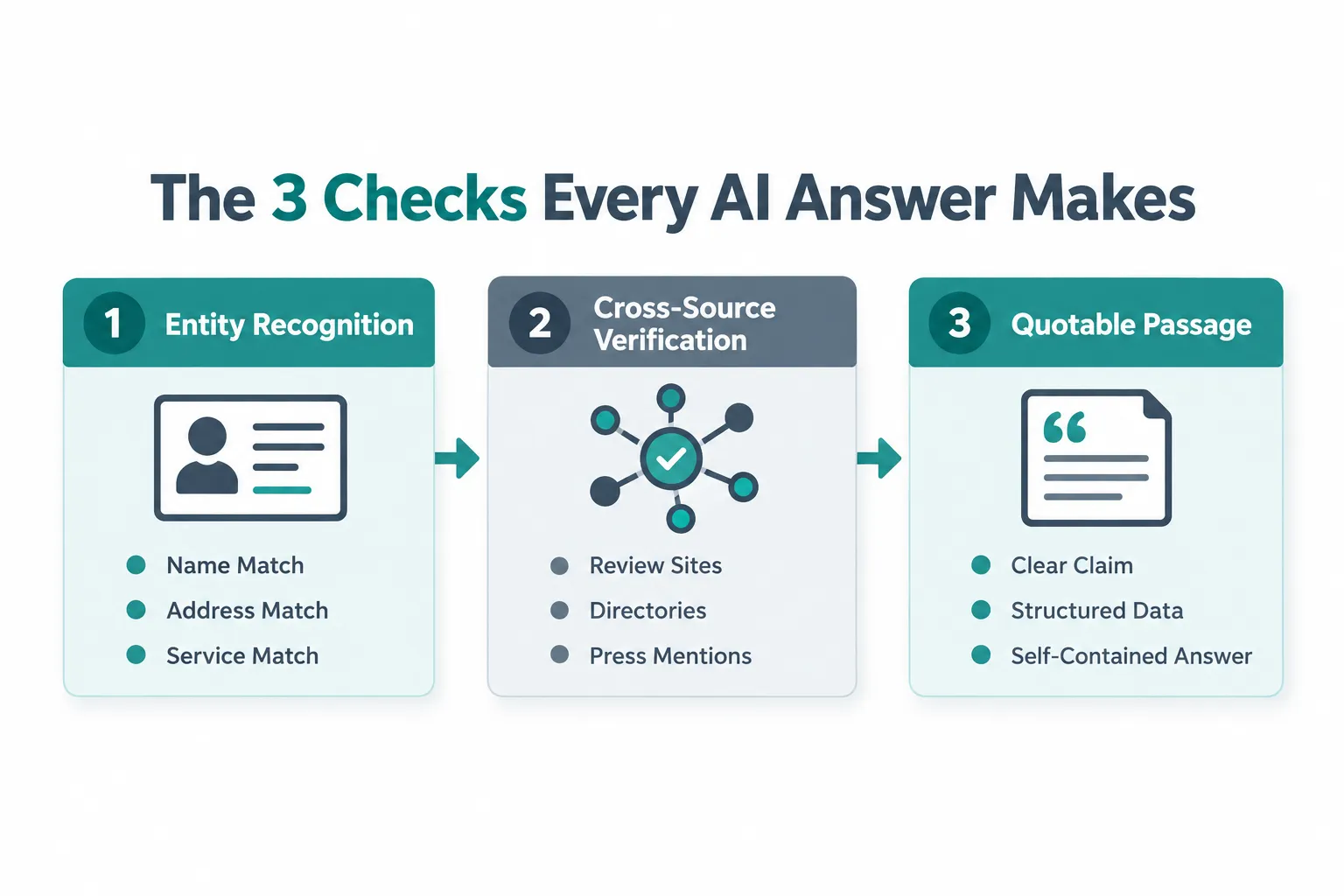
Traditional SEO asks whether Google can find and rank a page. AI SEO asks a harder question: will an AI system choose this business as a source when it writes an answer? That decision happens in roughly three steps, according to how Princeton's GEO research describes generative engine optimization and how Google frames AI features in Search:
- Recognition. The AI system has to identify who the business is, usually by matching name, address, and service details across multiple sources.
- Verification. The system cross-checks that identity against reviews, directories, press mentions, and other independent sources.
- Extraction. The system looks for a specific, quotable passage on the business's own site that answers the question directly.
A provider offering AI SEO services typically works on all three fronts: cleaning up business listings and structured data, rewriting key pages into direct-answer formats, and building mentions on sites the AI engines already trust. Search Engine Land's AI SEO guide and Search Engine Land's SEO guide both describe this blend of technical, content, and off-site work rather than a single tactic.
Example: A family law firm with inconsistent phone numbers across Google Business Profile, Yelp, and its own contact page may rank fine in Google but never get named in an AI answer about "family lawyers near me," because the system cannot confirm which number is correct.
How much do AI SEO services cost
Most small businesses pay between $300 and $2,500 a month for AI SEO work, while mid-size and enterprise programs often run from $3,000 to $15,000 or more per month depending on scope.
Pricing depends on a few variables:
- Number of locations or service areas. A single-location business costs less to optimize than a multi-location franchise.
- Content volume. Rewriting ten key pages into quotable answer blocks costs less than overhauling a 500-page ecommerce catalog.
- Citation building effort. Outreach to industry publications and review platforms takes ongoing labor, which agencies typically price as a separate line item.
- Installation vs. advisory. A provider that installs changes directly on your website usually costs more than one that only delivers a report, but it also removes the step where recommendations sit unused.
Decision rule: Choose a lower-cost, narrower-scope package if you have one location and a small site. Choose a broader, higher-cost program if you operate in multiple markets or sell a large product catalog, since the entity and content work scales with the number of pages and listings involved.
Common mistake: Paying for a large monthly retainer without a written scope. Ask any provider to define, in writing, what gets installed and what gets measured before you sign anything.
Best AI SEO tools compared
There is no single best AI SEO tool. The right choice depends on whether you need auditing, content generation, or citation tracking.
| Tool type | What it does | Best for | Limitation |
|---|---|---|---|
| AI visibility trackers | Monitor whether a brand is cited across ChatGPT, Perplexity, Gemini, and AI Overviews | Measuring progress over time | Rarely fixes the underlying problem |
| Schema/structured data checkers | Validate markup that helps AI systems parse page content | Technical SEO teams | Doesn't address content quality |
| Entity consistency tools | Scan directories and profiles for NAP (name, address, phone) mismatches | Local and multi-location businesses | Needs manual cleanup after detection |
| Content generation platforms | Draft answer-style content at scale | Teams producing high page volume | Can produce generic content without expert review |
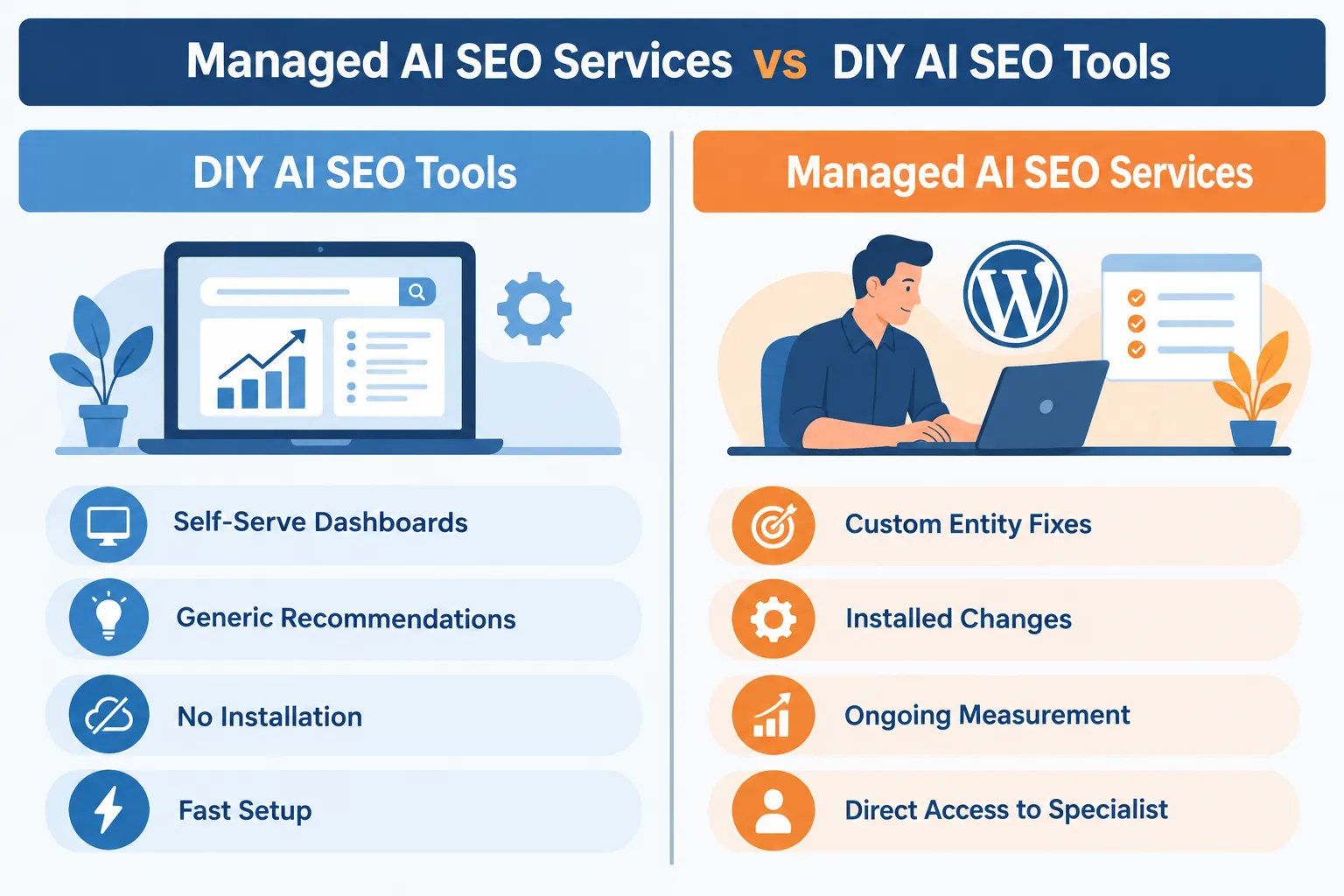
| Managed AI SEO services | Combine auditing, installation, and measurement under one engagement | Business owners who want work done, not just diagnosed | Costs more than a standalone tool |
Platforms like those covered in Search Engine Land's AI search optimization guide and its GEO measurement coverage combine several of these functions into one engagement, which is useful if you don't want to manage multiple tool subscriptions separately.
Decision rule: Choose a standalone tool if you already have an in-house team that can act on its findings. Choose a managed service if you want the findings acted on for you.
Can AI SEO services actually improve rankings
AI SEO services can improve how often a business is cited in AI answers and how well it ranks in traditional search, but no provider can guarantee a specific AI mention. Google's AI Overviews and AI Mode pull from the same index and Knowledge Graph used for regular search results, so fixing technical SEO and entity data benefits both.
What tends to move, based on how agencies in this space report results:
- Organic keyword rankings, when technical SEO and content depth improve.
- Map pack visibility, when local listings and reviews are cleaned up and consistent.
- AI citation frequency, when quotable answer blocks and third-party mentions increase.
What does not move automatically:
- A guarantee of appearing in any specific AI-generated answer. AI models select sources dynamically, and no agency controls that selection process directly.
Edge case: A business can rank first in Google and still never appear in an AI Overview, because the AI feature may judge that no single page answers the specific question clearly enough to quote. This is why answer-block formatting matters as much as ranking position.
AI SEO services vs hiring an SEO agency
AI SEO services are not a replacement for traditional SEO. They are an expansion of it that specifically targets AI answer engines, while traditional SEO agencies focus mainly on search engine result pages.
| Factor | Traditional SEO agency | AI SEO services |
|---|---|---|
| Primary goal | Rank in Google's organic results | Rank in Google plus get cited in AI answers |
| Core work | Keywords, backlinks, technical fixes | Same fundamentals, plus entity clarity and quotable content |
| Measurement | Rankings, traffic, conversions | Rankings, traffic, plus dated AI citation counts |
| Typical reporting | One blended traffic report | Search and AI performance reported separately |
Many providers, as Google's AI search guidance notes, now frame GEO work as an add-on layer rather than a separate discipline, because the underlying technical SEO work overlaps so heavily.
Decision rule: If your current SEO agency has never shown you a dated AI citation count, ask for one before assuming the work already covers AI search. If they can't produce one, the "AI SEO" in their package name may just be relabeled traditional SEO.
Do AI SEO services work for small businesses
AI SEO services work for small businesses, and in some ways small businesses have an advantage because a single owner usually controls the content, listings, and reviews that need to stay consistent.
Small business advantages:
- Fewer locations to clean up in directories.
- Direct access to the owner for fast approval of content changes.
- Smaller site size, so quotable content updates can be completed faster.
Small business constraints:
- Smaller budgets mean the engagement needs a tight, prioritized scope.
- Limited content history can make it harder to demonstrate first-hand expertise, one of the trust signals AI engines look for.
Example: A single-location bathtub reglazing business improved its average position on four commercial keywords from 5.0 to 1.75 over roughly seven months by fixing entity consistency and building out service-area content, according to case data published by AI SEO providers tracking this kind of work. Results like this depend heavily on starting position, competition, and market size, so treat any single example as illustrative rather than a guarantee.
Common mistakes people make with AI SEO
The most common mistake is treating AI SEO as a one-time audit instead of an ongoing cycle of measurement and installation. A second common mistake is chasing every AI platform equally instead of prioritizing the ones a business's customers actually use.
Other frequent mistakes:
- Ignoring Knowledge Graph accuracy. If Google has no confident record of a business, AI Overviews and Gemini have less to draw on.
- Publishing content without a quotable answer block. Long articles with no direct, checkable claim near the top rarely get lifted into an AI response.
- Skipping third-party citation building. AI systems check sources beyond a business's own website. Mentions on review platforms, industry lists, and press coverage still matter.
- Locking into a long contract before seeing results. Month-to-month terms let a business owner evaluate progress without being stuck if the work underperforms.
- Assuming one blended report tells the whole story. Search rankings and AI citations behave differently and should be reported as separate lines, not one combined number.
AI SEO services for ecommerce sites
Ecommerce sites need AI SEO work focused on structured product data, comparison content, and review signals, since AI shopping answers draw heavily on schema markup and third-party validation.
Priorities for ecommerce AI SEO:
- Product schema markup. Price, availability, and specification data in structured format helps AI systems quote accurate product details.
- Comparison and buying-guide content. Pages that directly compare products in clear, checkable language tend to get quoted more than generic product descriptions.
- Review aggregation. AI systems weigh review volume and sentiment when deciding which retailer or product to recommend.
- Category page depth. A category page that answers "what should I look for in X" tends to outperform a page that only lists products.
Decision rule: Prioritize your highest-margin or highest-volume product categories first. Fixing schema and content across an entire catalog at once is rarely necessary and often not affordable for a small ecommerce operation.
Why isn't my AI SEO tool improving my traffic
An AI SEO tool that only audits or tracks citations will not improve traffic on its own, because tracking a problem is not the same as fixing it. Traffic improves when the findings get installed on the website and the underlying entity, content, and citation gaps get closed.
Common reasons an AI SEO tool shows no traffic improvement:
- The tool identifies issues but no one implements the fixes.
- The business measures only one platform (for example, only Google AI Overviews) while customers are asking questions on ChatGPT or Perplexity instead.
- Content was rewritten for AI citation but never checked against actual search queries customers use.
- The site has deeper technical SEO problems (slow load times, broken internal links, thin content) that block both Google ranking and AI citation at the same time.
Troubleshooting step: Pull a dated citation count for your domain across at least three AI platforms. If the number hasn't moved in 60 to 90 days, the issue is almost always implementation, not measurement.
Is AI SEO better than manual SEO optimization
AI SEO is not better than manual SEO optimization. It is an extension of it. Both disciplines rely on the same technical foundation, crawlable pages, clear site structure, and authoritative content, so neither replaces the other.
Where they differ:
- Manual SEO optimization focuses on keyword targeting and backlink building to rank in traditional search results.
- AI SEO adds entity clarity, answer-block formatting, and citation tracking specific to how language models select sources.
Decision rule: Choose a provider who treats AI SEO as an addition to solid technical SEO, not a replacement for it. Any provider who claims AI SEO makes traditional ranking work unnecessary is overselling the service.
AI SEO services for local businesses
Local businesses benefit most from AI SEO work that focuses on listing consistency, map pack visibility, and Knowledge Graph accuracy, because AI answer engines rely heavily on these signals when recommending a nearby business.
Priorities for local AI SEO:
- NAP consistency. Name, address, and phone number need to match exactly across the website, Google Business Profile, and third-party directories.
- Review volume and recency. AI systems weigh both review count and how recently reviews were posted.
- Knowledge Graph confidence. A higher confidence score in Google's entity database correlates with a better chance of being named in AI Overviews and Gemini responses.
- Service-area content. Pages that clearly state what services are offered in which city or region give AI systems a specific passage to quote.
Example: A pain medicine clinic with twelve conflicting business records across directories consolidated them into one, after which its Knowledge Graph confidence score rose from 29 to 75. This kind of cleanup is a common first step in local AI SEO work because it addresses the recognition step directly.
What should I look for in an AI SEO platform
Look for a platform or provider that measures AI citations with dates and platform names, installs changes directly on your website, and offers month-to-month terms with a written scope before any paid work begins.
Checklist for evaluating an AI SEO provider:
- Do they publish their own dated AI citation numbers, not just client testimonials?
- Do they install changes on your website, or only deliver a report?
- Do they report search rankings and AI citations as separate metrics?
- Do they name which AI platforms they measure (Google AI Overviews, AI Mode, ChatGPT, Perplexity, Gemini, Copilot)?
- Do they offer month-to-month terms, or require a long contract?
- Do they avoid guaranteeing specific AI placements?
- Can you reach the person doing the actual work, not just a sales contact?
Common mistake: Signing with a provider that shows only percentage growth charts without dates or named platforms. A number like "AI visibility up 40%" means little without knowing the starting count, the date range, and which AI system it refers to.
Free AI SEO tools that actually work
Several free tools can check technical fundamentals that affect AI visibility, though none of them install fixes for you.
- Google's Rich Results Test checks whether your structured data is valid, which affects whether AI systems can parse your page content correctly.
- Google Search Console shows which queries already bring traffic, useful for spotting which pages might already be quotable.
- Manual prompt testing (asking ChatGPT, Perplexity, or Gemini directly about your business or industry) is free and gives a rough read on whether you're currently being cited at all.
- Schema markup generators (several free versions exist online) help you build the structured data an AI SEO provider would otherwise need to add manually.
Decision rule: Use free tools to get a baseline understanding of your current gaps. Move to a paid tool or managed service once you know specifically what needs fixing, since free tools rarely close the gap themselves.
AI SEO services for content creation and keyword research
AI SEO services approach content creation and keyword research differently than traditional SEO by writing for direct, quotable answers first and by researching the follow-up questions an AI system is likely to ask, not just the primary keyword.
Key differences in method:
- Keyword research expands into question clusters. Instead of targeting one phrase, the research maps the main query plus the follow-up questions a person or an AI system would naturally ask next.
- Content structure leads with the answer. A quotable paragraph near the top of the page states the direct answer before supporting detail follows.
- Structured data reinforces the written answer. Schema markup repeats the same claim in machine-readable form, so the written content and the structured data agree.
- Depth across the whole topic matters more than any single page. AI systems appear to weigh how completely a domain covers a subject, not just whether one page ranks well.
Common mistake: Writing a long article with the main answer buried several paragraphs down. AI systems and readers both benefit from the direct answer appearing immediately.
FAQ
What is the difference between SEO and AI SEO?
SEO focuses on ranking in traditional search engine results pages. AI SEO adds work focused on being recognized, verified, and quoted by AI answer engines like ChatGPT, Perplexity, Gemini, and Google's AI Overviews.
How long does it take to see results from AI SEO services?
Technical fixes like entity consistency can show measurable change in Knowledge Graph confidence within weeks. Content and citation building usually take two to four months before AI citation counts shift noticeably.
Do I need separate strategies for ChatGPT versus Google AI Overviews?
Yes, partially. Both rely on clear entity data and quotable content, but Google AI Overviews draws directly from Google's search index and Knowledge Graph, while ChatGPT and Perplexity weigh independent web sources and citation footprint more heavily.
Can a small business do AI SEO without hiring an agency?
A small business can handle entity consistency and basic content formatting in-house. Citation building and structured data implementation usually benefit from outside expertise, especially if the owner has no SEO background.
Is it normal for an AI SEO provider to guarantee rankings or AI mentions?
No. No provider can guarantee a specific AI mention or ranking position, since AI models select sources dynamically. Be cautious of any provider that promises guaranteed placement.
What's the single biggest factor in whether an AI system cites a business?
Consistency and clarity of the business's identity across the web, paired with a clear, checkable answer on the business's own site, are the two most frequently cited factors across AI SEO providers' published methodologies.
Do AI SEO services replace the need for backlinks?
No. Backlinks and third-party citations still matter. AI systems check independent sources before trusting a business's own claims, so citation building remains part of the work.
How do I check if my business is already being cited by AI systems?
Ask ChatGPT, Perplexity, and Gemini direct questions a customer might ask about your industry and location. Record the date and the exact question so you can track changes over time.
References
- Princeton University, GEO: Generative Engine Optimization (arXiv)
- Google Search Central, Top Ways to Ensure Your Content Performs Well in Google's AI Experiences
- Google Search Central, AI Features and Your Website
- Search Engine Land, What Is AI SEO?
- Search Engine Land, What Is SEO?
- Search Engine Land, How to Optimize Content for AI Search Engines
- Search Engine Land, Measuring GEO: What's Trackable Now and What's Still Missing