
Answer Engine Optimization · Business perspective
How Google AI Overviews Choose Their Sources
And What Triggers One
How Google AI Overviews choose their sources comes down to one rule: Google's systems pull passages from pages its core ranking already trusts, then widen the pool through a technique called query fan-out, so a page does not have to sit in the top ten to get quoted. AI Overviews SEO means building pages that answer a specific question cleanly enough to be lifted and cited, not just pages that rank. In our own pull of 24 buyer searches for SEO help on October 14, 2026, Google showed an AI Overview on 19 of them, and those 19 Overviews cited 97 pages total, 57 of which were not in the top ten organic results for that same search.
Key Takeaways
- An AI Overview is Google's generative summary at the top of search results, built from its own ranking systems plus a Gemini model, not a separate index.
- Google triggers an Overview when it decides a question needs synthesis across sources, which is why question-shaped and comparison searches get one far more often than bare service-name searches.
- Across our October 14, 2026 pull of 24 buyer searches, 19 showed an AI Overview, and those 19 Overviews cited 97 pages.
- Of those 97 citations, 57 came from pages outside the top ten organic results, so ranking in the top ten is not a requirement to be quoted.
- In 18 tracked buyer questions, 19 percent of citations (14 of 74) went to YouTube, LinkedIn or Reddit, not a business's own site.
- You cannot opt your business out of AI Overviews directly, but you can keep specific pages out of them using existing snippet controls.
- Being cited is not the same as ranking well; a page on page two can still win the quote if it answers the question more cleanly than anything else Google can find.
As seen in

What is a Google AI Overview
A Google AI Overview is a generated summary that appears above the normal blue-link results on certain searches, pulling together information from several web pages into one answer with citations attached. Google describes it as showing "when our systems determine that generative AI can be especially helpful," especially when a search would benefit from pulling together information from a range of sources rather than one single page.
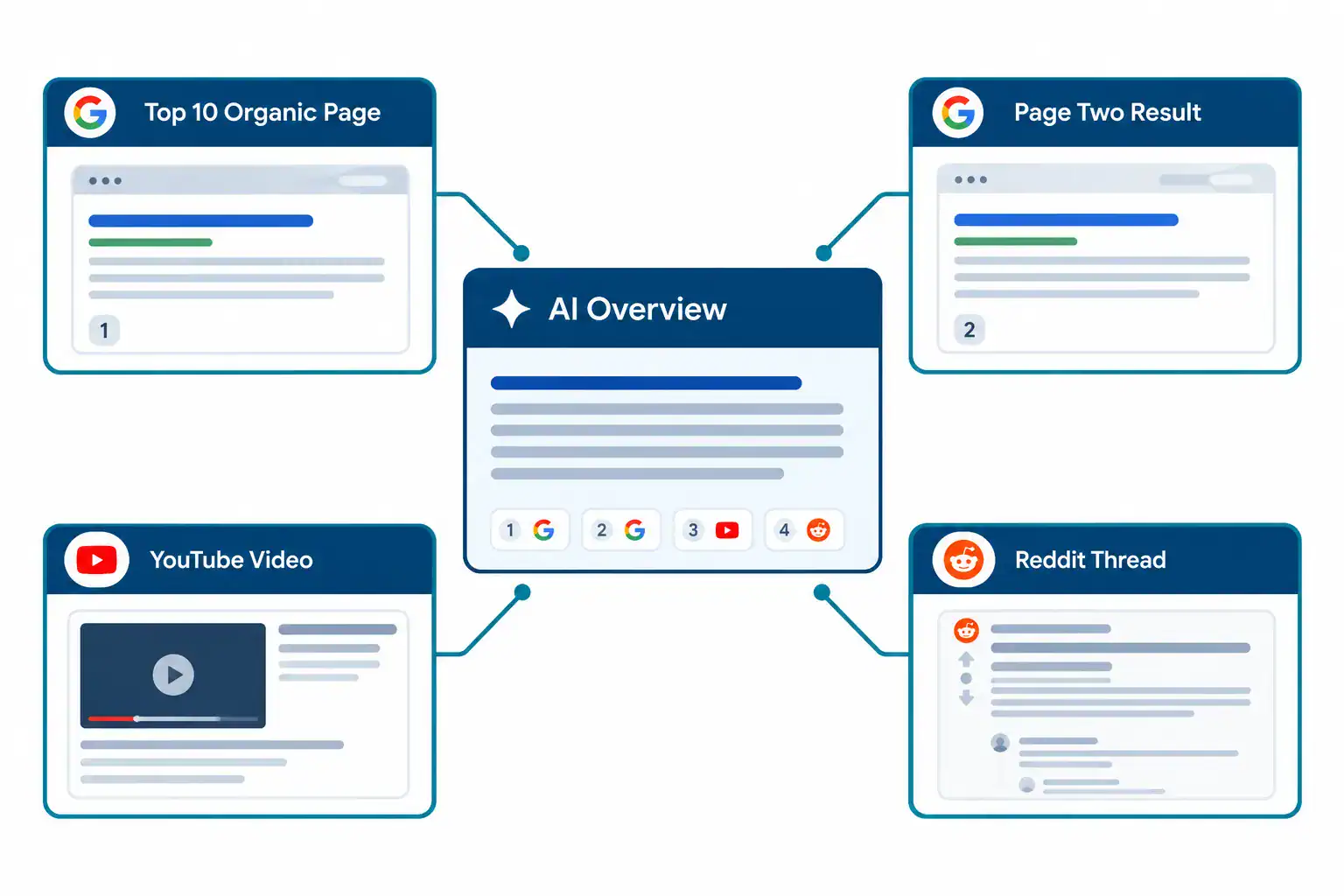
The summary is produced by a customized Gemini model working alongside Google's long-standing ranking and entity systems, including the Knowledge Graph [1]. That matters for your business: the model is not inventing an answer from nowhere. It is synthesizing from pages Google's own ranking systems already consider reliable [2].
How does Google choose which sources go into an AI Overview
Google chooses AI Overview sources mainly from pages its core web ranking already trusts, but the pool is wider than the visible top ten because of a technique called query fan-out. The system issues multiple related searches behind the scenes, across subtopics tied to your original question, and gathers supporting pages from each of those searches before writing the summary [3].
This is why "How Google AI Overviews Choose Their Sources (and What Triggers One)" is really a question about breadth, not just rank position. Independent analysis of AI Overview citations found that roughly three-quarters of cited URLs come from the top 10 organic results for the query, with most of the rest still inside the top 20 . Our own numbers show a different split for buyer-intent SEO-help searches specifically: of 97 citations pulled October 14, 2026, 40 were already in the top ten and 57 were not. The practical point stands either way: being quoted and being ranked are related but separate wins.
Google also cross-checks claims against the pages it cites: a 2026 study of live AI Overviews scored how faithfully each claim traced back to the text of its cited source, so pages whose wording directly supports the claim are the safe citation targets [4].
What triggers Google to show an AI Overview vs regular results
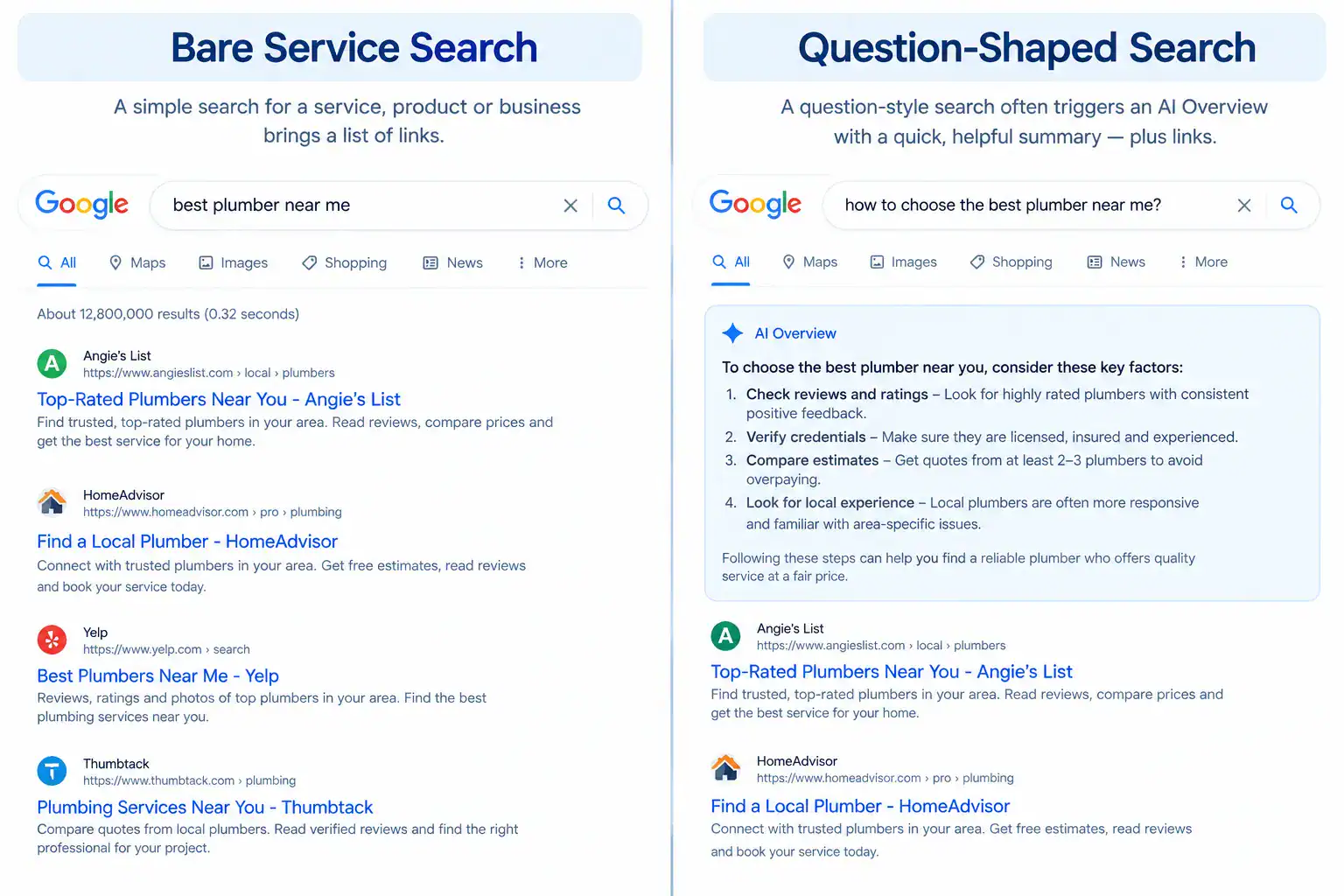
An AI Overview triggers when Google's systems judge that a question needs information drawn from multiple sources rather than a single, obvious answer. Simple navigational or bare service-name searches ("plumber Denver") are less likely to trigger one than open-ended, comparative, or planning questions ("how much does a water heater replacement cost" or "tankless vs. traditional water heater, which is better").
Search Engine Land's guide describes the trigger as searches where a synthesized answer helps more than a single retrieval, particularly in learning or comparison modes [5]. This is the practical answer to what triggers an AI Overview: question-shaped searches, "which should I choose" searches, and multi-part research searches trigger them far more consistently than one-word category searches.
Decision rule for your pages: if your buyers search your service name alone, you are less likely to face an Overview and more likely to compete on classic rankings and the map pack. If your buyers search questions about your service, expect an Overview, and build content that answers that exact question in the first few sentences.
Is Google AI Overview the same as a featured snippet
No. A featured snippet pulls one passage from one page and displays it in a box. An AI Overview synthesizes passages from several pages into one generated answer, with separate inline citations attached to different parts of the response [6].
The practical difference for you: a featured snippet rewards one page being the single best match. An AI Overview can reward several of your pages at once, or reward a competitor's video, forum thread, or review profile alongside your website, because the Overview is built section by section, with each section sourced independently [6].
Why isn't my website appearing in Google AI Overviews
Your site is most likely missing from Overviews because your pages are not answer-ready, not indexed cleanly, or because Google is already satisfied with other sources for that exact question. Common causes:
- The page buries the direct answer under a long introduction instead of stating it plainly near the top.
- The page is blocked from snippets, intentionally or by accident, through a
nosnippetor restrictivemax-snippettag [3]. - The page is not indexed or is technically weak, so it never enters Google's candidate pool at all [3].
- A competitor's page, video, or even a forum thread already gives Google a cleaner passage to quote, and your page says the same thing with more words.
Common mistake: owners assume they need to outrank competitors on the main search results page to be quoted. The 57-out-of-97 figure from our October 14, 2026 pull proves otherwise. You need the clearest answer, not necessarily the highest rank.
Can I opt out of Google AI Overview
Not entirely, but you can keep individual pages out of the summaries. Google still respects existing snippet controls, including nosnippet, max-snippet, and noindex, which apply to AI Overviews the same way they apply to classic snippets [3][6]. There is no setting that removes your entire site from triggering an Overview on someone else's search while leaving your regular rankings untouched; the controls work page by page.
If a specific page contains sensitive pricing, legal, or proprietary language you do not want quoted out of context, apply nosnippet to that page. For everything else, your better move is making the page quotable, not hiding it.
Does Google AI Overview cite where information comes from
Yes. AI Overviews generate text with inline citations linking back to the original source for each section, or "block," of the answer [1][6]. These citations let a reader click through to verify a claim, and they are usually grouped so each part of the answer has its own supporting source rather than one page backing the whole response.
This citation structure is also why a share of citations go to places other than business websites. In our 18 tracked buyer questions from October 2026, 14 of 74 AI Overview citations, 19 percent, went to YouTube, LinkedIn, or Reddit instead of a business's own site. If your business has no presence on those platforms, you are giving up roughly a fifth of the available citation slots before you even start competing on your own domain. This is part of why answer engine optimization treats third-party platform presence as part of the job, not an extra.
Which types of websites show up most in AI Overviews
Pages that already carry strong topical authority, clear structured data, and a track record of being indexed and crawled reliably show up most often, alongside third-party platforms like YouTube, Reddit, and LinkedIn for certain question types. Google's Overview system draws on the same Knowledge Graph and ranking systems that power classic Search, including the Shopping Graph for product and commercial queries [1][3][6].
| Source type | Why it gets cited | What it means for you |
|---|---|---|
| Top-10 organic pages | Already trusted by core ranking | Keep ranking fundamentals strong |
| Page-two or lower pages with a sharp answer | Clear, quotable passage wins over position | Write direct answers near the top of the page |
| YouTube | Visual, specific, often first-hand | A video citation surface matters; see YouTube SEO for AI search |
| Reddit and LinkedIn | Real buyer language, perceived as candid | Participate where your buyers already discuss the topic |
| Knowledge Graph entries | Confirmed entity facts | Strengthen your business entity clarity |
When does Google not show an AI Overview
Google skips an AI Overview when it has low confidence in synthesizing a reliable answer, when the query is simple enough that a direct link serves the user better, or when the topic is sensitive and better served by direct results [5]. Sometimes an Overview will appear lower on the page instead of at the top, or not appear at all, and Google continues testing exactly when this happens [5].
In our October 14, 2026 pull, 5 of the 24 buyer searches for SEO help returned no AI Overview at all. Those tended to be narrower, more transactional searches rather than open questions, which matches the broader pattern: simple, well-served queries are less likely to get the synthesized treatment.
How accurate are the sources Google uses in AI Overviews
Google aims to surface sources backed by its existing quality and ranking systems, and the company states Overviews are built to only show information supported by top web results [2]. That does not make every citation flawless, but it does mean the sources are drawn from the same trust signals that already govern classic search rankings, cross-checked across multiple pages before a claim is included [4].
For your business, this means the usual credibility signals still matter: clear authorship, verifiable facts, and consistency across your site. Our own breakdown of E-E-A-T in SEO covers the proof points Google and AI engines look for before trusting a source.
Does Google AI Overview help or hurt website traffic
It depends on whether your page is the one cited. If your page is quoted, you gain a visible citation and a chance at a click from a user who wants more depth. If a competitor is quoted instead, your traffic for that question can shrink even if you still rank on page one, because some users read the summary and move on.
This is why counting rankings alone no longer tells the full story. A full picture needs AI Overview citation tracking alongside classic rank tracking, something covered in detail in our guide to AI search visibility metrics and KPIs.
How can I get my site featured in Google AI Overview
Getting featured in an AI Overview means writing the clearest, most specific answer to a real buyer question and making sure Google can read and trust the page that holds it. Steps that matter most:
- Answer the question in the first two or three sentences of the relevant page, before any backstory.
- Make each page answer one question, rather than burying five answers in one long post.
- Add structured data so Google can confirm what the page is about, not just guess from the text.
- Keep the page indexed and technically clean, since a page Google cannot crawl reliably cannot be cited at all.
- Build presence on third-party platforms your buyers already trust, since a meaningful share of citations go there instead of to business websites.
- Target question and comparison searches, not just bare service-name searches, since those trigger Overviews more reliably.
This is the core of how to optimize for AI Overviews: write for the question, not just the keyword. If you want this built and installed rather than just explained, our answer engine optimization services handle the research, the writing, and the structured data together.
Do ecommerce and news sites rank differently in AI Overview
Yes, somewhat. Ecommerce queries draw on the Shopping Graph alongside standard ranking, so product pages with clean structured data and intent-rich, long-tail phrasing are more likely to surface for commercial questions [3][6], which is why ecommerce AI SEO starts with accurate structured data and product feeds. News-style queries move faster and depend more on freshness and timely authority, while evergreen "how" and "why" questions, the kind most service businesses compete for, lean more on depth, structured answers, and consistent topical authority over time [1][6].
If you sell a service rather than a product, your opportunity sits mainly in the evergreen question space: pricing questions, comparison questions, and "what should I expect" questions from buyers researching before they call.
What queries don't have Google AI Overviews
Narrow transactional searches, brand-name searches, and searches where Google already has one obviously correct destination tend not to trigger an Overview. In our October 14, 2026 pull, the searches without an Overview skewed toward simple, specific requests rather than open research questions. If your buyers mostly search that way, your growth still depends heavily on classic rankings, the map pack, and clear service pages, not AI Overview citations.
Mistakes to avoid
- Chasing rank instead of clarity. A page ranked number three with a buried answer can lose the citation to a page ranked number fourteen that states the answer plainly.
- Ignoring third-party platforms. With roughly a fifth of citations going to YouTube, Reddit, and LinkedIn in our tracked questions, skipping those platforms leaves citations on the table.
- Writing one page to answer five questions. Google's fan-out process rewards pages built around one clear question, not generalist pages trying to cover everything.
- Blocking snippets by accident. A leftover
nosnippettag from an old plugin can silently remove a page from citation eligibility. Leftover plugin settings like this are among the hidden platform problems AI SEO for WordPress work is built to catch.
Conclusion
AI Overviews SEO is not a separate discipline from good SEO; it is an extension of it with new rules about what gets quoted. Google chooses sources from pages its ranking systems already trust, then widens the pool through fan-out so page-two content with a sharp, direct answer can still win the citation. Question-shaped and comparison searches trigger Overviews far more than bare service-name searches, and a real share of citations go to platforms like YouTube, Reddit, and LinkedIn rather than business websites.
The next step is practical: audit your highest-value pages for whether they answer a real buyer question in the first few sentences, check your indexation and snippet settings, and build presence on the platforms your buyers already trust. If you want a straight answer on where your business currently stands against competitors in the AI answers, book a call with Phil and see the test before anything is proposed.
FAQ
What is the main trigger for a Google AI Overview?
Google shows an AI Overview when it decides a search needs an answer pulled from several sources rather than one obvious page, most often on question, comparison, or planning searches.
Do I need to rank in the top ten to be cited in an AI Overview?
No. In our October 14, 2026 pull, 57 of 97 AI Overview citations came from pages outside the top ten organic results for that search.
Can I stop my page from appearing in an AI Overview?
Yes, using the nosnippet or max-snippet tag on that specific page, the same controls that apply to classic snippets.
Why do Reddit and YouTube show up in AI Overviews for business questions?
Google treats them as sources with specific, first-hand answers. In our tracked data, 19 percent of citations across 74 tracked AI Overview citations went to YouTube, LinkedIn, or Reddit rather than business websites.
Is an AI Overview the same thing as a featured snippet?
No. A featured snippet shows one passage from one page. An AI Overview combines passages from multiple sources into one generated answer with separate citations per section.
Does getting cited in an AI Overview guarantee more website traffic?
No. A citation can bring a click from a user wanting more depth, but it can also satisfy the user's question well enough that they never click through at all.
References
- Generative AI in Search: let Google do the searching for you. blog.google.
- About AI Overviews and AI Mode. Google Search.
- AI features and your website. Google Search Central.
- Measuring Google AI Overviews: activation, source quality, claim fidelity, and publisher impact. arXiv.
- Google AI Overviews guide. Search Engine Land.
- AI Overviews optimization guide: how to rank in generated results. Search Engine Land.
Continue your research
What an AI Search Audit Should Deliver: what a measured audit of these citation slots should hand you.
How Long Does SEO Take? Eight Dated Records, Week by Week: the dated windows source-selection work tends to move in.
Discuss what this means for your business
Our proprietary Rank Intelligence Engine connects 25 specialized analysis and implementation capabilities with commercial judgment, content, and WordPress implementation. Phil Belleville has worked in SEO since 1995 and brings that experience to the priorities and decisions behind the work.
Explore our answer engine optimization services to see the service behind this business perspective.
30 minutes with Phil. Written scope and pricing before paid work begins.