AI SEO Services · Business perspective
Is SEO Dead?
What 90 Days of Tracked AI Answers Actually Show
Is SEO dead? No. Google's AI Overviews now appear on 73.3% of branded searches as of September 2026, up from 61.3% in July, but ranking, crawlability, and authority still decide who gets named inside those answers. SEO today means winning two jobs at once: the traditional organic click and the AI citation. Businesses that ignore either one are leaving buyers on the table.
Key Takeaways
- AI Overviews jumped from appearing on 61.3% of branded keyword searches in July 2026 to 73.3% in September 2026 [2].
- In a 100-brand panel, 76.2% of AI Overviews on brand-name searches placed above the brand's own organic listing [1][2].
- Wikipedia appeared in 71.9% of AI citation sets, YouTube in 38.6%, LinkedIn in 22.8% [2].
- Organic SEO is not dead, but old-style SEO built only for rankings is fading fast.
- Technical SEO, schema markup, and crawlability are prerequisites for AI engines to find and quote a business.
- Content built only for keyword density loses to content built as a quotable, cite-worthy answer block.
- B2B SEO and B2C SEO now diverge more sharply because AI answers favor research-heavy, authority-backed content.
- A federal judge dismissed antitrust claims against Google over AI Overviews in September 2026, signaling the AI-answer shift is not going away through litigation [3].
- MIT Sloan researchers found most companies have blind spots in measuring AI visibility at all [4].
- Businesses that pair local SEO, national SEO, and AI search optimization together outperform those chasing only one channel.
As seen in

What Does SEO Actually Mean Now With AI Answers
SEO today is not just ranking a page on Google. It is making sure a business gets named, quoted, and linked inside the answer itself, whether that answer comes from Google's AI Mode, ChatGPT, Perplexity, Gemini, or Copilot.
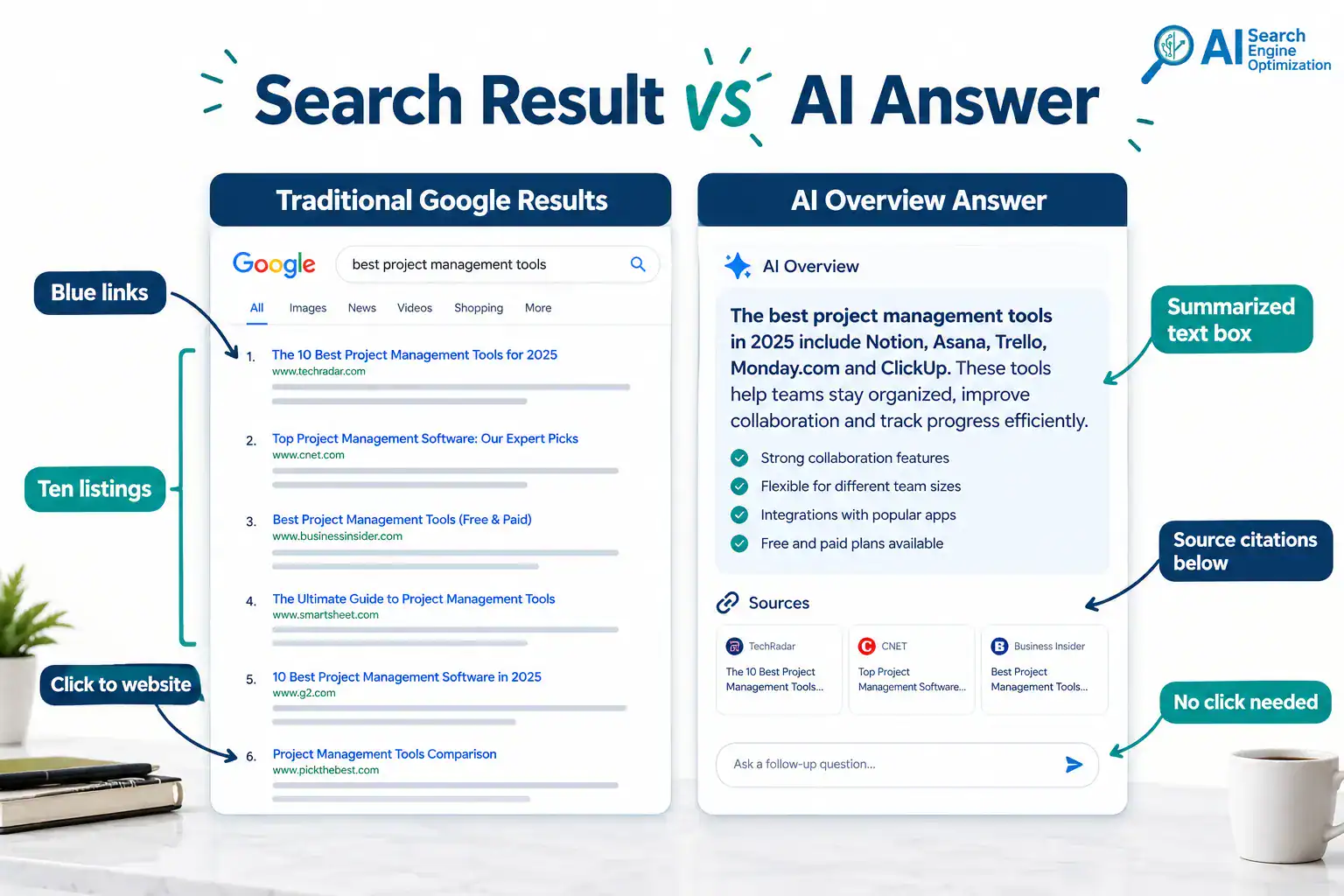
Ten years ago, SEO meant one thing: rank a page in the top ten blue links. Modern SEO still does that, but it also has to win a second race that did not exist before. When a buyer asks an AI engine "who should I hire for roof repair in Dallas," the engine does not list ten websites. It names one or two businesses and moves on.
That is the real shift behind the question "is seo dead." The mechanics of search engines understanding content, crawling websites, and ranking authority have not disappeared. What changed is where the buyer's attention lands. Here's what modern SEO covers now:
- Traditional organic rankings in Google and Bing
- Visibility inside Google's AI Overviews and AI Mode
- Citations inside ChatGPT, Perplexity, Gemini, and Copilot answers
- Local map pack and Google Business Profile optimization
- Entity recognition in Google's Knowledge Graph
Choose a full SEO strategy if you want to show up everywhere a buyer might look. Choose to ignore AI search optimization and you are betting your growth on the half of search that is shrinking.
How Much Has Organic Traffic Changed Since AI Summaries Started
Organic traffic patterns have shifted measurably since AI summaries scaled up in 2026, with AI Overviews now appearing on nearly three out of every four branded searches. That does not mean traffic vanished. It means some of it moved from clicks to citations.
Ahrefs analyzed 232.8 million U.S. desktop Google crawls between July and September 2026, including 92.5 million branded-keyword crawls [2]. AI Overviews appeared for 61.3% of branded keywords in July, 65.1% in August, and 73.3% in September [2]. That is close to a 20% increase in three months.
In a separate 100-brand panel, AI Overviews showed up on brand-name queries for 63 brands by September 30, compared with only 5 of 98 usable queries on July 1 [1][2]. Of those 63 appearances, 48 (76.2%) showed up in the first position, ahead of the brand's own website listing [1][2]. That is a real decline in guaranteed top-position clicks for businesses that used to own their own name in search results.
Should I Still Build Backlinks if Google's Using AI
Yes. Backlinks still matter because AI engines, including Google's own AI Overviews, rely on crawlable, trusted, authoritative sources to build their answers. A backlink gap is still a visibility gap, whether a buyer reads a search result or an AI answer.
AI systems do not invent facts from nothing. They pull from indexed, crawled, cited content across the web. Google's AI Overviews lean heavily on sources that already carry topical authority and backlink strength. Build authority the old way and the AI engines are more likely to cite you the new way.
A common mistake: businesses pause their backlink and off-site authority campaigns because they assume links don't matter to AI. That's backwards. The toxic backlink disavow process, the backlink gap analysis against ranking competitors, and ongoing authority building matter more now, not less, because AI engines reward the same trust signals Google always has.
Why Is My SEO Traffic Dropping With AI Answers Showing Up
Your traffic is likely dropping because an AI Overview or AI Mode answer is satisfying the buyer's question before they ever reach your website, especially on branded and informational searches. This is called a zero-click search, and it is the single biggest change in search behavior since mobile-first indexing.
Here is the mechanism. A buyer searches a question. Google or an AI engine generates a summarized answer right at the top of the results. The buyer reads it, gets what they need, and never clicks through. Your page can still rank number one and lose the visit.
This hits informational content the hardest. Service pages, local pages, and money pages built for conversion fare better because buyers still want to click through to call, book, or buy. If your traffic drop is concentrated on blog posts and FAQ pages, not core service pages, that is a strong sign zero-click search is the cause, not a technical SEO problem.
Does SEO Still Work for Ecommerce or Just Content Sites
SEO still works for ecommerce, local service businesses, and content sites alike, but the strategy differs by business type because buyer intent differs. Ecommerce SEO depends more on product schema markup, review signals, and comparison content; local and national service SEO depends more on entity clarity, Google Business Profile optimization, and the map pack.
B2B SEO and B2C SEO also split further apart in the AI era. B2B tech companies win AI citations with data-backed studies, named frameworks, and case studies the AI engines can quote directly. B2C and local businesses win with proximity, reviews, and profile strength. A roofing company and a SaaS platform should never run the same SEO strategy, even though both are optimizing for the same search engines.
| Business type | What drives AI visibility |
|---|---|
| Local service business | Google Business Profile, map pack, reviews, local pages |
| National B2B company | Original research, named frameworks, backlinks, topical authority |
| Ecommerce | Product schema, review volume, comparison content |
What Should I Focus on Instead of Traditional SEO Tactics
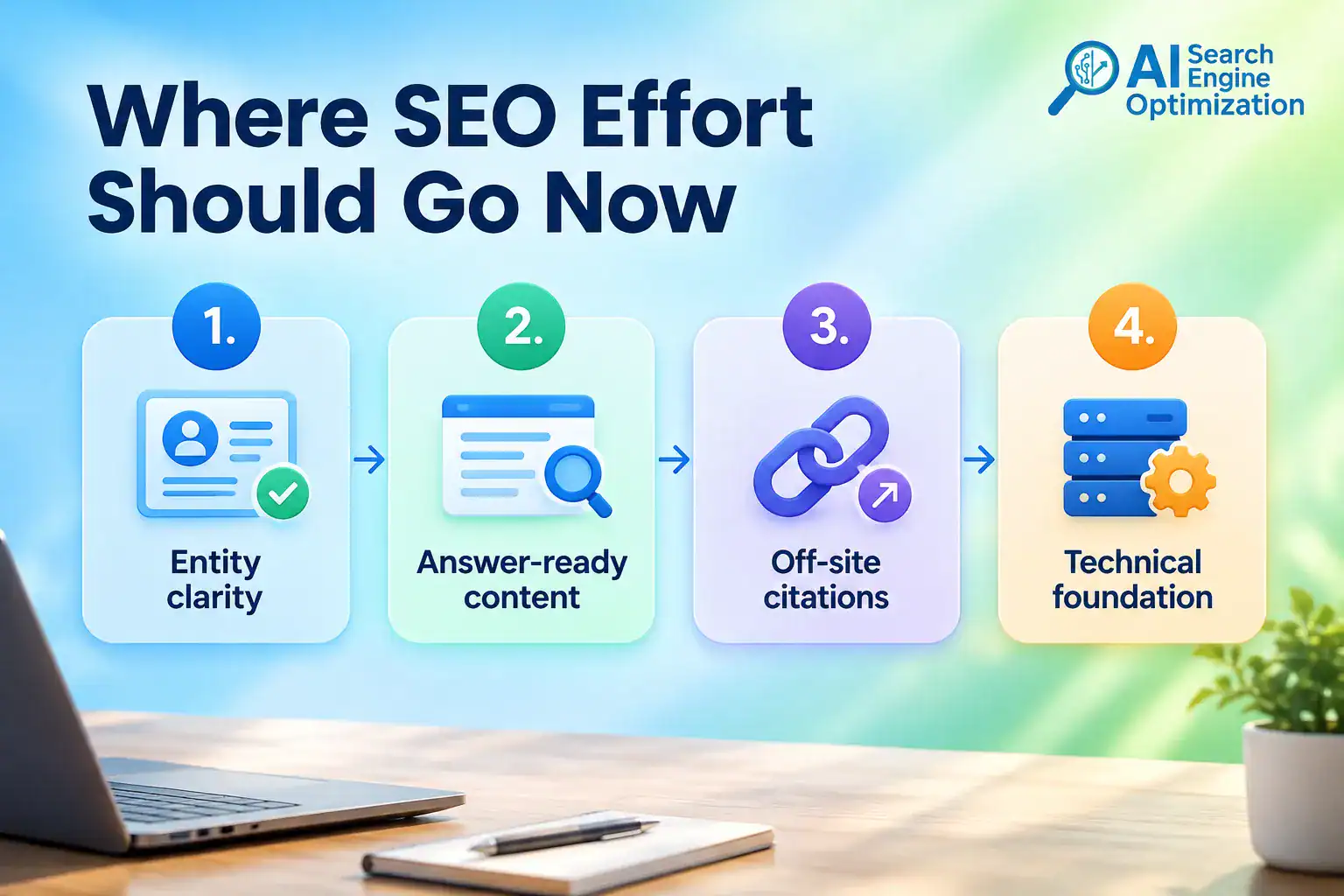
Focus on answer-ready content, entity clarity, and off-site citations rather than keyword stuffing and thin pages built only to rank. Traditional SEO tactics like exact-match anchor text and volume-based content farms produce less return in a search landscape where AI engines decide which single source to quote.
Five places to put your energy in 2026:
- Prioritize conversions, not just clicks. A page that ranks but doesn't convert is a wasted asset. Build pages for the buyer who is ready to hire, not just the browser.
- Use real data to drive decisions. Pull your own Search Console and analytics data before guessing at a fix. Daily ranking history tells you more than a monthly snapshot ever will.
- Build topical authority, not scattered posts. Ten connected articles under one pillar beat fifty unrelated blog posts every time.
- Fix technical SEO basics. Core Web Vitals, crawlability, and clean site structure remain the floor every AI and search engine stands on.
- Make your content quotable. Write standalone, specific passages an AI engine can lift and cite without losing meaning.
Are People Still Making Money from Organic Search in 2026
Yes, businesses with strong organic rankings and local map pack visibility are still converting real buyers into real revenue. Organic search traffic has not stopped producing business; it has become more selective about which businesses it rewards.
The businesses still winning share three traits: they rank in the top three organic positions or the map pack three-pack, they hold entity authority Google recognizes, and they build content that converts rather than just attracts clicks. SEO still works for these businesses because they treat SEO as a growth channel tied to revenue, not a vanity metric tied to rankings alone.
How Do I Rank When AI Is Summarizing Competitor Content
You rank, and get cited, by building content that goes further than whatever source the AI engine currently quotes. If a competitor's page is thin, generic, or missing data, your job is to publish the version that is specific, sourced, and impossible to summarize without crediting you.
AI engines favor content carrying a dated fact, a named framework, or first-party data nobody else has published. A generic "how to" article competes with a thousand others. An article with your own measured data point, a case study, or an original statistic becomes the source engines point back to instead of paraphrasing around.
What Data Proves SEO Is or Isn't Dead Right Now
The data shows SEO is not dead, but it is being redistributed across more surfaces. AI Overviews on branded searches nearly tripled in reach over three months in 2026 [1][2], yet businesses with strong backlink profiles, schema markup, and entity signals are the ones AI engines cite inside those very answers.
MIT Sloan Management Review's October 2026 research, based on interviews with 15 senior marketing leaders across financial services, SaaS, retail, media, higher education, and professional services, found three recurring problems: blind spots in AI-visibility measurement, inertia in old SEO workflows, and underestimating how fast AI can spread inaccurate brand information [4]. None of those findings say SEO is dead. They say most companies are measuring the wrong things.
Separately, a U.S. federal judge dismissed antitrust lawsuits against Google over AI Overviews in September 2026, while acknowledging publishers' traffic concerns and suggesting legislation, not antitrust law, may be the real remedy [3]. That ruling confirms AI-driven search is a permanent fixture, not a passing experiment regulators will unwind.
Can You Still Get Traffic from Google Organic Results With AI Overviews
Yes, Google organic results still send real traffic even with AI-driven search features like AI Overviews and AI Mode layered on top. Conversion-focused money pages, local service pages, and product pages still earn clicks because buyers ready to act want to visit the actual business, not just read a summary.
The traffic hit concentrates on informational queries where a short answer satisfies the buyer. Transactional and local searches, where the buyer wants to call, book, or compare options directly, still convert into website visits at healthy rates.
What's the Difference Between Featured Snippets and AI Answers
Featured snippets pull one short excerpt from a single ranking page and still link directly to that page above the fold. AI answers like Google's AI Overviews synthesize information from multiple sources into one generated summary, often citing several sources at once, and frequently appear above where featured snippets used to sit.
The practical difference for a business owner: a featured snippet was a single-source spotlight you could win outright. An AI answer is a shared stage where you might be one of three or four cited sources, or left out entirely if a competitor's content is more specific or better structured.
Are There Any Websites Where SEO Still Drives Real Results
Yes. Local service businesses that dominate their map pack, national companies that hold first-position rankings across a full keyword set, and businesses with strong entity authority in Google's Knowledge Graph are still winning real, measurable organic traffic and leads every month. Results like these are documented through dated case studies and tracked ranking windows, not guesses.
This is also where founder-led, measurement-driven SEO firms separate themselves. AI Search Engine Optimization, founded by Phil Belleville, who has ranked websites since 1995, runs on 31 years of ranking record and a proprietary AI-driven fulfillment system built to chase both halves of this job: first-position rankings in Google and counted citations in AI answers. The firm's own marketing sites hold the city-SEO rankings end to end in two top-40 U.S. cities, proof the method works in competitive markets, not just theory.
How Do I Optimize for AI Answers Instead of Just Google
You optimize for AI answers by building entity clarity, structured answer blocks, and off-site citations, on top of the technical SEO foundation that lets engines crawl and trust your site in the first place. This is generative engine optimization, sometimes called answer engine optimization, and it runs alongside traditional SEO, not instead of it.
Three concrete moves:
- Build a schema markup graph that declares exactly who your business is, what it does, and where it operates.
- Write FAQ and answer-block content that stands alone as a complete, quotable response to one specific question.
- Earn mentions on review platforms, industry sites, and knowledge entries the AI engines already pull from, since Wikipedia alone appeared in 71.9% of citation sets in one major brand study [2].
What's the Biggest SEO Mistake People Are Making Now
The biggest mistake is treating SEO as dead and pulling back investment entirely, right when the competition for AI citations is wide open. A close second is the opposite mistake: ignoring AI search optimization completely and betting everything on old-style keyword tactics that no longer move the needle alone.
Both mistakes come from an all-or-nothing read of the question "is seo dead." The right answer sits in the middle. Keep the technical SEO, backlink, and content fundamentals. Layer AI visibility work on top. Businesses that do both are the ones showing up named, cited, and clicked.
Comprehensive SEO Services to Drive Sustainable Growth
A business that wants to dominate its market needs local SEO, national SEO, and AI search optimization running together, not as separate vendors with separate goals. That is the gap most agencies leave open, and it is the gap AI Search Engine Optimization was built to close. Our AI SEO services run that combined engagement, with AI citation counting installed from day one.
The approach includes a keyword site map that assigns every term to one page, money pages built for Google, the searcher, the AI answer, and the buyer at once, entity work that makes a business recognizable to Google's Knowledge Graph, and an AI visibility audit that counts real citations instead of a vague readiness score. Full SEO audits, local SEO audits, GEO audits, and ranking drop diagnosis round out the toolbox, all run on direct access to ranking, backlink, keyword, and AI-answer data rather than guesswork.
FAQ
Does SEO even matter anymore?
Yes. SEO still matters because search engines and AI answer engines both rely on crawlable, authoritative, well-structured content to decide what to rank and what to cite. Businesses with strong SEO still earn organic traffic, map pack visibility, and AI citations that competitors without it simply do not get.
What is the 80/20 rule in SEO?
The 80/20 rule in SEO means roughly 80% of your organic traffic and rankings typically come from about 20% of your pages, usually your strongest money pages and pillar content. Focus optimization effort on that top 20% first, since it drives most of your real business results.
Is SEO paid or free?
SEO itself is free in the sense that you do not pay search engines for organic rankings, unlike paid ads. However, doing SEO well requires real investment in content, technical fixes, audits, and strategy, often through an SEO agency or in-house team, so it is never truly a zero-cost channel.
Are SEO jobs in demand?
Yes. SEO jobs remain in demand, and the skill set is expanding to include AI search optimization, entity SEO, and generative engine optimization alongside traditional technical SEO and content strategy. Businesses need people who understand both halves of modern search visibility.
Final Thoughts: Is SEO Dead? Not Even Close.
Is SEO dead? The data says no. AI Overviews nearly tripled their reach on branded searches between July and September 2026 [1][2], and that is exactly why SEO matters more, not less. The businesses getting named inside those answers are the ones that already built authority, structure, and trust the old-fashioned way.
Organic SEO dead talk makes for a good headline. It does not match what tracked rankings, counted AI citations, and real client results show every month. SEO today looks different than it did ten years ago, but the core job, being the business buyers find and choose, has not changed at all.
Ready to find out where your business stands against AI engines right now? Work directly with Phil Belleville and run a real AI visibility audit before your competitors get named instead of you.
References
- Google's AI Overviews roughly tripled on brand-name searches in September. MarketScale.
- AI Overviews on big-brand searches. Search Engine Journal.
- Google wins dismissal of Penske Media lawsuit over AI search snippets. The Hollywood Reporter.
- The new rules of brand visibility in AI search. MIT Sloan Management Review.
Continue your research
AI SEO vs Traditional SEO: where the two disciplines overlap and where they split.
AI Answer Benchmark, September 2026: one week of tracked answers, every question and every named firm published.
Discuss what this means for your business
Our proprietary Rank Intelligence Engine connects 25 specialized analysis and implementation capabilities with commercial judgment, content, and WordPress implementation. Phil Belleville has worked in SEO since 1995 and brings that experience to the priorities and decisions behind the work.
Explore our AI SEO services to see the service behind this business perspective.
30 minutes with Phil. Written scope and pricing before paid work begins.