AI SEO for Startups:
Get Cited Before You’re Famous

Last updated: November 1, 2026
Quick answer
AI SEO for startups makes your company the one AI answer engines name when a buyer describes the problem you solve and asks what to use. Startup buyers (developers, ops leads, founders) research with ChatGPT, Gemini, Perplexity, and Google AI Overviews before they ever visit a pricing page. We build the evidence engines check: product and use-case pages, comparison content, documentation, reviews, and structured data. So your startup is the cited answer, measured monthly against sign-ups and demo requests.
Key takeaways
- AI answers are the one channel where a startup out-cites an incumbent without outspending it: evidence, not fame, wins.
- A professional firm on this program grew statewide top-three organic terms from 1 to 11, measured across all of California.
- Your Google Business Profile, G2 and Capterra reviews, Crunchbase record and industry directory listings should tell the same story as your site; we make sure they do.
- Citation counts in our published records climbed at least threefold between July and October 2026; the proof you already have sets the pace.
- The work is installed on your existing WordPress site, you own every asset, and written scope and pricing come before any paid work begins.
As seen in

Why startups can win AI answers before they win the market
AI answers are the one channel where a startup beats an incumbent without outspending it. The engine does not weigh ad budgets or brand fame; it weighs evidence. Documentation, comparisons, reviews, consistent identity. A startup that builds that layer deliberately gets cited next to companies a hundred times its size.
The window is open now because most incumbents have not done the work. Their pages answer marketing questions; the engine needs buyer questions. The startup that answers ‘what does it cost,’ ‘how does it compare,’ and ‘who is it for’ in verifiable form becomes the citation the incumbent cannot displace.
Documented results from this kind of work
The proof below comes from a special education law firm serving families across California, earning first-page positions measured statewide, against every competitor in the state. A startup and a statewide specialty firm face the same problem: no brand recognition, winning purely on verifiable evidence against established names. The measured outcome:
| Signal | Starting point | Latest reading |
|---|---|---|
| Organic terms in the top three, measured statewide | 1 (Sep 17–23, 2025) | 11 (Aug 27–Sep 2, 2026) |
| …of those, terms at #1 | n/a | 6 |
| Organic terms in the top ten | 6 | 20 of 26 |
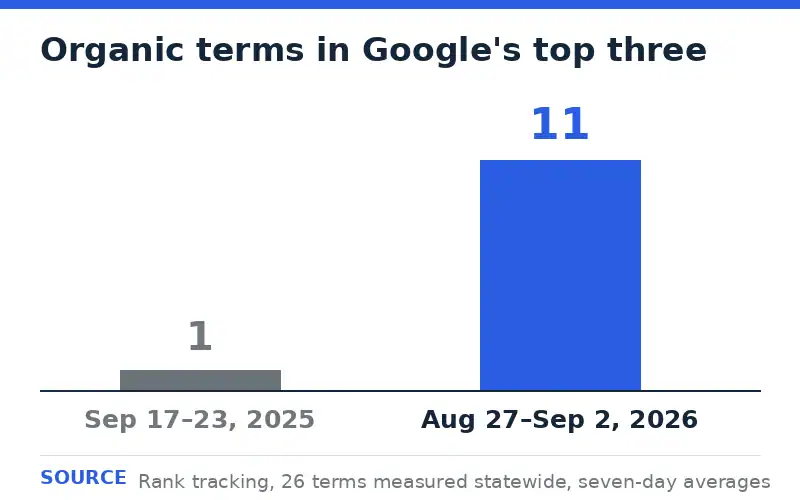
For a startup, the same evidence-first discipline is how a company with no brand can outrank incumbents in AI answers, which lean on evidence more than on fame. Seven-day averages; 26 terms measured statewide across California. Figures are published on our case studies page.
The research conversation your buyers have with AI
Buyers research with AI for weeks before they contact anyone. Each answer shapes who makes the shortlist, and who never gets quoted.
| What buyers ask AI | What the answer draws on |
|---|---|
| best tool for [the problem you solve] | Use-case pages, G2/Capterra reviews, comparison content |
| [your category] pricing | Pricing content the AI can quote |
| [you] vs [the incumbent] | Honest comparison pages on your site |
| how to solve [problem] without [old way] | Educational content, then your product |
| is [your product] worth it | Review sentiment, documentation depth, case evidence |
How AI engines decide which startup to recommend
Pitch decks and launch-day buzz fade fast in an AI answer. AI engines draw on the public record of your product: your Google Business Profile, G2, Capterra, and Product Hunt reviews, Crunchbase and LinkedIn company records, industry directories, editorial mentions, and the structured data on your own site. They answer at the service level: “best tool for [the problem you solve]” and “[your category] pricing” pull from different evidence.
For startups, comparison and documentation evidence carries the weight: honest competitor-comparison pages and real documentation give the engine something it can cite, and citations compound into the answer buyers repeat.
What an AI SEO engagement for a startup includes
The work runs on your existing WordPress site and your existing reputation. Most established startups need correction and connection, not a rebuild. An engagement covers:
- An entity audit of the listings, directories, and reviews that shape how AI answers describe a startup
- Service pages rebuilt answer-first, one per line of work:
- use-case and solution pages
- competitor-comparison pages
- documentation and integration content
- pricing transparency
- Product and organization schema with pricing and category details, machine-readable
- Listing and citation cleanup across your Google Business Profile, G2, Capterra, and Product Hunt reviews, Crunchbase and LinkedIn company records, industry directories, and editorial mentions
- A review-signal program, and monthly AI-answer monitoring tied to sign-ups and demo requests, not vanity dashboards
Our AI SEO services are installed directly on your site, and you own every asset we build. This page is part of our AI SEO for Professional Services program. This starts from an AI visibility audit of every source the engines check for startups.
The first 90 days for a startup
Days 1–30: we audit every source AI engines check for a startup (GBP, G2 and Capterra profiles, Crunchbase, Product Hunt, editorial mentions) and fix the contradictions. Days 31–60: your use-case, comparison, documentation, and pricing pages are rebuilt answer-first with product and organization schema. Days 61–90: citation monitoring goes live across the major AI platforms, and you see the first movement report tied to sign-ups and demo requests, measured against the day-one baseline. For startups, the Days 1–30 audit also covers the internal link audit most sites skip.
How long before the citations reflect it
What our published records show: citation counts that rose threefold to sixfold from July 1 to October 13, 2026, and ranking jumps inside five-week windows. Software buyers shortlist early, so the product that is visible during their research is the one that gets the trial. See our AI SEO progress timeline for the month-by-month rollout we measure against.
No agency can guarantee what a specific AI model will say. We commit to evidence you can verify, measured from a baseline set on day one.
Who this is not for
This is not for startups that are not on WordPress, buyers shopping content by volume, or anyone expecting a guaranteed AI mention. For startups whose buyers research in AI tools, which is every software and service buyer, this is the highest-leverage visibility work available to a young company right now. If you are still comparing agencies for startups, our guide on how to choose an SEO agency for AI search lists the questions to ask before signing a retainer.
Related guides
- AI SEO for Small Businesses: Be the Name AI Gives: the sister program in this series.
- Keyword mapping: why one search, one page, no exceptions comes before any content gets written.
- AI SEO automation: which SEO tasks AI can automate, and which still need a person.
- AI search visibility metrics: the metric definitions behind every movement report.
Own the research phase
30 minutes with Phil. Written scope and pricing before paid work begins.
FAQ
We already do content marketing. What does AI SEO add? Content marketing feeds the blog; AI SEO builds the evidence layer that makes engines cite you: comparison pages, documentation, review velocity, and structured data. The content you already have becomes far more valuable once it is consistent and specific enough to quote.
Can a startup really out-cite an established competitor? Often, yes. AI answers lean on specific, checkable evidence more than on brand fame. The program builds comparison pages, documentation, and review momentum deliberately, so the engine has more checkable reasons to name you than the incumbent’s marketing pages give it.
We are pre-revenue. Is this too early? The evidence compounds, so earlier is cheaper: every month of citations earned before launch is a month the incumbent cannot take back. The call is free, and we will tell you honestly if the timing is wrong for your stage.
How do we know whether it is working? Three numbers, tracked monthly from a day-one baseline: how often AI engines name your startup for the queries that matter, referral visits from AI platforms in your analytics, and sign-ups and demo requests attributed to those visits. You receive the evidence behind every figure, the same standard we apply to our own published results.