AI Content Optimization · Business perspective
Your Homepage Is the Page AI Reads First
85 of 109 Fetches, and the Six Facts It Looked For
Homepage AI search optimization means writing your homepage so the six facts an AI engine needs are stated in plain text, near the top, instead of buried in a slider or a slogan. Between September 19 and October 18, 2026, our own crawler log showed ChatGPT's live browsing agent fetching our homepage 85 times out of 109 total requests. The page gets read constantly. Whether it gets quoted depends entirely on what it says.
Key Takeaways
- From September 19 to October 18, 2026, ChatGPT's live browsing agent made 109 requests to our site, and 85 landed on the homepage.
- Googlebot made 120 requests in the same window; its top content page was also the homepage, at 12 fetches, followed by the local services page at 10.
- Applebot made 59 requests, favoring the local services page (6) over the homepage (4).
- Six facts decide whether an AI engine can quote a homepage: business type, services, location, buyer goal, proof, and contact method.
- A homepage read 85 times but quoted zero times is the single clearest sign the copy is hiding those six facts.
- Homepage SEO 2026 is less about keyword stuffing and more about stating facts an engine can lift as a standalone sentence.
- A homepage mistake that costs visibility: letting a hero slider or video carry the business description instead of plain text.
- You do not need to choose between Google and AI engines; the same six facts and the same clean structure help both.
As seen in

Why Do Search Engines Prioritize Crawling Your Homepage First
Search engines and AI agents crawl the homepage first because it is the entry point every link, sitemap, and citation chain points back to. It is the page with the most internal links pointing at it, which tells a crawler this is the center of the site.
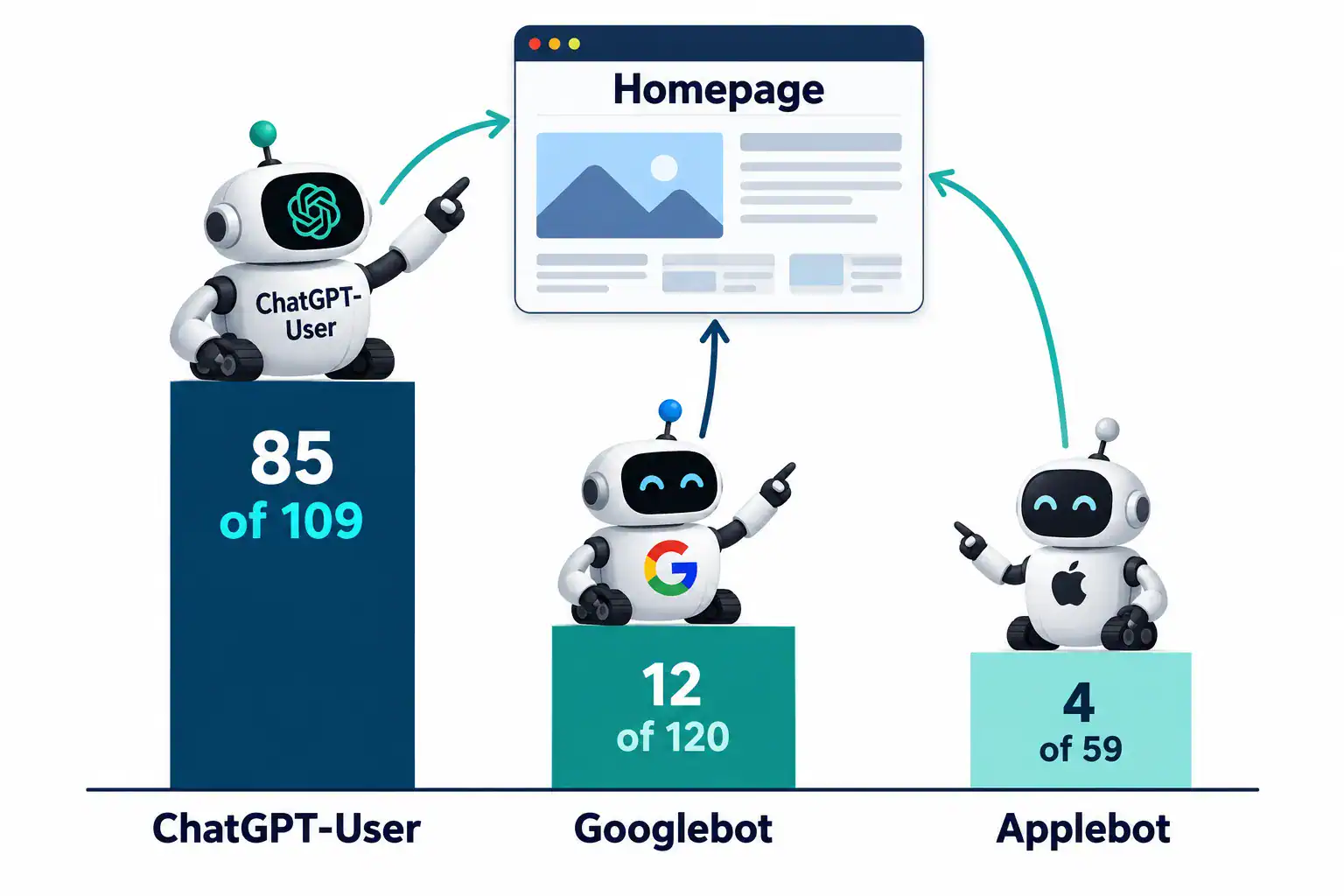
Our own log backs this up twice over. Googlebot's single most-fetched content page across the 30 days from September 19 to October 18, 2026 was the homepage, at 12 fetches. ChatGPT's browsing agent went further: 85 of its 109 fetches, in that same window, landed on the homepage. No other page came close; a benchmark blog post got 9, and our AI content optimization service page got 4.
That pattern matches what independent research on AI crawling has found. Our own crawler log shows the homepage is the first hop reached in the large majority of AI browsing runs, and it leads AI referral traffic too, though not by a landslide majority. The takeaway for an owner: your homepage is the front door every engine walks through before it decides whether to trust the rest of the house.
What Are the Six Facts That AI Looks For on a Homepage
An AI engine scanning a homepage is checking for six specific facts, and it either finds them in plain text or it does not quote the page at all. We pulled this list from 105 tracked buyer-question answers across six engine modes, stored between October 4 and October 16, 2026.
The six facts are:
- What kind of business it is. A plumbing company, a law firm, a dental clinic, stated as a sentence, not implied by a logo.
- Which services it offers. A short list an engine can repeat back to a buyer who asks "who does X near me."
- Where it is and where it serves. A city, a region, a service radius, stated in text, not only in a map embed.
- Which goal it serves for the buyer. What problem does this business solve, in the buyer's words.
- Proof. Dated, measured results, reviews, or credentials an engine can cite as evidence.
- How to contact or book. A phone number, a form, or a booking link stated plainly.
A homepage that states all six, near the top, in sentences rather than slogans, is the page an engine can quote directly. A homepage that buries them under a rotating image slider, a vague tagline, or a wall of stock photography gets fetched the same 85 times and quoted zero times. The research matches this: measured LLM-visibility work shows engines read and reuse pages whose key facts sit in plain text far more readily than pages that rely on visual branding alone [1].
How to Optimize Your Homepage for Search Engine Crawlers
Optimizing your homepage for crawlers means making the six facts readable without JavaScript, images, or guesswork, and backing them with structured data that matches the visible text word for word.
Use this checklist, adapted from the standard we apply to our own money pages:
- Put the business type and main service in the page title, the H1, and the first sentence of visible text.
- Add one sentence near the top stating why this business is the one to trust for the service, a credential, a year founded, or a measured result.
- Add complete structured data (schema markup) that mirrors the visible text exactly, never adding a claim the page does not make.
- Write a meta title and meta description built for the click, not just for keyword count.
- State the six facts in sentences an engine can lift on their own, without needing the paragraph before or after.
Two months of measured LLM traffic on a working site found the major AI crawlers are generally served the full page, not a stripped-down version [2], and current agent-readiness guidance treats full server-rendered content as the baseline [3]. The technical barrier is mostly gone. The content barrier is not.
Does Homepage Content Directly Affect Your SEO Rankings
Yes, homepage content affects rankings because Google and AI engines both use it to confirm what the business is and whether the rest of the site backs that claim up. A homepage that states the service and location clearly helps every inner page inherit that context.
That said, the homepage is not the only page that matters. Deep agent sessions keep going after the first hop: in our log, most fetches after the homepage land on deeper pages. Our own log shows the same split by bot: Applebot favored our local services page over the homepage. This means the homepage sets the frame, and inner pages carry the weight of proving each specific service or city claim. If your site architecture sends every service to its own clearly labeled page, the homepage's job gets easier: state the six facts, then link out.
What Information Should Be on Your Homepage for AI to Find
The information an AI engine needs to find is the same six facts listed above, placed where a crawler does not have to scroll or render a script to find them: business type, services, location, buyer goal, proof, and contact.
Beyond the six facts, add:
- A short "why us" sentence near the top, stating a specific differentiator rather than a generic claim.
- Dated proof: a year, a measured result, or a client outcome described by what the client does and where.
- A clear path to every service page, so the homepage does not try to explain everything itself.
If your homepage and your keyword map disagree about which page owns which term, the homepage ends up vague because it is trying to cover terms that belong on service pages. Assign the six facts to the homepage and the specifics to inner pages.
Common Homepage Mistakes That Hurt Search Visibility
The most common mistake is replacing plain text with a slogan, a slider, or a video and assuming the message still gets through. It does not, because crawlers read text, not vibes.
Other frequent mistakes:
- Hiding the service list inside a dropdown menu with no supporting text on the page.
- Stating the city only inside an embedded map, with no text mention of the service area.
- Skipping proof entirely, leaving an engine with nothing to cite when a buyer asks "why should I pick them."
- Letting two pages compete for the same homepage term, a problem covered in depth in our piece on keyword cannibalization.
- Writing a meta description that describes the company's mission instead of what a searcher will click to find.
How Often Do Search Bots Recrawl Your Homepage
Recrawl frequency depends on the bot and the site's update pace, but our own 30-day log, from September 19 to October 18, 2026, shows daily-level activity: Googlebot made 120 total requests, Applebot 59, and ChatGPT's browsing agent 109, with the homepage the top target for two of the three.

There is no fixed universal schedule. A site that updates its homepage content regularly and keeps it technically clean tends to get recrawled more often than a static page nobody touches. The practical rule: treat the homepage like a page worth refreshing with current proof points, not a page you write once and forget.
Can a Great Homepage Make Up for Weak Inner Pages
No. A strong homepage earns the first fetch, but an AI engine or a buyer that clicks through to a thin service page or an outdated location page will abandon the business just as fast as if the homepage had failed.
The homepage and the inner pages do different jobs. The homepage states the six facts and builds trust in one glance. The inner pages prove each specific claim: the actual service, the actual city, the actual case. A full SEO audit usually finds the homepage is fine and the service pages are the weak link, or the reverse. Fix both, in the right order.
What Homepage Structure Works Best for Search Engines
The structure that works best places the business type and primary service in the H1, follows it with a short trust sentence, then states services, location, proof, and contact in that order, each in its own labeled section rather than one dense paragraph.
Choose this structure if your homepage currently opens with a slogan and no sentence describing the business. Replace the slogan with a direct first sentence, and move the slogan below it as a supporting line, not the lead.
How to Check if Google Is Actually Crawling Your Homepage
Check your site's indexing report to confirm Google has fetched and indexed the homepage, and watch for a "crawled, not indexed" status, which means Google read the page but chose not to include it, usually because the content looked thin or duplicate.
A homepage that gets crawled constantly but never indexed is a warning sign worth escalating into a full diagnosis, the kind covered in a full site architecture audit, rather than guessed at.
Does Homepage Load Speed Impact SEO and Rankings
Yes, load speed is a measured ranking factor, and a slow homepage also risks timing out an AI agent's fetch before it reads the six facts at all.
Keep the homepage lean: compress images, avoid unnecessary scripts above the fold, and make sure the six facts load in the first render rather than waiting on a slider animation to finish.
What Meta Tags and Structured Data Should Your Homepage Have
A homepage needs a meta title carrying the main keyword, a meta description written to earn the click, and complete structured data (schema markup) that matches the visible page text exactly, including the business type, address, and services.
Mismatched schema, where the structured data claims something the visible page does not say, is a common and avoidable mistake. Every schema field should describe something a visitor can also read on the page.
Does Homepage Design Matter for Search Engine Optimization
Design matters for conversion and trust, but it only helps SEO when the design does not hide the six facts behind images, animation, or decorative text. A homepage can look polished and still fail an AI engine if the words a crawler needs are nowhere in the HTML.
Research on AI tool landing pages found persuasive copy and clear structure outperform decorative design for both conversion and machine readability. Good design and good homepage AI search optimization are not in conflict; they just require writing the facts before styling them.
What Happens When Search Engines Can't Properly Crawl Your Homepage
When a homepage cannot be properly crawled, because of blocked scripts, broken rendering, or content that only appears after a user interaction, engines either skip it or index an incomplete version, which cuts the business out of both search rankings and AI citations.
Published readiness checks keep finding rendering problems that keep AI agents from reading key homepage content at all [3], even though full-page access is the norm [2]. The safest move is to verify, not assume, which is also the standard we apply to our own clients' work through E-E-A-T and entity checks before anything is called finished.
Conclusion
Your homepage already gets the traffic. The crawler log proves it: 85 of 109 ChatGPT fetches, 12 of Googlebot's top content hits, both in the 30 days ending October 18, 2026. The only open question is whether your homepage gives those fetches anything worth quoting.
State the six facts in plain text near the top: business type, services, location, buyer goal, proof, and contact. Match your structured data to the visible words. Write the meta title and description for the click. That is the whole job, and it is a writing job before it is a technical one.
If you want a second opinion on whether your homepage already does this, our team's approach to AI content optimization starts with exactly this kind of fact-by-fact read. The next step is a conversation, not a form: book a call with Phil and find out what your own homepage is actually saying to the engines reading it right now.
FAQ
What is homepage AI search optimization?
It is writing and structuring a homepage so AI engines can find and quote the six facts a buyer question needs: business type, services, location, goal, proof, and contact.
What should a homepage say for AI to quote it?
It should state plainly what the business does, where it operates, what problem it solves, what proof backs it up, and how to reach it, all in sentences an engine can lift on their own.
Why is my homepage read often but never cited by AI engines?
The facts an engine needs are likely hidden in a slider, a slogan, or an image instead of stated as plain text near the top of the page.
Does a strong homepage replace the need for good service pages?
No. The homepage earns trust and the first click; inner pages must back up each specific claim with detail, or visitors leave anyway.
How often should I update my homepage for AI and Google?
Update it whenever a fact changes, a new service launches, or new proof becomes available. A static, outdated homepage gets crawled less and trusted less.
Does homepage design hurt SEO?
Design itself does not hurt SEO, but design that hides text facts behind images or animation does.
References
- Making your site visible to LLMs: 6 techniques that work, 8 that don't. Martian Chronicles.
- Which AI actually reads your site? Two months of LLM traffic, measured. Martian Chronicles.
- Making your catalog discoverable to AI agents. Vercel.
Continue your research
How to Check AI Visibility: the 20-minute method that shows what the homepage earns.
AI Visibility Audit: the measured read on every page, not just the homepage.
Discuss what this means for your business
Our proprietary Rank Intelligence Engine connects 25 specialized analysis and implementation capabilities with commercial judgment, content, and WordPress implementation. Phil Belleville has worked in SEO since 1995 and brings that experience to the priorities and decisions behind the work.
Explore our AI content optimization services to see the service behind this business perspective.
30 minutes with Phil. Written scope and pricing before paid work begins.
Found this useful? Add us to your Google Preferred Sources and our next guide will find you first.
Add us as a Google Preferred Source