AI Visibility Audit & AI SEO Audit · Business perspective
How to Check AI Visibility
A 20-Minute Method With a Denominator
To check AI visibility for your business, write 15 to 20 real buyer questions, run them across ChatGPT, Google AI Overviews, AI Mode, Gemini, and Copilot, count how many answers name your business, and report it as a dated fraction: mentions over the answers you read. When our September 2026 benchmark ran this method, the same buyer question was answered with agency names on ChatGPT and with a table of software tools on AI Mode, which is why every platform is checked on its own. A single test on one engine is not a measurement. A tracked rate, repeated monthly, is.
This check is written for owners and in-house marketers who want a number they can defend without buying a tool first. All it takes is a spreadsheet, a logged-out browser and 20 minutes. If you came here to audit an AI system your own company runs, that is a different job: the NIST AI Risk Management Framework covers how to measure and monitor an AI system’s performance, reliability and transparency.
Key Takeaways
- The check takes about 20 minutes: 15 to 20 buyer questions, four or five AI platforms, one tally sheet, and one fraction at the end.
- Write the questions the way your buyers ask them, without your business name in them. A branded question only tells you the AI has heard of you.
- Run every question on each AI platform separately and record the date and location, because answers change by platform and by city.
- Count what came back before you count mentions: how many questions you ran, how many returned an answer, and how many of those you read.
- Report the result as a dated fraction, “7 of 18 answers, November 5, 2026”, never as a bare percentage.
- Repeat the same questions on a schedule. A single run is a snapshot; the rate only means something once it has a previous value.
- An AI visibility checker or the first-party reports from Google and Bing can automate parts of the check, but none of them shows the exact answer your buyer read [2][3][4].
- For what AI visibility is and why the denominator matters, see our definition of AI visibility; this page is the hands-on test.
As seen in

Before You Start: Set Up the Tally Sheet
The whole check runs off one sheet, and setting it up first is what keeps the result honest. You are recording, for every question on every AI platform, whether the answer named your business, linked your website, or recommended you. Each row shows whether your brand appears in AI search results for that question, and the sheet as a whole shows your brand’s presence across the AI platforms your buyers use. What those three counts mean, and why they are kept apart, is covered in our measurement model for AI visibility.
Use a spreadsheet with one row per question per platform and these columns:
| Column | What you write |
|---|---|
| Date and location | The day you ran it and the city the AI answered for |
| Platform | ChatGPT, ChatGPT with web search, AI Overviews, AI Mode, Gemini, Perplexity, Copilot or Claude |
| Question | The exact wording, unchanged from month to month |
| Answer collected / AI answer appeared | Yes or no for each; some runs fail and some searches show no AI answer |
| Named / cited / recommended | Yes or no for each |
| Competitors named | Every business the answer named instead of, or as well as, you |
| Sources cited | The websites the answer linked, so you can see where the AI is reading |
The 20-Minute AI Visibility Check, Step by Step
This is the same method we run for clients and for our own published benchmark, scaled down to something an owner can do in one sitting. Our September 2026 benchmark used it at full size: 26 questions asked on six AI platforms over one week [1].
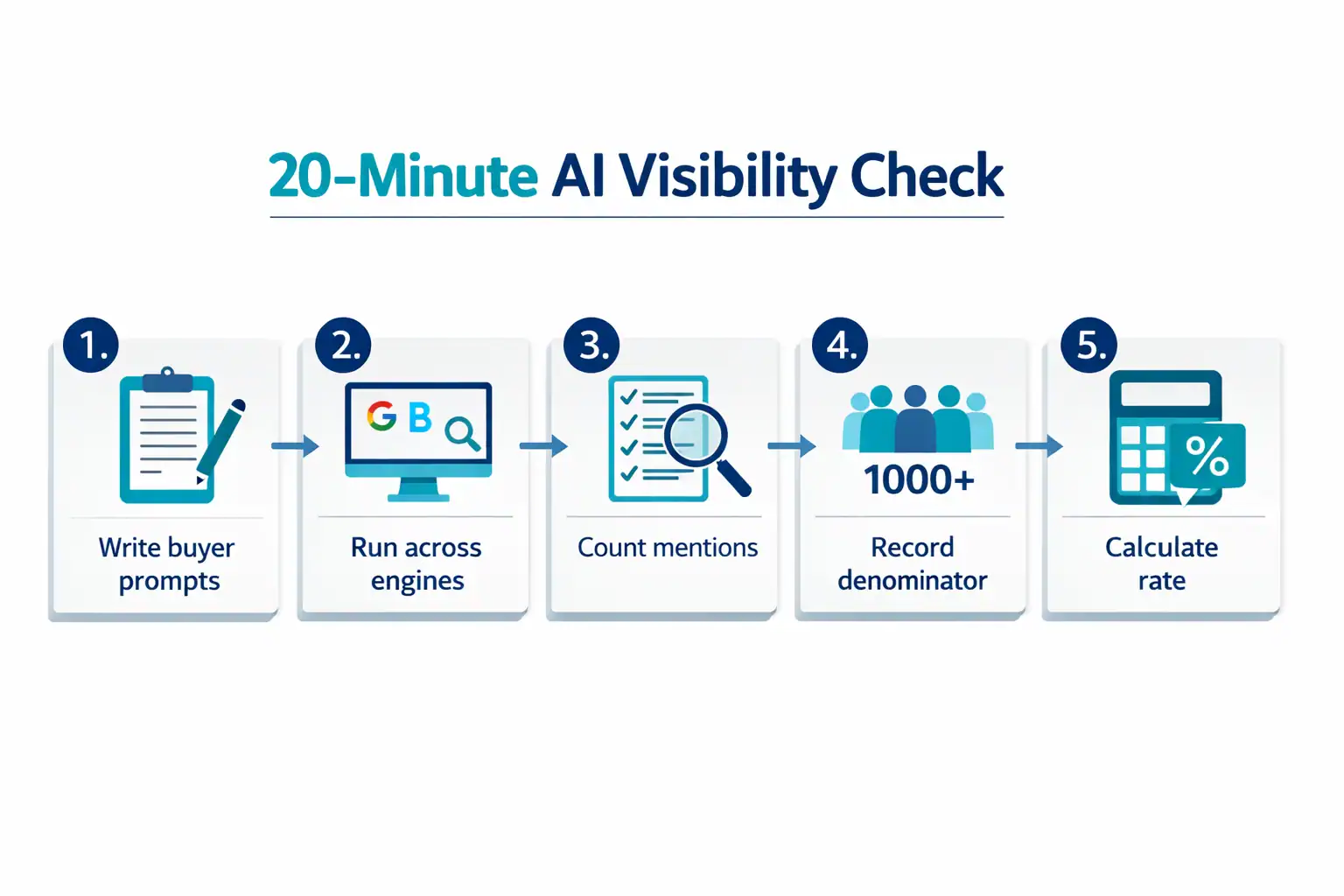
- Minutes 0 to 5: write 15 to 20 buyer questions. Use the real questions your customers ask, in their words: “best [service] in [city]”, “who should I hire for [problem]”, “[service] near me”, “is [service] worth it for [situation]”. Add three to five research questions your pages should be the source for, such as “how do I [task your service solves]”. The benchmark split 16 buyer questions and 10 research questions [1].
- Minutes 5 to 7: open the AI platforms in a clean session. Use a logged-out or fresh chat where you can, set the location you serve, and note it on the sheet. Answers are localized: in the benchmark one question localized to three different cities on successive attempts [1].
- Minutes 7 to 15: run every question once on each platform. Copy the AI responses or screenshot them, then mark the yes-or-no columns: collected, AI answer appeared, named, cited, recommended. List every competitor named and every source cited.
- Minutes 15 to 18: count what came back first. At the top of the sheet, write how many questions you ran, how many returned an answer you could read, and, for Google, how many searches showed an AI answer at all. Then count mentions, citations and recommendations for each platform.
- Minutes 18 to 20: calculate and date the result. Divide mentions by answers analyzed, per platform and overall, and write the fraction with the date and location. That fraction is an AI visibility score calculated honestly, from answers you can show. Note the three competitors named most often and the sources cited most often.
That fraction is your baseline. A one time snapshot shows where you stand today; the next run, same questions, same platforms, same location, is what turns it into a measurement of whether your brand visibility is improving.
Which AI Platforms to Include in the Check
At minimum, check ChatGPT, Google AI Overviews, AI Mode and Google Gemini, the AI assistants most buyers use. Add Copilot if your buyers research vendors at work, and Perplexity or Claude if they lean on cited, research-style answers. Run each one separately: popular LLMs such as ChatGPT, Claude, Gemini and Perplexity draw on different AI models and sources, so they do not answer the same question the same way.
| Platform | Answers in our September 2026 benchmark week (401 in all) | What to watch for in your own check |
|---|---|---|
| ChatGPT | 79 | Named agencies outright for a buyer question [1] |
| ChatGPT with web search | 79 | Record the cited sources; they show which sites it read |
| Google AI Mode | 71 | Answered the same buyer question with a table of software tools [1] |
| AI Overviews | 67 | Does not appear for every search; record whether it triggered |
| Bing Copilot | 53 | Also answered with software tools; matters for B2B buyers [1] |
| Gemini | 52 | Switched on mid-week in the benchmark, so fewer answers [1] |
| Perplexity | Not in that run | Citation-heavy; log every source it links |
Decision rule: if your buyers are consumers searching casually, prioritize ChatGPT and Google AI Overviews. If your buyers are other businesses researching vendors, add Copilot and Perplexity to the mix.
A Worked Example: Turning the Sheet Into a Dated Fraction
Say you planned 20 questions on one platform and 18 came back with an answer you could read. Your business was named in 7 of them, cited in 2, and recommended in 1. The sheet’s top line reads: 20 planned, 18 collected, 18 analyzed, AI answer shown in 15 of the Google searches.
The result you write down is “named in 7 of 18 answers, cited in 2, recommended in 1, ChatGPT, Phoenix, November 5, 2026”. That line can be checked by anyone who reruns your questions. “39% AI visibility” cannot, because it hides how many answers it came from, which platform, which city and which day.
How to Read Your Tally Sheet
Read the sheet as an action plan: the pattern tells you what is missing and where to look next. Use the cited-sources and competitors columns to spot gaps, not just the mention count.
| What the sheet shows | What it usually means | What to check next |
|---|---|---|
| Not named on any platform | Thin entity signals and little third-party coverage | The sources the answers cited: review sites, directories, best-of lists |
| Named on one platform, absent on others | Each platform reads different sources | Compare the cited-sources column platform by platform |
| Named but never cited | The AI knows the name but cites other sites, not your own domain, as its source | Whether the cited pages answer the question more directly than yours |
| Competitors named instead | They are stronger on the sources these questions draw on | The competitors’ cited pages and listings |
| Named with wrong details | Conflicting business facts across the web | Your Google Business Profile, directory listings and schema markup |
This is where AI visibility work overlaps traditional SEO and answer engine optimization, which works on your brand’s authority across the web as much as on your own pages: the fixes are entity signals, structured data, pages AI models can quote, and making sure AI crawlers can reach the pages you want cited. A low count is a diagnosis, not a dead end. Wrong details deserve the fastest fix, because a buyer who calls an old number blames you, not the AI: check your Google Business Profile first, then the name, address and phone number on every directory you can find.
How Often to Run the Check
Run the full check monthly at minimum, and again after any major AI platform update or any drop in inbound leads you cannot otherwise explain. Track the same questions, on the same platforms, from the same location every time, or the comparison breaks: what you want to see is whether you are mentioned more often than last month.
- Monthly works for most established service businesses tracking steady buyer questions.
- Weekly makes sense while you are actively working on visibility and want to see whether new citations, press, or schema changes are moving the count.
- After a visible platform update, an extra run is worth it, because mention patterns can shift quickly.
Keep every past sheet. The month-to-month line is the measurement; any single sheet is just a reading.
Common Mistakes When Checking AI Visibility
The most common mistake is running one question, on one platform, once, and treating the result as a fact about the business. The benchmark shows why that fails: in a single week the platforms returned between 52 and 79 answers each, because runs fail and platforms come online at different times [1]. That is why you divide by the answers you read, not by the questions you planned.
- Testing only branded questions. “Tell me about [my business]” does not test visibility. Non-branded buyer questions do, because that is what buyers who have not heard of you ask.
- Confusing mention with citation. Brand mentions are not citations: being mentioned in the text is not the same as having your website linked as the source.
- Dropping the denominator. “We show up 60% of the time” with no record of questions, platforms or dates cannot be checked.
- Changing the questions between runs. New wording makes the month-to-month comparison meaningless.
- Ignoring location. A “near me” answer for one city says nothing about another.
- Trusting a single score. Even a good AI visibility score from a tool is a starting signal, not the measurement, unless you can see the answers behind it [2].
Decision rule: run each buyer question at least three times per platform before you trust its rate. One run tells you almost nothing.
Free AI Visibility Checkers and Automated Tracking
Search for a free AI visibility checker and you will find plenty. A good free tool tells you within seconds whether you appear in AI search for a handful of prompts, which makes it a useful quick free check before you run the full sheet. Treat its score as a starting signal, not a verdict: a single free score can hide platform-level gaps, and the free report rarely includes the questions and answers behind it, so ask what the full report includes before you trust the number [2].
For first-party data straight from the platforms:
- Google’s Search Generative AI performance reports, rolled out fully to all websites by August 31, 2026, show generative-AI impressions, pages, countries, devices, and dates for AI Overviews and AI Mode [3].
- Microsoft’s Bing Webmaster Tools AI Performance report, in public preview since February 2026 and expanded through June with Intents, Topics, Citation Share, and Compare features, reports citations, cited pages, and sampled grounding queries [4].
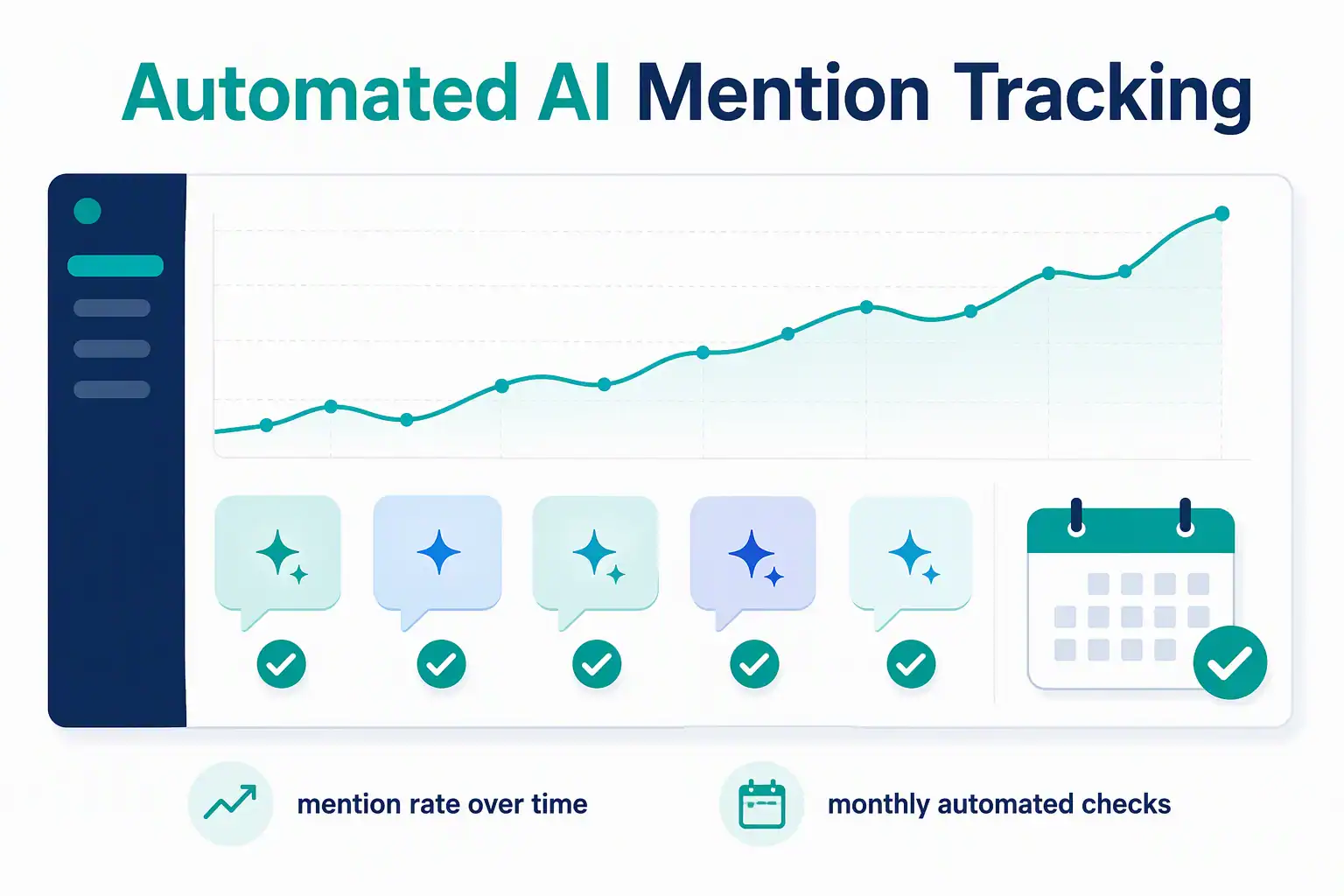
Dedicated tracking tools run the same questions on a schedule, analyze your AI share of voice against competitors, and keep the dated history a manual sheet builds slowly. When you want this run as a measured program instead of a monthly manual check, our AI visibility audit sets the baseline and the tracking cadence.
Decision rule: use a free checker for a quick pulse. Use the Google and Bing reports for the ongoing record of your own site, and the 20-minute sheet for the one thing neither shows: the answer your buyer actually read.
Does the 20-Minute Check Work for Small Businesses?
Yes. The check scales down well for a small service business, because the work is writing good questions and reading answers carefully, not running enterprise data pulls. A single-location business can run 15 questions across four platforms, about 60 answers, inside the 20 minutes.
Decision rule: if you run one location, 15 questions is plenty. If you serve several cities, run 15 to 20 questions per city, because “near me” answers change with location.
FAQ
How long does an AI visibility check take?
About 20 minutes for 15 to 20 questions across four or five AI platforms: five minutes to write the questions, ten to run them and mark the sheet, and five to count the denominator and calculate the dated fraction.
How many questions should I test?
Fifteen to twenty buyer questions for a single location, plus three to five research questions your pages should be cited for. For several cities, run that set per city, because answers to “near me” questions change with location.
Which AI platforms should I check?
ChatGPT, Gemini, AI Overviews and AI Mode at minimum, plus Copilot and Perplexity if your buyers use them. Run each separately: in our September 2026 benchmark the same buyer question got agency names on ChatGPT and software tools on AI Mode [1].
Should I include my business name in the questions?
No. Use the non-branded questions buyers ask before they know you, such as “best [service] in [city]”. A branded question only confirms the AI has heard of you; it does not show whether the AI would recommend you.
How do I calculate my AI visibility rate?
Divide the answers that named your business by the answers you read, per platform and overall, and write it as a dated fraction, such as “7 of 18 answers, November 5, 2026”. Note separately how often Google showed an AI answer at all.
How often should I run the check?
Monthly at minimum, with the same questions, platforms and location each time, and again after a major platform update or an unexplained drop in leads. Weekly runs make sense while you are actively working on visibility.
Is a free AI visibility checker enough?
It is a useful first look, not the measurement. A single free score can hide platform-level gaps and rarely shows the questions and answers behind it, so pair it with your own dated sheet or a tracked program [2].
What should I do if AI names my competitors instead?
Read the sheet’s cited-sources column for those answers. It shows where the AI found the competitors: review sites, directories, best-of lists or their own pages. Those sources, plus clear entity signals on your site, are where the work starts.
Conclusion
Checking AI visibility is not complicated, but it does require a discipline most owners skip: real buyer questions, more than one AI platform, and the denominator recorded beside every mention count.
Start this week. Write 15 to 20 questions your buyers would ask. Run them across ChatGPT, Gemini, AI Overviews and AI Mode. Count the mentions, write the dated fraction, and keep the sheet. Repeat next month and watch whether the number moves.
If the number is low, or your competitors keep getting named instead, that is a diagnosis, not a dead end. It usually points to a gap you can fix: weak entity signals, thin off-site coverage, or content that does not give AI engines a reason to quote your site instead of someone else’s. The sheet becomes the brief for a content strategy built for AI generated answers, and for the AI content optimization of the pages it points to.
If you would rather see this done by someone who has run search visibility work since 1995, across Google rankings and AI answers alike, book a call with Phil Belleville at AI Search Engine Optimization. We will show you, from a real test, exactly which competitors the AI engines are naming instead of you, before you spend a dollar on fixing it.
References
- AI Answer Benchmark: who the AI engines actually name. AI Search Engine Optimization.
- Your AI visibility score may be hiding a problem. MarTech.
- Introducing Search Generative AI performance reports in Search Console. Google Search Central.
- Introducing AI Performance in Bing Webmaster Tools (Public Preview). Bing Webmaster Blog.
Continue your research
AI Search Visibility Metrics: The KPIs a Report Should Show: the definitions behind the denominator this method counts against.
What an AI Search Audit Should Deliver: what a full audit adds on top of the 20-minute check.
Discuss what this means for your business
Our proprietary Rank Intelligence Engine connects 25 specialized analysis and implementation capabilities with commercial judgment, content, and WordPress implementation. Phil Belleville has worked in SEO since 1995 and brings that experience to the priorities and decisions behind the work.
Explore our AI visibility audit to see the service behind this business perspective.
30 minutes with Phil. Written scope and pricing before paid work begins.