AI SEO Services · Business perspective
AI SEO Strategy for an Established Business
What to Build, in What Order, and What to Measure
An ai seo strategy for an established business means building foundational SEO first, then layering entity clarity, structured data, and answer-ready content so Google, ChatGPT, Perplexity, Gemini, and Copilot can find, trust, and quote you. Build order matters: crawlability and site health first, entity and schema second, content and citations last. Google's own guidance confirms SEO still drives AI visibility because AI Overviews and AI Mode retrieve answers from the same search index.
Key Takeaways
- An ai seo strategy is not a separate discipline from SEO; AI Overviews and AI Mode pull from Google's existing search index through retrieval and query fan-out [1].
- Google's October 2026 update expanded source links in AI Search, and use of Preferred Sources grew more than 7x since the start of 2026, rewarding recognizable publishers [2].
- Tactics like llms.txt files, special AI markup, and forced content chunking do not give special ranking advantage in Google Search [1].
- AI Overviews appeared on 39.4% of U.S. desktop Google searches as of June 2026, so most established businesses are already affected [5].
- A completed Google spam update (through October 8, 2026) makes October ranking comparisons noisy; don't panic over short-term swings [6].
- The EU AI Act's transparency rules, active since August 2, 2026, require labeling of certain AI-generated content for businesses serving EU audiences [4].
- Non-commodity content, first-hand data, proprietary research, and expert judgment, earns more citations than generic articles [1].
- Measure both branded and non-branded AI prompts, roughly 20% branded and 80% non-branded, to see whether you're actually recommended.
As seen in

What Actually Is AI SEO Strategy and How Does It Work
An ai seo strategy is the set of decisions an established business makes about how its website, content, and data get read, trusted, and quoted by AI search tools and Google itself. It is not a new form of search engine optimization; it is an extension of search engine optimization into AI answer surfaces.
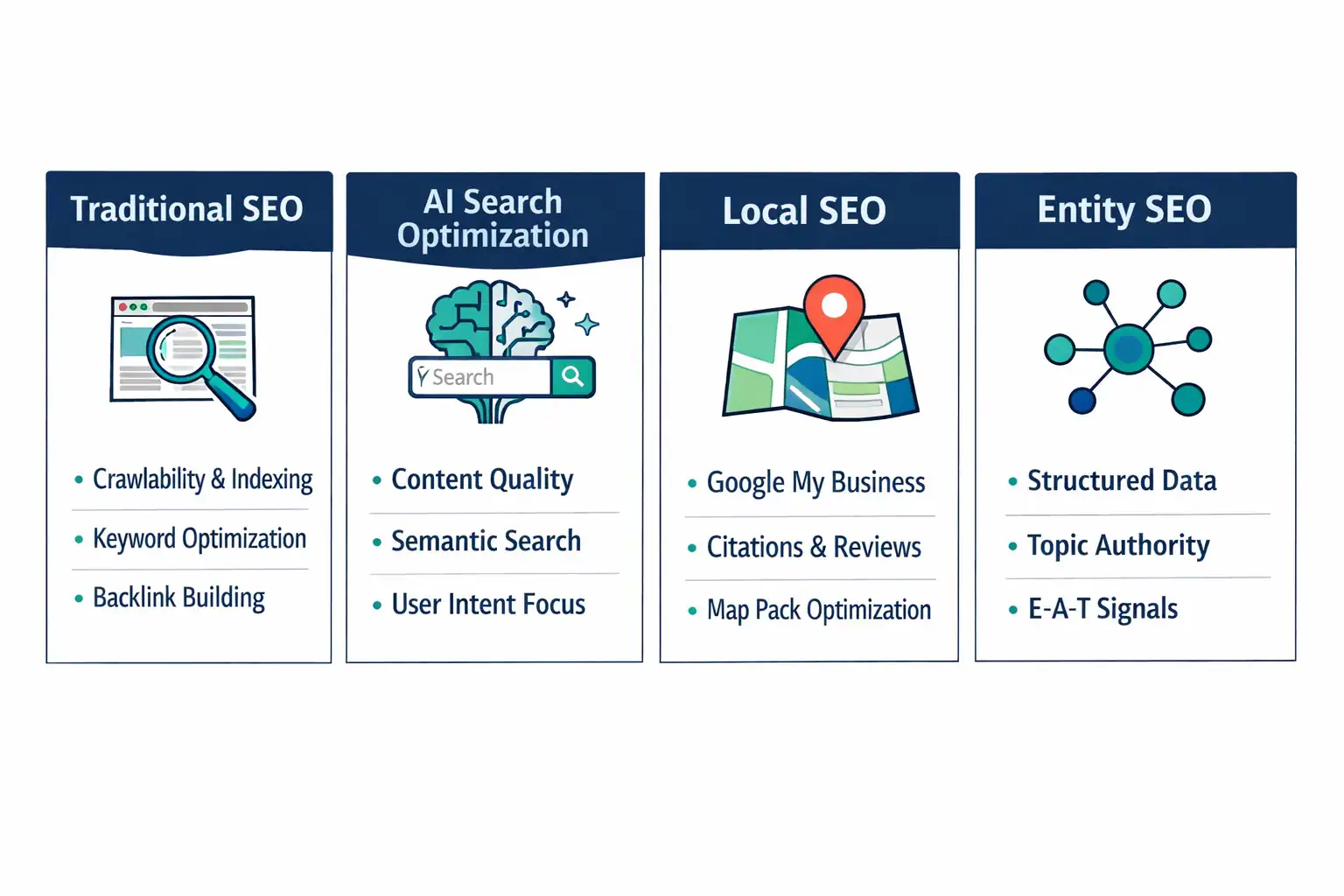
Here's how it works in practice. When someone types a question into Google AI Mode, ChatGPT, Perplexity, Gemini, or Copilot, the system runs what Google calls query fan-out: it breaks one question into several related searches, retrieves pages from the search index, and assembles an answer from what it finds [1]. That means the pages winning in AI answers are, in nearly every case, pages that were already crawlable, indexed, and well-structured for traditional search.
For an established business, this changes the stakes but not the fundamentals. You already have a website. You already have content. Your ai seo strategy should audit what you have, fix what's broken, and then build the layers, entity clarity, structured data, answer blocks, that make your existing authority easy for AI engines to find and quote. That is the same build order we run inside our AI SEO services engagements: measure what exists, fix what is broken, then build the AI layers.
Decision rule: if your site already ranks well in Google organic results, start your ai seo strategy with an AI visibility audit rather than a rebuild. If your site struggles with basic indexing or page experience, fix that first, before worrying about AI citations at all.
How Is AI SEO Different From Traditional SEO
AI SEO and traditional SEO share the same technical foundation, but AI SEO adds a layer focused on being quoted by name rather than just ranked on a results page. Traditional SEO wins clicks; AI SEO optimization wins mentions, sometimes without a click at all.
Traditional search engine optimization measures success through rankings, impressions, and click-through rate in Google search results. AI search optimization, sometimes labeled generative engine optimization (GEO) or answer engine optimization (AEO), measures success through how often your business is named inside an AI-generated answer [1]. Google itself treats GEO and AEO as alternate labels for work that already falls under SEO rather than a separate field [1].
The practical differences:
- Source links now matter more visibly. Google's October 15, 2026 update added more inline links placed higher in AI answers, dedicated sections for official websites, and tested clickable creator and publisher profiles [2]. That means being named is only half the job; being linked matters too.
- Third-party authority counts more. Industry analysis distinguishes GEO from SEO by noting GEO also depends on reputable media coverage, review sites, forums, and comparison publishers, not just your own site.
- Non-commodity content wins. Google places the greatest weight on original research, first-hand experience, and expert judgment when deciding what to cite in AI answers [1].
Common mistake: treating AI SEO as a totally separate budget line from your existing SEO program. Google's guidance is explicit that there's no special schema or markup required for AI Overviews beyond what already earns rich results [3].
What Should an Established Business Build First for AI SEO
Build foundational SEO first: crawlability, indexation, mobile page experience, and internal linking. Google's own strategic guidance says pages must be crawlable, indexable, snippet-eligible, and well-structured before they can even be considered as supporting sources in AI features [3].
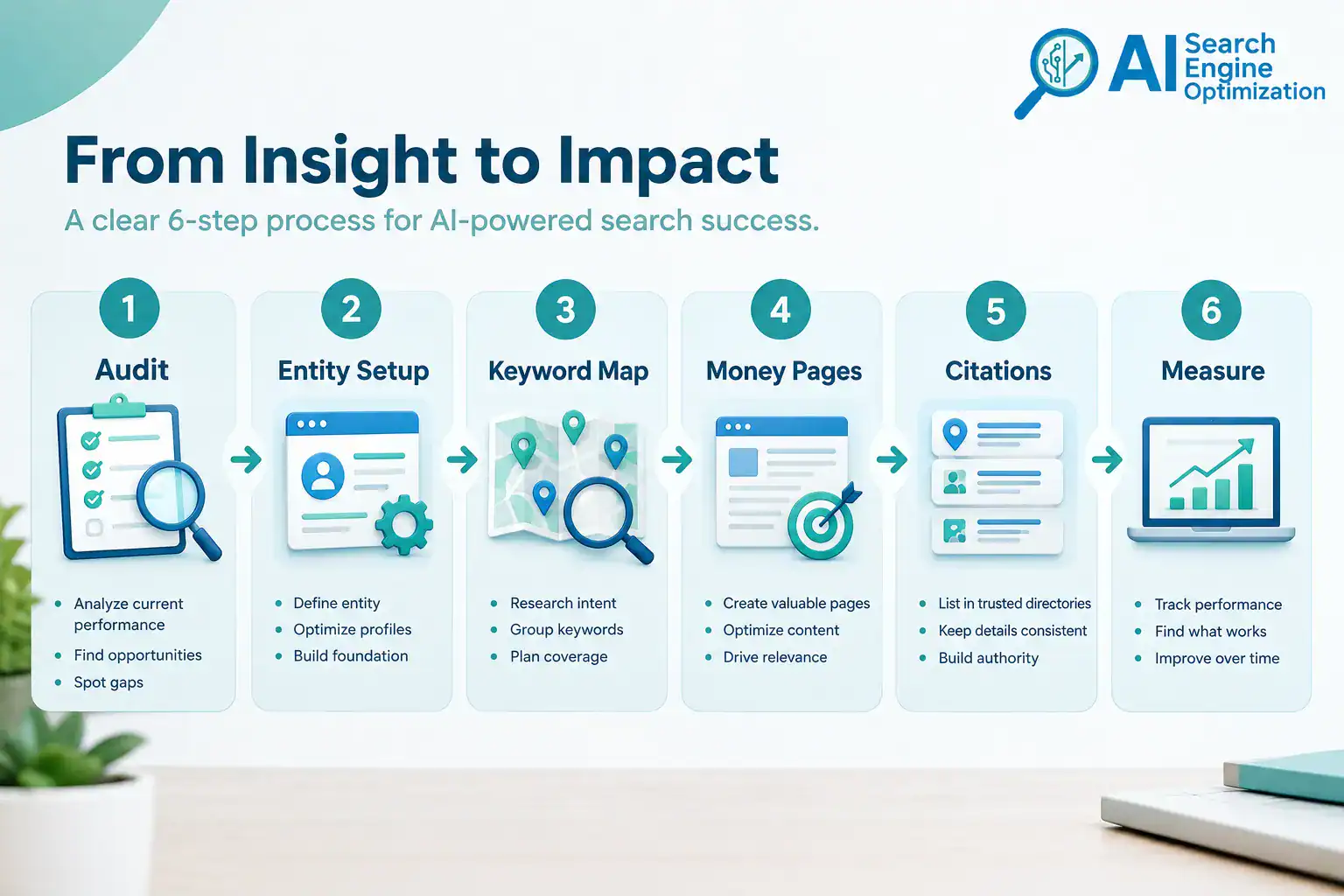
Here is the build order we recommend, drawn from running this exact sequence across local and national engagements:
- Technical and content audit. Full SEO audit across your site, checking technical health, on-page content, authority signals, and AI search readiness together, scored against competitors that already rank [1].
- Entity clarity. A verified record of who your business is, its services, locations, credentials, and founder background, anchored on About and press pages so Google and AI engines can confirm it.
- Structured data that matches visible content. Schema markup should mirror exactly what's on the page. Mismatched schema is a known trust problem, and Google's guidance says markup helps ordinary rich-result eligibility, not a special AI boost [1].
- Keyword site map and money pages. Every term assigned to one page, so your site stops competing with itself, then money pages built to beat whoever already ranks.
- Answer-ready supporting content. Standalone passages, FAQs, and data-backed articles built to be lifted and quoted.
- Off-site citations. Presence on review platforms, industry press, and best-of lists that AI engines pull from.
Example: a regional law firm with strong organic rankings but zero AI Mode mentions should start at step 2 (entity clarity) and step 6 (off-site citations), skipping straight past the audit since their technical SEO is already sound.
How Much Do AI SEO Tools Actually Cost
AI SEO tools themselves, rank trackers, AI-visibility trackers, crawler-log analytics, backlink databases, typically run from free tiers to several hundred dollars a month per platform, but tool subscriptions are the smallest part of real cost. The larger cost is the labor and judgment needed to turn tool data into installed, verified changes on your site.
Most agencies and in-house SEO teams stack multiple data platforms: rank tracking, backlink intelligence, on-page content scoring, AI-answer visibility tracking, and server log analytics. Several of these platforms bill by usage, so actual monthly spend varies by site size and query volume. Free AI SEO tools exist, mostly basic AI-prompt testers and limited rank checkers, but they rarely cover crawler-log verification or AI citation counting at scale.
For an established business, the real investment question isn't "what does the software cost," it's "what does it cost to have someone write, install, verify, and measure the resulting pages." That's where agency fees or in-house salary replace tool subscriptions as the dominant cost.
Decision rule: if you're spending more on tool subscriptions than on the people executing changes from that data, you're buying dashboards instead of results.
Why Isn't Our AI SEO Improving Our Rankings
If your ai seo strategy isn't moving rankings, the most common cause is measurement noise, not a failed strategy. A completed Google spam update (through October 8, 2026, after roughly a 13-day rollout) makes month-over-month comparisons unreliable right now [6].
Beyond timing noise, there are a few recurring causes worth checking:
- Keyword cannibalization. Multiple pages on your own site competing for the same term, diagnosed only through daily rank-tracking data showing which page actually holds the position day to day.
- Content that merely matches, rather than exceeds, what already ranks. Google rewards pages offering superior value, not pages that restate what's already indexed [1].
- Structured data that doesn't match the visible page. This breaks trust signals Google and AI engines both check [1].
- No off-site citations. If no independent source mentions your business, AI engines have nothing external to confirm your authority against.
- Crawler access problems. If Google, Bing, or AI crawlers can't read a page, it cannot appear in results no matter how well written it is.
Edge case: some pages rank well in organic Google search results but never appear in AI Overviews. This usually means the page ranks for the query but isn't structured as a standalone, quotable answer. Rewriting the first paragraph as a direct, self-contained answer often fixes this without any other change.
What Metrics Matter Most for Measuring AI SEO Success
The metrics that matter for ai seo strategy are counted AI citations, map pack position, first-position and top-three organic rankings, and crawler-log confirmation that AI engines are actually reading your pages. Readiness scores and visibility indexes are not useful because they can rise without any buyer ever seeing your business named.
Here's what to track and why each one matters:
| Metric | What it tells you | Source of truth |
|---|---|---|
| AI citation count | How often you're named by AI engines, per platform, per question | AI-answer visibility tracker |
| Map pack position | Whether you appear in the visible three local results | Local rank tracker |
| Top-three organic position | Whether you rank where buyers actually click | Rank tracker with daily history |
| Crawler visits | Whether Google, Bing, and AI crawlers are reading new pages | Server log analytics |
| Click-through rate on ranked pages | Whether rankings translate into visits | Search Console data |
Google reported AI Overviews on 39.4% of U.S. desktop searches as of June 2026 [5], and separately noted brand-name AI Overview appearances roughly tripled in September [5]. That's a reminder: track branded and non-branded AI prompts separately. One recommended split is about 20% branded prompts and 80% non-branded prompts, so you see both how AI engines describe your own business and whether they recommend you during category research.
Common mistake: reporting average position across hundreds of keywords. A buyer never sees an average; they see the map pack's three spots or the first page of results. Measure what a buyer would actually notice.
Best AI SEO Tools for Large Established Businesses
For an established business, the best AI SEO toolkit combines a rank tracker with daily history, an AI-answer visibility tracker, a server-side crawler-log analyzer, and a backlink intelligence platform, used together rather than individually. No single tool covers all four jobs well.
What each tool category needs to do:
- Rank tracking must show per-keyword daily history and map-pack classification, not just weekly snapshots.
- AI visibility tracking must submit real buyer questions to Google AI Mode, ChatGPT, Perplexity, Gemini, and Copilot, and record which sources get cited.
- Crawler-log analytics must distinguish human visitors from search crawlers and AI agents, and timestamp the first visit to any new page.
- On-page content scoring must analyze the actual ranking field for a target term, not just count keyword density.
Google's own October 2026 guidance is useful here too: it flatly states llms.txt files and special AI markup provide no advantage in Google Search [1], so any tool marketed around those tactics is selling a solution to a problem Google says doesn't exist. Choose tools that measure real outcomes, counted citations, dated rankings, confirmed crawler visits, over tools that produce a synthetic "AI readiness score."
Is AI SEO Worth It if We Already Rank Well
Yes, AI SEO is worth pursuing even for businesses that already rank well in traditional Google search results, because ranking well organically does not guarantee being named in AI Overviews, AI Mode, or chatbot answers. These are measured separately and can diverge.
Consider the math: AI Overviews now appear on a sizable share of desktop searches [5], and Google's October 2026 update is pushing even more visible source links into those answers [2]. A business ranking first organically but never cited in the AI answer above that result is losing visibility exactly where buyers are increasingly looking first. Preferred Sources usage growing more than 7x since the start of 2026 suggests Google is also rewarding publishers who establish clear identity and authority, not just ranking pages [2].
Decision rule: if you already rank well and want to confirm whether it's worth the added investment, run a real test first. Submit the actual questions your buyers ask to the AI engines and see who gets named. If competitors show up instead of you, that's your answer.
What Are the Biggest Mistakes Companies Make With AI SEO
The biggest mistake companies make with AI SEO is chasing tactics Google has explicitly said don't work, instead of fixing foundational SEO and content quality. Google's own October 2026 guidance names several of these tactics directly [1].
Common mistakes:
- Installing llms.txt files expecting a ranking boost. Google says this provides no special advantage [1].
- Rewriting content for exact long-tail keyword phrases instead of writing content that actually answers the underlying question [1].
- Buying artificial web mentions to manufacture AI citations. Google treats these as ineffective [1].
- Publishing AI-generated content without fact-checking. Google's October 1, 2026 publishing guidance specifically calls for manual fact-checking before publication, extending even to titles, meta descriptions, and image alt text [6].
- Ignoring content provenance requirements for EU audiences. The EU AI Act's transparency obligations, active since August 2, 2026, require labeling for certain AI-generated or manipulated content [4].
- Measuring success with vanity scores instead of counted citations and dated rankings.
Example: a national retailer that mass-produced AI-written product descriptions without manual review risked both a trust problem with buyers and a compliance gap under EU transparency rules if any of that content touched EU markets [4] [6].
How Long Does It Take to See Results From AI SEO Implementation
Most established businesses see measurable movement in AI citations and rankings within three to six months of a properly sequenced ai seo strategy, though foundational technical fixes can show crawler-confirmed changes within weeks. Full topical authority and consistent AI citation presence typically take longer, often six to twelve months.
The timeline depends on what's being built:
- Technical fixes (crawlability, indexation, schema accuracy): days to a few weeks, confirmed by crawler logs showing the first engine visit to a corrected page.
- Entity and structured data work: a few weeks to install, but recognition by Google's Knowledge Graph can lag behind the install itself.
- Money pages and supporting content: weeks to write and install, but competitive ranking movement depends on how established competitors already are.
- Off-site citation placement: often the slowest layer, since it depends on third-party publishers and review platforms picking up the business.
Common mistake: expecting AI citation gains at the same speed as a single-page technical fix. Entity recognition and off-site authority compound slowly and need sustained content strategy, not a one-time push.
Should We Hire an Agency or Build AI SEO In House
Hire an agency if your in-house team lacks direct access to AI-visibility tracking, crawler-log analytics, and backlink intelligence platforms, or if nobody internally can install and verify changes on your live site. Build in house only if you already have dedicated SEO staff with those tools and the time to execute consistently.
The honest comparison:
- In-house pros: institutional knowledge of your business, faster internal approvals, no vendor cost.
- In-house cons: most internal marketing teams lack access to AI-answer visibility trackers, server-log crawler analytics, and the time to run full technical SEO audits alongside AI citation work.
- Agency pros: direct data access across multiple platforms, dedicated execution lanes that write, install, and verify changes, and measurement built from dated rankings rather than guesses.
- Agency cons: cost, and the need to vet whether an agency's SEO strategy is actually grounded in current Google guidance rather than outdated tactics.
Decision rule: if your team can already produce a monthly report built from daily rank-tracking data, crawler-log confirmation of AI crawler visits, and counted AI citations, keep it in house. If that report doesn't exist today, an agency will likely get you there faster.
How Do We Integrate AI SEO With Our Existing Content Strategy
Integrate AI SEO into your content strategy by auditing existing content for non-commodity value first, then building new content only where gaps exist against what already ranks and gets cited. Google weighs original research, first-hand experience, and expert judgment above generic topical coverage [1].
Practical integration steps:
- Map every existing page to a single target term so new content never competes with an existing page, closing the keyword cannibalization problem before it starts.
- Identify your non-commodity assets, proprietary data, customer case studies, expert staff, original research, and feature them ahead of generic blog posts [1].
- Build answer blocks inside existing high-traffic pages rather than always creating new pages.
- Refresh cited pages substantively, not by date-bumping, to stay inside the freshness window AI engines favor.
- Coordinate with any offshore or in-house writers using the same keyword map, so content strategy and SEO strategy never drift apart.
Example: a manufacturer with years of technical documentation already has non-commodity content sitting unused. Converting existing spec sheets and support answers into structured, quotable FAQ content often produces faster AI citation gains than commissioning new articles from scratch.
What's the Actual Return on Investment for AI SEO Tools
The actual return on investment for AI SEO tools comes from buyers who choose your business because they found or were told about you, not from the tools themselves. Tools only produce ROI when paired with execution that installs and verifies changes on your live site.
To estimate ROI, start with numbers you already know: the lifetime value of a typical client and roughly how many buyers in your market search monthly for what you sell. Your ai seo strategy's value is the difference in how much of that search demand you capture with the work versus without it, multiplied by client lifetime value.
What inflates apparent ROI without delivering it: visibility indexes, readiness scores, and average-position reporting that moves without a single buyer noticing. What proves real ROI: counted AI citations on the exact questions your buyers ask, map-pack position measured over dated windows, and organic rankings confirmed with daily tracking data.
Decision rule: before paying for any tool or service, ask for a real test showing which competitors AI engines currently name instead of you, on your buyers' actual questions. That test alone tells you whether there's a gap worth paying to close.
Frequently Asked Questions
What is the 30% rule of AI?
There is no single official "30% rule of AI" tied to Google's search guidance. The figure sometimes circulated in marketing content is not confirmed in Google's current AI optimization documentation [1]. Treat any specific percentage rule you encounter with caution unless it traces to a named, dated source.
Is there an AI that can do SEO?
AI tools can assist with keyword research, content drafts, and data analysis, but Google's guidance says AI-generated content still needs manual fact-checking before publication, including titles and meta descriptions [6]. No AI tool fully replaces human judgment, verified installation, and measurement of real site changes.
What is the 80/20 rule in SEO?
In practice, one useful 80/20 framing is measurement design: roughly 20% branded AI prompts and 80% non-branded prompts, so you see both how AI engines describe your business and whether they recommend you during actual category research. This isn't a universal law, but a practical testing ratio.
What are the top 5 SEO strategies?
Top strategies for an established business are: fix crawlability and indexation first, build entity clarity and accurate structured data, create money pages that beat the current ranking field, earn off-site citations from reputable third parties, and measure with counted rankings and AI citations rather than vanity scores [1].
Conclusion
An established business doesn't need a brand-new discipline to compete in AI search. It needs foundational SEO done right, then entity clarity, accurate schema, and answer-ready content layered on top, measured with counted citations and dated rankings instead of synthetic scores.
Start by testing what AI engines say about you today, on the exact questions your buyers ask. Then fix crawlability and indexation, confirm your entity is correctly represented, build or rewrite money pages against the pages currently winning, and get off-site citations from sources the engines already trust. Track AI citations and map-pack position the same way you'd track revenue: counted, dated, and checkable.
If you want a clear read on where you stand before spending another dollar on content or tools, run the real test first: see which competitors AI engines are naming instead of you, on your buyers' actual questions, then build the ai seo strategy that closes that exact gap.
References
- AI optimization guide. Google Search Central.
- More ways to connect with the web from Search. blog.google.
- AI features and your website. Google Search Central.
- The EU Artificial Intelligence Act. artificialintelligenceact.eu.
- Google's AI Overviews roughly tripled on brand-name searches in September. MarketScale.
- Search recap: October 16, 2026. Search Engine Roundtable.
Continue your research
How Long Does SEO Take? Eight Dated Records, Week by Week: the week-by-week windows this build order produces, with dated records.
AI SEO Investment and ROI: What Progress Should Mean: what the spend buys and how the return is measured.
Discuss what this means for your business
Our proprietary Rank Intelligence Engine connects 25 specialized analysis and implementation capabilities with commercial judgment, content, and WordPress implementation. Phil Belleville has worked in SEO since 1995 and brings that experience to the priorities and decisions behind the work.
Explore our AI SEO services to see the service behind this business perspective.
30 minutes with Phil. Written scope and pricing before paid work begins.
Found this useful? Add us to your Google Preferred Sources and our next guide will find you first.
Add us as a Google Preferred Source