AI SEO for SaaS Companies:
Get Recommended by AI
Last updated: October 21, 2026
Quick answer
AI SEO for SaaS companies makes your product the one AI answer engines name when a buyer asks which tool to shortlist. By category, by use case, by integration. B2B buyers now run their entire software research phase inside ChatGPT and Google AI before they ever visit a site. We rebuild the evidence engines check: comparison pages, review profiles, documentation, and structured data. So the engine names your product, measured monthly against demo and trial signups.
Key takeaways
- Software buyers shortlist inside AI answers now, the products named in the comparison answer get the demos; everyone else gets compared on price.
- A law firm on this program grew AI citations of its site from 21 to 123 between July and October 2026.
- Before naming anyone, AI engines verify your product across G2, Capterra, your documentation, and comparison content, consistent evidence there is what wins the recommendation.
- Expect visible AI-citation movement within 60 to 90 days; verified comparison and integration content speeds that up.
- The work is installed on your existing WordPress site, you own every asset, and written scope and pricing come before any paid work begins.
As seen in

Why SaaS teams feel the AI shift in pipeline quality
A buyer who used to Google a category and open ten tabs now asks an AI for the shortlist, best tools for their use case, their stack, their company size. The products named in that answer get the demo requests. Products the engine cannot verify get filtered out before your sales team knows the deal existed.
The products being named are not always the category leaders. They are the ones whose evidence is machine-readable and consistent, pricing pages that state the numbers, documentation the engine can quote, review profiles that confirm the claims, and comparison pages that own the “versus” and “alternatives” queries buyers actually ask.
Documented results from this kind of work
The proof below comes from an immigration law firm, the one record here that measures AI citations directly, not Google positions. A SaaS product and an immigration law firm share the same buyer behavior: a high-stakes choice made after weeks of research, with every name verified across every source before contact. The measured outcome:
| Signal | Starting point | Latest reading |
|---|---|---|
| AI citations of the firm’s site | 21 (Jul 1, 2026) | 123 (Oct 13, 2026) |
| Monthly visits referred from ChatGPT | 4 (Jul 2026) | 75 (Sep 2026) |
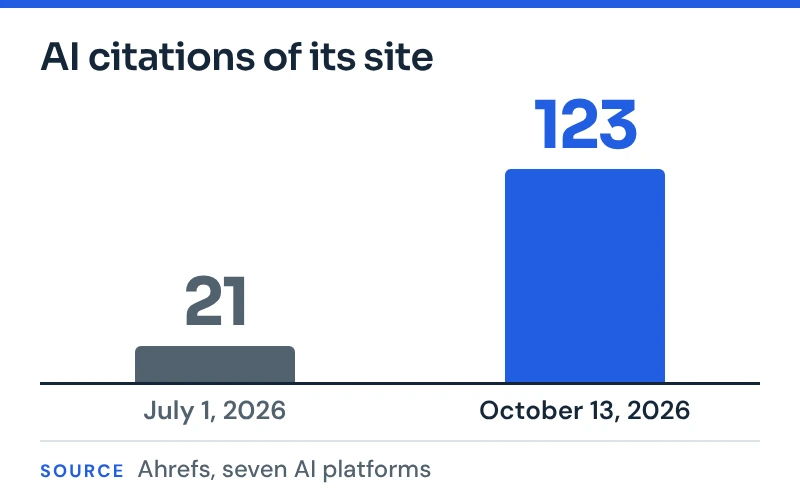
For a SaaS product, the same citation discipline wins the shortlist, and the shortlist, with a demo page that converts, is where pipeline starts. Citations counted across ChatGPT, Gemini, Perplexity, and Google AI Overviews. Figures are published on our case studies page.
The research conversation your buyers have with AI
Buyers research with AI for weeks before they contact anyone. Each answer shapes who makes the shortlist, and who never gets quoted.
| What software buyers ask AI | What the engine checks before answering |
|---|---|
| best invoicing software for freelancers | Category and use-case pages, review depth |
| crm alternatives for a small sales team | Alternatives pages the engine can quote |
| project management tool that integrates with our stack | Integration pages, partner directory listings |
| how much does payroll software cost | Pricing page clarity, plan comparisons |
| best knowledge base software for saas teams | Use-case content, documentation evidence |
How AI engines decide which SaaS product to recommend
AI engines do not rank feature lists, they verify products. Before naming anyone, they cross-reference your positioning and pricing across your own site, G2 and Capterra, your documentation, and the comparison articles they already trust. They answer at the use-case level, “best invoicing software for freelancers” and “crm alternatives for a small sales team” pull from different evidence.
For SaaS, the “versus” and “alternatives” queries carry the revenue: a comparison page with an honest verdict gives the engine a quote it can reuse, and a review profile that matches the claim confirms it.
What an AI SEO engagement for a SaaS company includes
The work runs on your existing marketing site and product pages, most SaaS companies need correction and connection, not a rebuild. An engagement covers:
- An entity audit of every source AI engines check before naming a SaaS product
- Service pages rebuilt answer-first, one per line of work:
- category and use-case pages
- comparison and alternatives pages
- integration pages
- pricing and plan content
- SoftwareApplication and FAQ schema with pricing and feature credentials, machine-readable
- Listing and citation cleanup across G2, Capterra, software directories, review sites, and your documentation
- A review-signal program, and monthly AI-answer monitoring tied to demo and trial signups, not vanity dashboards
Our AI SEO services are installed directly on your site, and you own every asset we build. For SaaS companies, the engagement starts from an AI visibility audit of every source the engines check.
The first 90 days for a SaaS company
Days 1–30: we audit every source AI engines check for your category. Your site, G2, Capterra, documentation, comparison articles, and fix the contradictions. Days 31–60: your category, comparison, and integration pages are rebuilt answer-first with software schema. Days 61–90: citation monitoring goes live across the major AI platforms, and you see the first movement report tied to demo and trial signups, measured against the day-one baseline. For SaaS companies, part of that audit is the internal link audit, the ranking gain most sites have never taken.
How long before the shortlist reflects it
Across our client engagements, visible movement in AI citation counts commonly appears within 60 to 90 days of the rebuild work, with Google movement often following. Considered purchases reward early work: the buyer who finds you during research stays through the decision. See our AI SEO progress timeline for the month-by-month rollout we measure against.
No agency can guarantee what a specific AI model will say. We commit to evidence you can verify, measured from a baseline set on day one.
Who this is not for
This is not for pre-launch products with no customers to reference, teams shopping content by volume, or anyone expecting a guaranteed AI mention. For established SaaS companies whose buyers research in AI before they book a demo, this is the highest-leverage pipeline work available right now. If you are still comparing agencies for SaaS companies, our guide on how to choose an SEO agency for AI search lists the questions to ask before signing a retainer.
Related guides
- AI SEO Services: the parent service program.
- AI SEO for IT Services: the sister program in this series.
- AI SEO automation: which SEO tasks AI can automate, and which still need a person.
- AI search visibility metrics: the metric definitions behind every movement report.
Own the research phase
30 minutes with Phil. Written scope and pricing before paid work begins.
FAQ
We already rank on Google for our category. What does AI SEO add? Rankings put you in a list of ten blue links; AI SEO earns the product named inside the answer. For SaaS the difference is the shortlist: buyers ask for two or three tools, and the engine’s answer decides which get the demo. The foundation overlaps, so the same work lifts both channels.
Can you get us recommended against bigger competitors? Yes. AI engines answer at the use-case level, “best for agencies,” “best for small teams”, so we build and verify evidence per use case and segment, where focused products beat category leaders, not just for the brand as a whole.
Our buyers find us through review sites. Why change? Review sites are one source the engine checks, not the whole answer. This program makes sure your site, documentation, and comparison content confirm what the reviews say, so the engine can name you with confidence, and captures the buyers who ask before they ever open G2.
How do we know whether it is working? Three numbers, tracked monthly from a day-one baseline: how often AI engines name your product for the queries that matter, referral visits from AI platforms in your analytics, and demo and trial signups attributed to those visits. You receive the evidence behind every figure, the same standard we apply to our own published results.