AI SEO Services · Business perspective
AI SEO Red Flags
The Nine Warnings AI Engines Themselves Give Buyers, Counted Across 105 Answers
AI SEO red flags are the specific warning signs, guaranteed rankings, content churned out by the pound, vague "best agency" lists, and reports with no real numbers, that AI engines themselves volunteer when a buyer asks how to hire SEO help. We asked six AI engine modes 18 buyer questions and logged 105 answers between October 4 and October 16, 2026. In 43 of those answers, the engine warned the buyer about something nobody asked it to flag. This article counts those warnings and lays out all nine, so you can screen any proposal before you sign it.
Key Takeaways
- Across 105 stored AI answers (October 4-16, 2026), 43 contained an unprompted warning about SEO buying risks.
- The single most repeated warning: never accept a guarantee of rankings or AI mentions, it appeared in 22 of 105 answers.
- Selling content volume as a strategy was flagged in 12 answers; treating self-published "best agency" lists as neutral appeared in 9; paying for llms.txt or schema as a shortcut appeared in 6.
- Five more warnings showed up less often but are just as easy for any owner to verify directly, without any tool.
- The engines' advice lines up closely with what credible hiring guides and consumer-protection sources already say about SEO buying risk.
- The fix for most of these red flags is the same: demand dated, measured results and a named person doing the work, before you sign anything.
As seen in

What Are the Nine Specific Red Flags AI Engines Warn About for SEO Buyers
AI engines warn buyers about nine recurring risks when asked how to hire SEO help, and four of them dominate the conversation by a wide margin. The other five come up less often in raw counts, but any owner can confirm them in five minutes by looking at a proposal.
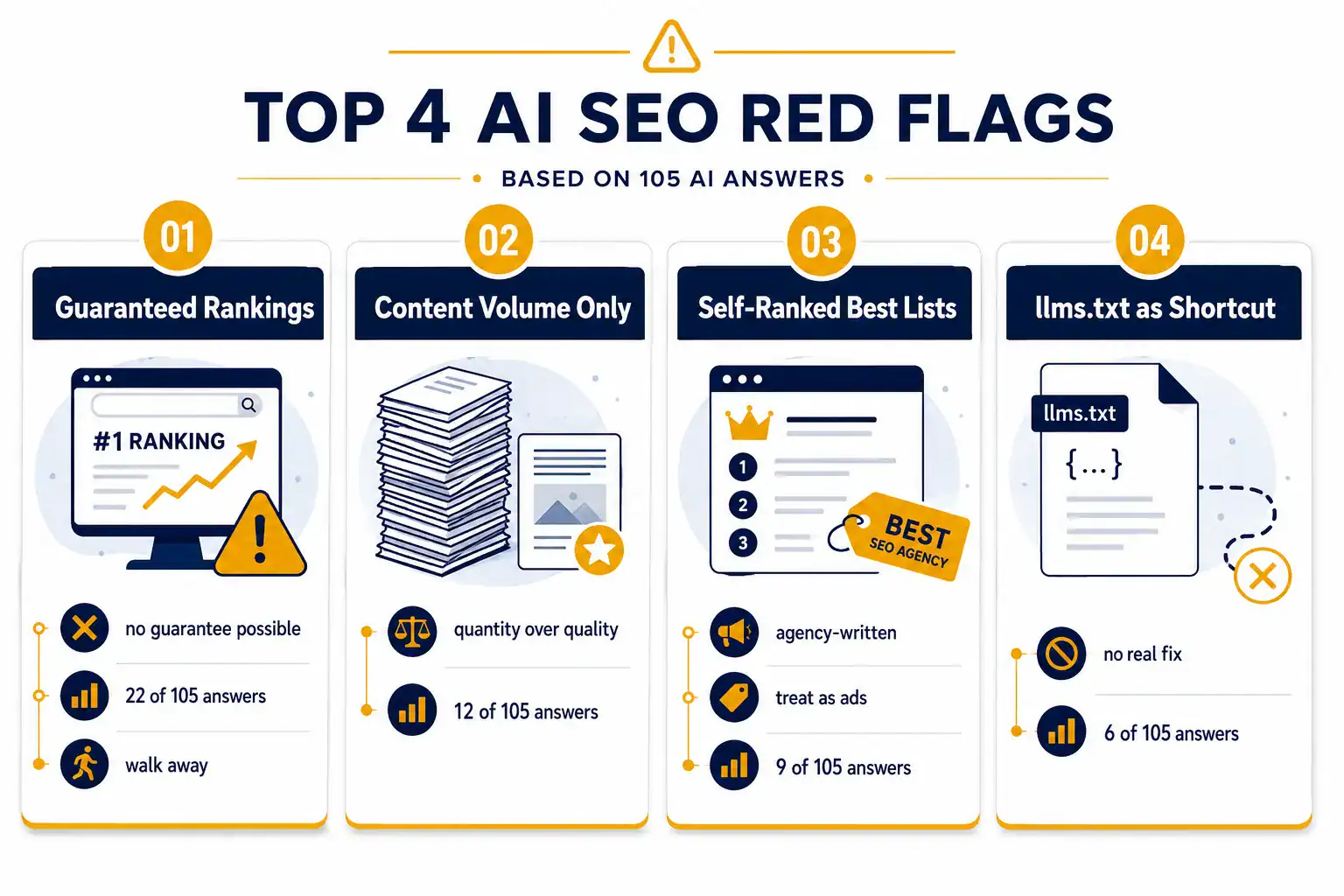
The four counted warnings, in order of frequency across the 105 stored answers (October 4-16, 2026):
- Never accept a guarantee of rankings or AI mentions, 22 of 105 answers.
- Be wary of agencies that sell content volume as the strategy itself, 12 of 105 answers.
- Treat agency-written "best agency" rankings as advertising, not independent research, 9 of 105 answers.
- Do not pay for llms.txt files or schema markup sold as a shortcut to AI visibility, 6 of 105 answers.
In 4 of the 105 answers, "watch for red flags" appeared as its own section heading, meaning the engine organized its entire response around warning the buyer, unprompted.
The remaining five warnings appeared less often in the raw counts, so we present them without a number. They are no less real, an owner can verify each one just by reading a proposal closely:
- An agency that cannot show dated, measured results.
- An agency that will not say who actually does the work.
- Reports built on averages, indexes, or readiness scores instead of real positions and citations.
- No plan at all for measuring AI visibility, only promises about it.
- Pressure to sign before any real diagnosis of your market.
Each one is detailed further below, with what it means in plain terms and how to check it yourself.
How Do I Know If an AI SEO Tool or Vendor Is Actually Trustworthy
A trustworthy AI SEO vendor shows you dated, specific numbers and names the person responsible for the work; an untrustworthy one talks in averages, scores, and vague promises. The distinction is almost always visible in the first conversation, before you spend anything.
Ask three direct questions before any contract:
- "Show me a result with a date on it." A credible vendor can point to a specific ranking position, a specific AI citation, or a specific map-pack placement, tied to a calendar window. A vendor who answers with "we've driven great visibility" is dodging the question.
- "Who does the actual work on my account?" If the answer is vague, "our team," "our proprietary system," without a name, that is the sixth uncounted warning above, showing up live.
- "How will you measure AI visibility specifically?" Rankings in Google and mentions by ChatGPT, Perplexity, Gemini, Copilot, and Google AI Overviews are different things. If there is no separate plan for the AI side, there is no AI SEO happening yet, regardless of what the pitch says.
Credible frameworks for hiring SEO help already stress dated proof and named accountability as baseline screening criteria [1][2]. The nine warnings above simply confirm, from the AI engines' own answers, that this advice has not changed with the arrival of AI search, it has just gotten more specific.
What's the Difference Between Legitimate AI SEO and SEO Scams
Legitimate AI SEO improves how a business is described, structured, and cited by Google and AI engines using verifiable methods; scams rebrand old manipulation tactics, hidden text, doorway pages, fake author bylines, scraped reviews, as "AI optimization" and hope the new label confuses the buyer about the old risk.
| Legitimate approach | Scam pattern |
|---|---|
| Dated rankings and counted AI citations | Visibility "scores" or indexes with no fixed reference point |
| Named person or team doing the work | "Our proprietary AI system" with no human accountable |
| Diagnosis before any proposal | Sign-today pricing, same conversation |
| Content built on real entity facts and schema | Mass-generated city/service pages with no unique value |
| Fundamentals (crawlability, site structure, entity SEO) fixed first | AI buzzwords layered over a broken site |
Recent hiring guidance and consumer-protection framing both treat guaranteed rankings and hidden manipulative tactics as the clearest line between the two camps [1][2]. If a vendor's pitch would have sounded like a 2015 black-hat warning with the word "AI" swapped in, it is the scam pattern.
Which AI SEO Red Flags Matter Most for Small Businesses
For a small or mid-sized service business, the guarantee red flag and the lack-of-diagnosis red flag matter most, because they cost real money fast and are the easiest for a smaller buyer to miss under sales pressure.
Why these two bite hardest for smaller businesses:
- Guarantees are the costliest lie. A guarantee of rankings or AI mentions (22 of 105 answers) locks a smaller business into a contract before anyone has checked whether the market, the competition, or the site itself even allows that outcome.
- Skipping diagnosis wastes the tightest budgets first. A business with a smaller marketing budget cannot absorb months spent on work that was never matched to its actual competitors. A proposal built without first diagnosing your specific market, the ninth uncounted warning, is the clearest sign the vendor is selling a template, not a strategy.
- Content volume promises drain budget without moving the needle. The second most-cited warning (12 of 105 answers) hits small businesses hardest because volume-based pricing feels productive, pages are published, while rankings and citations stay flat.
A smaller business should insist on a market-specific diagnosis before signing anything, the same standard described in our overview of AI SEO services.
What Should I Look for Instead When Choosing an AI SEO Vendor
Look for dated and counted results, a named person doing the work, a measurement plan that reports actual positions and citations, and a diagnosis completed before any proposal is written. These four replace the four most common red flags almost one for one.
A short standard to hold any vendor to:
- Dated results. Every claim should carry a specific window, "first position from these dates to these dates", not a season or a vague "recently."
- A named person. You should know who is doing your research, writing your pages, and making the calls on your account.
- Counted citations, not scores. AI visibility should be reported as "named in this many answers, on this engine, on this date," never as a readiness percentage.
- Diagnosis first. A real proposal follows a look at your actual competitors and your actual site, not a generic package.
This is also where E-E-A-T, experience, expertise, authoritativeness, trustworthiness, comes in: the same signals Google and AI engines use to decide whether to trust a business are the ones a buyer should use to decide whether to trust an agency.
Why Do AI Engines Warn Against Certain SEO Practices
AI engines are trained on a large body of public writing about SEO, including hiring guides, consumer-protection advice, and reporting on deceptive practices, so they reproduce the consensus warnings that already exist in that material when a buyer asks a hiring question.
This matters for three reasons:
- The warnings are not the AI's opinion. They reflect a pattern already documented across Google's hiring guidance and consumer-protection reporting on deceptive SEO practices [1][2].
- An agency cannot argue with its own trade's engines. If ChatGPT, Gemini, or Perplexity tell a buyer to avoid guaranteed rankings, an agency offering guaranteed rankings is arguing against the very engines it claims to optimize for.
- The warnings update as the field does. As AI Overviews and AI Mode become common entry points for buyer research, the engines increasingly fold AI-specific risks (like llms.txt sold as a shortcut) into the same warnings they already gave about traditional SEO.
How Much Should I Expect to Pay for a Legitimate AI SEO Solution
There is no fixed industry price for legitimate AI SEO, because the right scope depends on your market, your competitors, and whether your business already has local visibility, national reach, or neither. Any number quoted before a diagnosis is a guess, not a price.
What a legitimate pricing conversation looks like instead:
- The vendor runs or offers a diagnosis of your market and your current standing first.
- The figure you receive is tied to what that diagnosis found, in writing, after the call, not before it.
- The floor should reflect enough work to produce a measured result, not just a report.
Pressure to sign before any of that happens is the ninth uncounted warning above, and it is the easiest one to catch, because it shows up in the very first sales conversation.
What Happens If I Ignore These AI SEO Red Flags When Buying
Ignoring these warnings usually costs months and a contract before the problem becomes visible, because most of the nine red flags hide their damage until a buyer checks the actual numbers, which readiness scores and visibility indexes are built to avoid showing.

Typical sequence when a red flag is ignored:
- A guarantee is signed, work begins, and nothing in the contract requires dated proof.
- Reports arrive showing an index or a score moving upward, which feels like progress.
- Months later, an owner checks actual rankings or asks an AI engine who it recommends, and finds nothing has changed, or a competitor is named instead.
- The contract term has passed, and the budget is gone.
This is why outdated service information and stale entity facts matter too, a business that let a vendor coast on vague reporting often also let its own site information go stale, compounding the loss.
Are There AI SEO Approaches That Don't Trigger Any of These Warnings
Yes. An approach built on dated, counted measurement, a named practitioner, and a diagnosis completed before any proposal naturally avoids all nine warnings, because each warning exists precisely to catch the absence of one of those three things.
What that looks like in practice:
- Results are reported as specific map-pack positions, specific first-position rankings, and specific AI citation counts, each with a date.
- The person running the account is named and reachable, not an anonymous "team."
- A real diagnosis, audits of the site, the competitors, and the current AI visibility, happens before any price is quoted.
- Measurement never substitutes an average or a score for the actual thing a buyer would notice.
Our own rank intelligence engine approach is built around exactly this standard, and it is also how we measure our own site, which we treat as our own first case study.
What Do Most People Get Wrong When Evaluating AI SEO Vendors
Most buyers focus on the pitch's confidence instead of its proof, and they accept a score or an index because it looks like data, without asking whether that number would ever go down if nothing real had changed.
Common mistakes:
- Mistaking activity for results. Content volume (12 of 105 answers) feels like progress because pages are visibly published, even when rankings and citations stay flat.
- Trusting "best agency" lists at face value. The engines flagged this directly, these lists are often written by the agencies themselves and function as advertising, not independent research (9 of 105 answers).
- Accepting a score instead of a count. A readiness score or visibility index can rise even when nothing a buyer would notice has changed. A counted citation, on a dated answer, cannot be faked the same way.
- Confusing schema and llms.txt with a strategy. These are small technical pieces, not a path to AI visibility on their own (6 of 105 answers).
Can I Tell If My Current SEO Vendor Is Triggering Any of These Warnings
Yes, you can check this in one sitting by pulling your last three reports and your original contract, and matching them against the nine warnings above.
A quick self-check:
- Does your contract promise a ranking or an AI mention as a guarantee? If yes, warning one is already present.
- Do your reports show positions and citations with dates, or do they show scores and indexes? If the latter, warning seven is present.
- Can you name the person doing your account's actual work? If not, warning six is present.
- Was a proposal written before or after anyone looked at your specific competitors? If before, warning nine was present from the start.
If two or more of these match, it is worth a second opinion, including a direct comparison of your current AI SEO services against what a diagnosis-first engagement would look like.
How Often Do These AI SEO Red Flags Change or Evolve
The core four warnings have stayed stable across the tracked window (October 4-16, 2026), but the specific technical shortcuts the engines flag, like llms.txt or schema sold alone, are the part most likely to shift as AI search tooling changes.
What to expect going forward:
- The warning against guaranteed rankings or mentions is unlikely to disappear; it reflects a structural fact about how search and AI answers work, not a passing trend.
- New technical shortcuts will appear as new file formats and signals emerge, and the engines will likely fold warnings about each new one into their existing advice, the way llms.txt warnings have already appeared alongside older schema warnings.
- The uncounted five (dated results, named practitioner, real measurement, AI visibility plan, diagnosis before proposal) are durable because they describe sound business practice, not a specific tactic that can go out of date.
Do These Warnings Apply to All Types of Businesses or Just Some
The nine warnings apply to any service business hiring outside SEO help, local or national, though the weight of each warning shifts depending on whether the business competes on the map, in national organic results, or in AI answers specifically.
- Local businesses should weight the guarantee and content-volume warnings most heavily, since map-pack and local organic promises are the easiest to oversell.
- National and regional businesses should weight the diagnosis-first and measurement warnings most heavily, since a term set spanning a whole market cannot be judged accurately without competitor-specific research first.
- Any business worried about AI answers specifically should weight the llms.txt/schema-shortcut warning and the missing-AI-measurement-plan warning most heavily, since these are the newest and least understood by buyers.
The underlying standard, dated proof, named accountability, real diagnosis, does not change by business type, even though the specific red flag most likely to appear first does.
What's the Research Behind the 105 Answers That Identified These Nine Flags
The underlying research asked six AI engine modes the same 18 buyer questions about hiring SEO help, producing 105 total answers stored between October 4 and October 16, 2026, and then counted how often each warning appeared without being prompted.
Method in brief:
- 18 questions covered typical buyer concerns: how to vet an agency, what guarantees mean, how to measure AI visibility, and related hiring questions.
- Six AI engine modes were asked each question, producing 105 stored answers across the window.
- 43 of 105 answers included a warning the buyer had not explicitly asked for, meaning the engine volunteered caution unprompted.
- Warnings were then grouped into recurring patterns and counted by frequency, giving the four leading warnings their exact counts, with the remaining five grouped as lower-frequency but independently verifiable.
This mirrors the broader pattern documented in recent analyses of generative engine optimization and hiring risk, where guaranteed rankings, vague "AI-powered" claims, and unverifiable case studies recur as the clearest warning signs in Google's own hiring guidance [1]. It also lines up with longstanding guidance connecting deceptive SEO promises to consumer-protection concern [2].
Conclusion
The nine AI SEO red flags above are not opinions from one agency with something to sell. They are what ChatGPT, Gemini, Perplexity, Copilot, and Google's AI answers themselves told buyers, unprompted, in 43 of 105 tracked answers between October 4 and October 16, 2026. An agency cannot argue with the engines it claims to optimize for.
Before you sign anything, run the simple check from this article: ask for a dated result, ask who does the work, ask how AI visibility is measured, and ask whether a diagnosis of your market happened before the price did. If any of those four questions gets a vague answer, you have found a red flag the engines already warned you about.
If you want to see where your own business currently stands, ranked in Google, placed on the map, and named or ignored by AI, a full diagnosis is the right first step, not a generic package. Learn more about our approach to AI SEO services, built on dated results, a named founder doing the work, and counted citations instead of scores. When you are ready, book a call with Phil and get a market-specific diagnosis before any proposal is written.
FAQ
What are AI SEO red flags, in one sentence?
They are warning signs, like guaranteed rankings, content sold by volume, or vague "AI-powered" claims, that AI engines themselves tell buyers to watch for when hiring SEO help.
Is a guarantee of AI mentions ever legitimate?
No. AI answer placement is not something any vendor can guarantee, which is why this warning appeared in 22 of 105 tracked AI answers (October 4-16, 2026).
What is llms.txt, and why is paying for it a red flag?
Llms.txt is a small text file some sites use to signal preferences to AI crawlers. Paying for it alone, as if it were a full AI visibility strategy, was flagged in 6 of 105 tracked answers because it is a minor technical piece, not a strategy.
How do I check if my vendor's reports are trustworthy?
Compare your reports against dated, countable facts: specific rankings, specific map-pack positions, specific AI citations with dates. If your reports show only scores or indexes, that is one of the nine warnings in practice.
Do these red flags apply to small local businesses too?
Yes. The guarantee and lack-of-diagnosis warnings tend to matter most for smaller businesses, since they are the costliest to recover from on a tight budget.
Where did the 105-answer count come from?
Six AI engine modes were asked the same 18 buyer questions about hiring SEO help, producing 105 stored answers between October 4 and October 16, 2026, which were then reviewed for unprompted warnings.
References
- Do you need an SEO?. Google Search Central.
- Google's updated guidance urges FTC complaints against shady SEOs. Search Engine Journal.
Continue your research
What an AI Search Audit Should Deliver: the deliverable a credible provider puts on the table.
Signs Your Business Is Ready for AI Search Optimization: the readiness read before you hire anyone.
Discuss what this means for your business
Our proprietary Rank Intelligence Engine connects 25 specialized analysis and implementation capabilities with commercial judgment, content, and WordPress implementation. Phil Belleville has worked in SEO since 1995 and brings that experience to the priorities and decisions behind the work.
Explore our AI SEO services to see the service behind this business perspective.
30 minutes with Phil. Written scope and pricing before paid work begins.
Found this useful? Add us to your Google Preferred Sources and our next guide will find you first.
Add us as a Google Preferred Source