AI SEO for Shopify Stores:
Get Products Recommended
Last updated: October 21, 2026
Quick answer
AI SEO for Shopify stores makes your products the ones AI answer engines name when a shopper asks what to buy. By use case, by budget, by “best for.” Shoppers increasingly ask AI before they browse a marketplace: one recommendation becomes a product view, and the product view becomes a checkout. We rebuild the evidence engines check: product and collection content, reviews, feeds, and structured data. Inside your existing Shopify store, measured monthly against attributed orders.
Key takeaways
- Shoppers ask AI what to buy before they browse, the products named in the answer get the click, the view, and the checkout.
- An automotive appearance client on this program went from 8 to 75 terms at #1 in Google’s map pack in five weeks.
- Before naming anyone, AI engines verify your products across your store content, review apps, Google Merchant Center, and comparison articles, consistent evidence there is what wins the recommendation.
- Expect visible AI-citation movement within 60 to 90 days; verified product and collection content speeds that up.
- The work is installed on your existing Shopify store, you own every asset, and written scope and pricing come before any paid work begins.
As seen in

Why Shopify stores feel the AI shift at the product question
A shopper who wants a standing desk, a dog harness, or a gift under fifty dollars asks an AI what to buy, by use case, by budget, by “best for”, before they open a marketplace. The products named in that answer get the click. Stores the engine cannot verify compete for whatever traffic the named products leave behind.
The stores being named are not the ones with the biggest ad budgets. They are the ones whose product and collection pages answer what shoppers actually ask: sizing, materials, shipping, returns. And whose reviews and feeds verify across every source the engine checks.
Documented results from this kind of work
The proof below comes from a paint protection film specialist in England, a high-ticket automotive appearance service where buyers research for weeks before booking. A Shopify store and a paint protection film studio share the same buyer: someone spending real money on something they care about, researching for weeks before they commit. The measured outcome:
| Signal | Starting point | Latest reading |
|---|---|---|
| Terms at #1 in Google’s map pack | 8 (Jul 30–Aug 5, 2026) | 75 (Aug 30–Sep 5, 2026) |
| Terms in the visible map 3-pack | 64 of 123 | 108 of 123 |
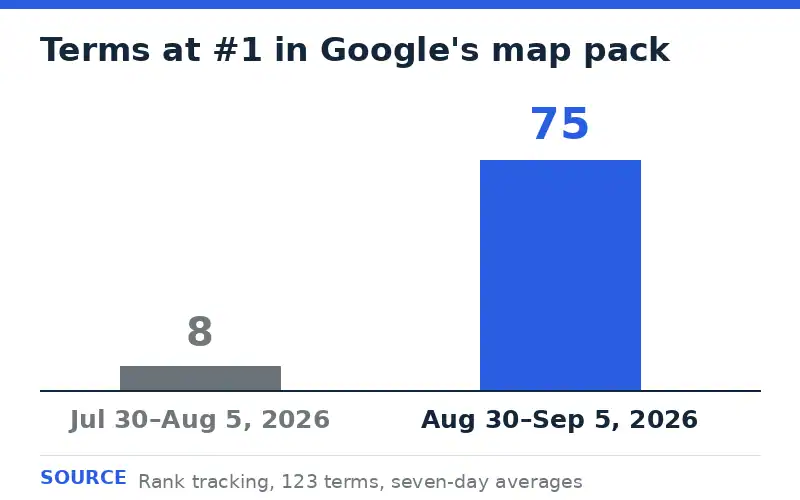
For a Shopify store, the same evidence discipline wins the product mention, and the mention, with a product page that closes, is where orders start. Seven-day averages; 123 tracked terms. Figures are published on our case studies page.
The research conversation your buyers have with AI
Buyers research with AI for weeks before they contact anyone. Each answer shapes who makes the shortlist, and who never gets quoted.
| What shoppers ask AI | What the engine checks before answering |
|---|---|
| best standing desk for a small office | Collection content, review depth |
| are handmade leather wallets worth it | Materials and craft content the engine can quote |
| best gifts for new dads under fifty dollars | Gift guides, collection structure |
| dog harness for a pulling husky | Product use-case content, sizing evidence |
| where to buy organic skincare online | Brand story, ingredient and certification pages |
How AI engines decide which store to recommend
AI engines do not rank storefronts, they verify products. Before naming anyone, they cross-reference your product claims across your Shopify store, review apps, Google Merchant Center, and the comparison articles they already trust. They answer at the use-case level, “best standing desk for a small office” and “dog harness for a pulling husky” pull from different evidence.
For Shopify stores, product specificity carries the weight: a product page that states materials, sizing, shipping, and returns gives the engine an answer it can quote, and verified reviews about the exact use case confirm it.
What an AI SEO engagement for a Shopify store includes
The work runs on your existing Shopify store and your existing reputation, most established stores need correction and connection, not a platform change. An engagement covers:
- An entity audit of every source AI engines check before naming a Shopify store
- Store pages rebuilt answer-first, one per type:
- product pages
- collection pages
- gift and use-case guides
- shipping, returns, and FAQ content
- Product and Offer schema with pricing, availability, and review credentials, machine-readable
- Listing and citation cleanup across your Shopify store, review apps, Google Merchant Center, and shopping directories
- A review-signal program, and monthly AI-answer monitoring tied to attributed orders, not vanity dashboards
Our AI SEO services are installed directly on your site, and you own every asset we build. For product catalogs, this builds directly on our ecommerce AI SEO practice.
The first 90 days for a Shopify store
Days 1–30: we audit every source AI engines check for your products. Your store, review apps, Merchant Center, comparison articles, and fix the contradictions. Days 31–60: your product and collection templates are rebuilt answer-first with Product schema. Days 61–90: citation monitoring goes live across the major AI platforms, and you see the first movement report tied to attributed orders, measured against the day-one baseline. For Shopify stores, that audit includes the internal link audit most sites have never taken.
How long before the shortlist reflects it
Across our client engagements, visible movement in AI citation counts commonly appears within 60 to 90 days of the rebuild work, with Google movement often following. Considered purchases reward early work: the buyer who finds you during research stays through the decision. A realistic month-by-month rollout is published on our AI SEO progress timeline page.
No agency can guarantee what a specific AI model will say. We commit to evidence you can verify, measured from a baseline set on day one.
Who this is not for
This is not for brand-new stores with no sales history, buyers shopping content by volume, or anyone expecting a guaranteed AI mention. For established Shopify stores whose shoppers research in AI before they buy, this is the highest-leverage visibility work available to your catalog right now. If you are weighing cost for Shopify stores, our AI SEO pricing proposals guide shows how engagements are typically structured.
Related guides
- AI SEO Services: the parent service program.
- AI SEO for Squarespace: the sister program in this series.
- AI mentions vs citations: why the two terms get confused, and why tracking them separately matters.
- Business entity clarity: the verification foundation AI engines check before naming anyone.
Own the research phase
30 minutes with Phil. Written scope and pricing before paid work begins.
FAQ
We already do Shopify SEO. What does AI SEO add? Classic Shopify SEO wins positions in a list of links; AI SEO earns the product named inside the answer. For stores the difference is the recommendation: shoppers ask for one or two products, and the engine’s answer decides which get clicked. The foundation overlaps, so the same work lifts both channels.
Can you get us recommended for “best” queries in our niche? Yes. AI engines answer at the use-case level, “best for small offices,” “best under fifty dollars”, so we build and verify evidence per product and collection, not just for the store as a whole.
Does this require leaving Shopify or changing our theme? No. The work is installed inside your existing Shopify store, theme templates, product and collection content, metafields, and schema. You keep your stack, your apps, and your workflows; you own every asset we build.
How do we know whether it is working? Three numbers, tracked monthly from a day-one baseline: how often AI engines name your products for the queries that matter, referral visits from AI platforms in your analytics, and attributed orders attributed to those visits. You receive the evidence behind every figure, the same standard we apply to our own published results.