AI Visibility Audit & AI SEO Audit · Business perspective
What Is AI Visibility?
A Definition With a Denominator, and the Three Numbers Behind It
AI visibility is how often an AI engine like ChatGPT, Perplexity, Gemini, or Google AI Overviews names your business when a buyer asks a question your business could answer. It is measured as a ratio: the number of answers that named you, divided by the number of answers where you could have been named. Our September 2026 benchmark measured it exactly that way, across 26 questions and six AI platforms, keeping all 401 answers in the denominator. Without that denominator, any visibility number is just a guess dressed up as data.
This guide is for business owners and marketing leads who want to know whether AI engines recommend them, and how to prove it either way. It covers the definition, the four-part measurement model, the three numbers that matter, and what moves them. It matters now because buyers increasingly ask an AI assistant who to hire before they visit a single website, and the business the answer names is the one that gets the call.
Key Takeaways
- AI visibility measures how often your brand appears in AI generated answers: the answers that name your business, divided by the answers that could have. A count without its denominator cannot be compared or checked [2].
- The model has three layers, mentions, citations and recommendations, and a fourth check that runs across all three: whether the answer describes your business accurately [3].
- The denominator is a fixed, dated question set run on each AI platform separately. Our September 2026 benchmark ran 26 questions and kept all 401 answers in the count [2].
- Share of voice is the competitive benchmarking view of the same ratio: your AI answers against the answers that named each competitor, over the same denominator [5].
- Single answers move between runs, so an AI visibility reading is a dated series, not a screenshot.
- AI visibility and traditional SEO share inputs but measure different outputs: search rankings decide what a crawler sees; AI visibility decides what answer engines say out loud.
- Platform reports have a blind spot: Search Console isolates AI impressions but shows no clicks or position for them, and no first-party report shows the answer a buyer actually read [4].
- To run the measurement yourself, the hands-on procedure is our 20-minute AI visibility check.
As seen in

What Is AI Visibility?
So what is AI visibility, precisely? AI visibility refers to the measurable chance that an AI system names your business, cites your content, or recommends your service when someone asks a question in your market. It covers the major AI platforms a buyer might use: ChatGPT, Perplexity, Gemini, Google AI Overviews and AI Mode, and Copilot. Where traditional search visibility counts positions on a results page, AI visibility focuses on what the answer says. It is not a vibe. It is a number with a numerator and a denominator, and most of the AI visibility claims in circulation leave the denominator out.
The evidence for that is specific. In the week our September 2026 benchmark was captured, ChatGPT cited one review of 27 firms offering AI visibility work; 22 of those firms did not disclose their prompt set, their measurement period, or the denominator behind their numbers [2]. An AI visibility number that cannot be reproduced is a claim, not a measurement.
At AI Search Engine Optimization, we treat AI visibility the same way we treat rankings: counted, dated, and checked against competitors. We run your buyer questions through the AI search engines and report how many answers named you, against how many named a competitor instead, out of how many answers were captured. That last number is the denominator. Everything else is marketing.
One clarification before the numbers. In IT and compliance teams, “AI visibility” has a second meaning: oversight of the AI systems an organization runs itself, covering which tools staff use, how models reach automated decisions, and whether that meets privacy and regulatory requirements. That kind of transparency helps catch errors and bias in automated decisions. This page is about the marketing meaning: whether AI engines name your business.
How Do You Measure AI Visibility? The Four-Part Model
To measure AI visibility you need four parts, and an AI visibility measurement missing any one of them cannot be trusted month over month. This is the model our AI visibility audit installs and the one behind every figure we publish.
- A fixed question set. Real buyer questions, the ones that ask who to hire, measure whether your brand appears in AI answers at all. Research questions, the ones that ask how something works, measure whether your pages are cited. The benchmark used 16 buyer and 10 research questions, worded exactly the same every week [2].
- Each platform counted on its own. ChatGPT, ChatGPT with web search, Google AI Overviews, Google AI Mode, Gemini and Bing Copilot each answer from different sources, so each gets its own column, and AI visibility can differ completely between multiple AI platforms. In the benchmark the same buyer question returned agency names on ChatGPT and Google AI Overviews and a table of software tools on Google AI Mode and Bing Copilot [2].
- The denominator, stated in full. The 26 questions produced 401 answers in the benchmark week, and every captured answer stays in the count, including answers that cited no sources at all, so no share is raised by leaving silent answers out [2].
- Dated readings against the same competitors. The same set runs on a schedule, so every figure has a previous value and a next one, and your brand’s presence is always read beside the firms the answers named instead.
This is what makes AI visibility comparable from one month to the next, and it is the reason a one-off test only shows you a single day’s weather, not the climate. Measured this way, you can identify gaps by platform and by question. If you want to apply it to your own business this week, the 20-minute AI visibility check walks through the procedure step by step.
Why Does AI Visibility Matter for My Website?
AI visibility matters because buyers are increasingly asking an AI assistant who to hire instead of scrolling ten blue links on search engines. If the AI never names your business, you lose that buyer before they ever reach your website.
44% of US adults say they use ChatGPT, more than double the share Pew recorded in 2023, and six in ten US adults say they read the AI summaries at the top of search results [1]. Those are measured figures, not estimates, and the direction is clear: the answer is increasingly delivered before the click happens.
This is why we built AI search optimization into the same engagement as local and national SEO. A business that ranks but never gets named in AI generated answers is still invisible to a growing share of buyers, which is why AI visibility matters even to firms that already rank well in traditional search results.
What’s the Difference Between AI Visibility and Traditional SEO?
AI visibility measures whether an AI engine names your business in a generated answer. Traditional SEO measures whether your website ranks in traditional search results. Unlike traditional SEO, the output is a sentence, not a position. That is the point where SEO and AI visibility differ most. They share inputs, like content quality and backlinks, but they produce different outputs and need different proof.
| Factor | Traditional SEO | AI Visibility |
|---|---|---|
| Output measured | Organic rank, map pack position | Named mention, citation, recommendation |
| Primary tool | Google Search Console, rank trackers | A fixed question set run on each AI platform |
| Unit of success | Position 1-3 on a results page | Answers naming you, out of the answers captured |
| Content need | Keyword-targeted pages | Direct answers backed by specific, checkable facts |
| Data gap | Well understood, decades of tooling | Search Console isolates AI impressions but shows no clicks or position for them [4] |
Choose SEO-only measurement if your buyers never use AI tools to shop. Choose combined measurement, the approach we run for every client, if your buyers use Google, ChatGPT, or Perplexity at any point in the decision.
What Are the Three Metrics That Make Up AI Visibility?
The three metrics are mentions, citations, and recommendations. Think of them as a hierarchy: a mention shows presence, a citation shows source attribution, and a recommendation shows the AI actually steering the buyer toward you.
- Mentions. Your brand appears somewhere in the AI answer. This is the floor, not the win.
- Citations. The answer links to one of your pages as the source of a fact. An AI citation proves the engine read your page; a source named without a link is logged separately and not counted.
- Recommendations. The answer names you as its pick, the business to contact first, rather than one of several names in a list, usually in response to a “who should I hire” question. This is the number closest to buyer action.
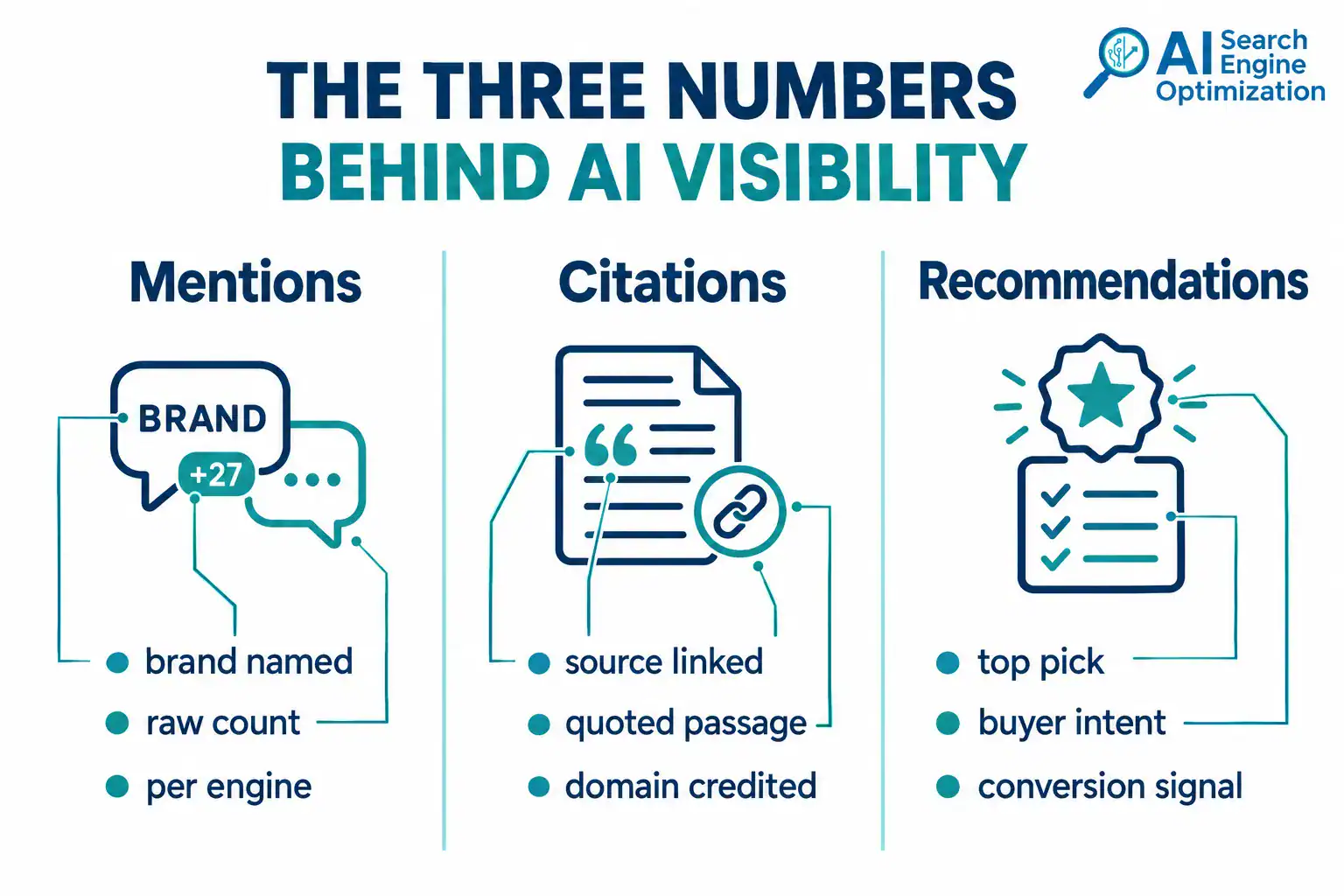
A fourth check runs across all three: accuracy. A brand can be named and described wrongly, with the wrong services, the wrong area or an old phone number, which MIT Sloan Management Review flags as a real and growing risk [3]. An answer that names you inaccurately is logged as a mention with an accuracy fault, not as a win.
A common mistake is counting only brand mentions and reporting that as AI visibility. A business can be mentioned ten times and recommended zero times, which means the AI knows you exist but does not think you are the best pick. That gap is exactly what an AI visibility measurement should expose.
What’s the Denominator in the AI Visibility Formula?
The denominator is the number of AI generated responses that could have named your business: every answer captured for your fixed question set, on each of the AI platforms, in the measurement window. Without it, a mention count is meaningless, because you do not know whether you were named once out of five chances or once out of five hundred.
The formula is simple: AI visibility rate = answers that name your business ÷ answers captured for the question set, per platform and per date. The denominator itself is built from four counts, and a credible report states all four:
- Planned prompts: how many questions the set contains.
- Collected answers: how many runs returned an answer at all; platforms time out, refuse, or fail.
- Answers where an AI answer appeared: Google AI Overviews do not render for every query, so the trigger rate is reported separately from the mention rate.
- Answers analyzed: how many of the collected answers were actually read and scored.
Here is what that looks like with real numbers. Across the 401 benchmark answers, firms were named 247 times, and a firm named in one answer counts once for that answer. The most-named firm appeared in 53 of the 401 answers, about 13 percent, which is what strong AI visibility looks like in a crowded category [2]. A vendor who says “you were mentioned 12 times this month” without the denominator has told you nothing: twelve mentions out of fifteen answers is dominance, and twelve out of fifteen thousand is irrelevance. We always report both numbers, so the ratio means something.
Is There a Standard AI Visibility Score?
No. Several AI visibility tracking tools now run prompts across ChatGPT, Perplexity, Gemini and AI Mode and report mention frequency, cited domains and share of voice against competitors [5], but there is no industry-standard AI visibility score, and each tool builds its number from its own prompts, platforms and dates.
Whatever the tool, two derived views are worth asking for. Query coverage is the share of your question set where you were named at least once, which shows how wide your presence is rather than how loud. Sentiment is the tone of the sentence that names you, which shows whether a mention helps or hurts.
A score is only as good as the disclosure behind it. Before you trust an AI visibility score, it should state the question set, the AI search platforms, the dates, and the denominator, and it should let you see the actual answers. A single blended number is the weakest form, because an average across platforms that read different sources describes no platform at all. That is why we never report a single readiness score. We report counted answers, per engine, per question, because a blended average hides which engine is ignoring you.
How Often Does AI Visibility Change?
AI visibility can change from one day to the next, because AI engines update their AI models and their retrieval sources, which changes how AI engines decide who to cite, far more often than Google updates core ranking systems. The benchmark caught it directly: on September 13, 2026 one question named this firm first of five; on September 16 the same question named three larger firms and not this one [2].
That volatility is a property of the measurement, not noise to ignore. It is why readings are dated, why the same question set repeats on a schedule, and why a one-time AI visibility audit has a short shelf life. We track AI visibility monthly, the same way we track rankings, because the AI landscape moves faster than traditional search ever did.
Is AI Visibility the Same Thing as Generative Search Visibility?
Yes, in practice these terms describe the same thing as AI search visibility: how often a brand appears in AI generated answers, as a mention, a citation or a recommendation, whether that answer comes from a chatbot or a search engine’s generative layer. “Generative engine optimization” and “answer engine optimization” are the industry’s names for AI visibility optimization, the discipline of improving that number [5][6].
ChatGPT, Perplexity, Gemini, Google AI Overviews and AI Mode all generate answers the same basic way: they retrieve sources, synthesize a response, and sometimes cite where the information came from. Whether you call it AI visibility, generative visibility, or AEO, the underlying question is identical: did the engine name you.
Can You Improve AI Visibility If You’re Already Ranking?
Yes. Ranking on page one of Google does not automatically make you the brand an AI engine names, because the two systems weigh different signals. A page can rank first in Google and still never get cited in an AI answer if it lacks the entity signals or the specific answer the AI engine needs to trust and quote it, or if AI crawlers cannot reach it.
If you already rank well, the fastest wins are usually entity work (making sure Google’s Knowledge Graph and the AI engines know exactly who you are), accurate schema for your business details, and rewriting key passages so they answer buyer questions directly and specifically. We run this as a layer on top of existing SEO, not a replacement for it.
How Do You Get Your Content Into AI Overviews?
Google says there are no extra requirements for AI Overviews: a page has to be indexed and eligible to show a normal search snippet, and no special schema or AI-specific format is needed [6]. Beyond that, the same things that earn rankings decide whether your page is used: how completely it answers the question and how much the engine trusts the source. Google is also surfacing more inline links and a “dive deeper” treatment inside AI Overviews, which raises the value of being the cited source rather than just ranking nearby [7].
On October 15, 2026, Google announced it is testing more frequent inline links, higher-positioned citations, and a new top-of-answer area reserved for official websites inside AI Overviews and AI Mode [7]. That is a direct signal: being the named, linked source inside the answer is becoming more valuable, not less.
What helps, on top of that baseline:
- Lead with the direct answer when it serves the reader. Short, self-contained passages can make evidence easier to extract, but there is no fixed word-count requirement for AI Overviews.
- Attach a dated, first-party fact or data point the engine cannot get elsewhere.
- Where you use structured data, keep it consistent with the visible copy. There is no need to mark up every answer block, and Google requires no special schema for its AI features [6].
- Build entity clarity so Google and the AI engines know exactly who you are, not just what your page says.
Does AI Visibility Require a Different Content Strategy Than SEO?
Partly. AI visibility and SEO both reward genuine expertise, clear structure, and strong sources. Google’s own guidance treats the two as one foundation: pages that follow standard SEO practice are the pages eligible to appear in its AI features, and no AI-specific writing format is required [6]. Where the work differs is proof and presence: AI answers lean heavily on specific facts and on what other sources say about you.
Practically, this means:
- Keep your keyword site map and ranking pages exactly as they are.
- Make sure each key page answers its buyer questions directly, with specific facts a reader or an engine can check.
- Use structured data where it genuinely applies, such as business details, services and FAQs, and keep it consistent with the visible copy. It supports ordinary SEO and rich results; it is not an AI-search requirement.
- Build off-site presence on the review platforms, best-of lists, and knowledge entries the AI engines actually cite; that AI presence off your site is part of your brand’s visibility too.
Do Small Businesses Need to Worry About AI Visibility?
Yes, because local buyers are already asking AI engines for recommendations, not just big national brands. A plumber, a dentist, or a law firm loses the exact same “who should I call” moment to a competitor if the AI names someone else. The stakes are higher in health, legal and financial categories, where AI engines lean harder on sources they treat as authoritative, so an accurate, well-cited presence counts for more.
Google AI Overviews now appear on 73.3% of tracked branded keyword searches, up from 61.3% in July, based on daily tracking through late September 2026 [8]. That volume alone means even a small local service business will have buyers hitting an AI generated answer before they ever see a traditional search result. The fix is not a national ad budget. It is entity clarity, a local Google Business Profile built correctly, and content written to be quoted.
Why Isn’t My Content Showing Up in AI Search Results?
Your content likely is not showing up because it does not answer the exact question as completely as a competing page, lacks verified entity signals, or comes from a source the engine has less reason to trust. AI engines pull from sources they can trust, not just sources that rank, and the signals AI engines weigh are mostly about trust.
Common causes:
- Business facts that conflict across your site, your Google Business Profile and directories, so the engine cannot tell which version is true. Structured data can help state the right version, but it is not an AI-search requirement.
- The answer a buyer needs is buried deep in a long page, or stated too vaguely to be useful.
- Weak entity presence, meaning Google’s Knowledge Graph barely knows who you are, or AI crawlers blocked from the pages that would explain it.
- No presence on the sources AI engines trust when they compile a shortlist: review platforms, best-of lists, and knowledge entries.
- A competitor’s page already answers the exact question more specifically or with better proof.
The fix is rarely “write more content.” It is usually rewriting what you have so it answers the exact question with specific, provable facts.
Frequently Asked Questions
What is AI visibility in simple terms?
AI visibility is how often AI engines such as ChatGPT, Gemini, Perplexity and Google AI Overviews name, cite or recommend your business when buyers ask questions you could answer, counted against the number of answers where you could have been named. It is the AI search equivalent of a ranking report.
How is AI visibility calculated?
AI visibility is calculated as the number of answers that name your business divided by the number of answers captured for a fixed question set, reported per AI platform and per date. A credible figure also states the four counts behind the denominator: planned prompts, collected answers, answers where an AI answer appeared, and answers analyzed.
What does AI vision mean?
“AI vision” most commonly refers to computer vision, the AI field focused on interpreting images and video. It is a different concept from AI visibility, which is about whether an AI engine names your business in a text-based answer. The terms sound alike but describe unrelated technologies.
What is SEO visibility?
SEO visibility is a metric that estimates how often your website appears in search results for a tracked set of keywords, usually expressed as a percentage or index compared to competitors. It focuses on rankings and impressions in traditional search, not on whether an AI engine names your brand in a generated answer.
Can you give me an example of how AI is being used in marketing?
One example: a local business runs its common buyer questions through ChatGPT and Google AI Overviews to see which competitor gets named instead of them, then rebuilds its content and entity signals to close that gap. This is the AI invisibility test we run before proposing any AI search optimization work.
Is SEO dead now with AI?
No. SEO is not dead, but it is no longer the whole picture. Google says AI Overviews draw on pages that are indexed and eligible for a normal search snippet, so strong SEO remains the foundation. AI visibility adds a second layer on top, since being ranked does not guarantee being named in a generated answer.
Conclusion
So, what is AI visibility? A real, countable thing: mentions, citations, and recommendations, measured against a fixed set of buyer questions on each AI platform, with the denominator stated and the date attached. The businesses winning this right now are the ones treating it exactly the way rankings used to be treated: checked, dated, and measured against competitors, not guessed at.
If you want to know where your business actually stands, the first step is not a content rewrite. It is a real test: run your buyers’ exact questions through ChatGPT, Perplexity, Gemini, and AI Overviews, and see who gets named. We run that test before we propose anything, because you should see your own gap before you pay anyone to close it. Book a call with Phil and find out whether your business is the one AI names, or the one it skips.
References
- Americans and AI 2026: Chatbots, smart devices and views on impact. Pew Research Center.
- AI Answer Benchmark: who the AI engines actually name. AI Search Engine Optimization.
- The new rules of brand visibility in AI search. MIT Sloan Management Review.
- Introducing Search Generative AI performance reports in Search Console. Google Search Central.
- How to measure and maximize visibility in AI search. Search Engine Land.
- AI features and your website. Google Search Central.
- More ways to connect with the web from Search. blog.google.
- AI Overviews on big-brand searches. Search Engine Journal.
Continue your research
AI Search Visibility Metrics: The KPIs a Report Should Show: the KPI definitions behind the three numbers above.
What an AI Search Audit Should Deliver: what a full audit adds on top of your own prompt-level checks.
Discuss what this means for your business
Our proprietary Rank Intelligence Engine connects 25 specialized analysis and implementation capabilities with commercial judgment, content, and WordPress implementation. Phil Belleville has worked in SEO since 1995 and brings that experience to the priorities and decisions behind the work.
Explore our AI visibility audit to see the service behind this business perspective.
30 minutes with Phil. Written scope and pricing before paid work begins.