
AI Local SEO Services:
Get Found in Google Maps, Search, and AI Answers

Last updated: October 14, 2026
Quick answer
Local AI SEO combines traditional local search optimization (Google Business Profile, map pack, citations) with the entity and review signals that ChatGPT, Perplexity, Gemini, and Google's AI Overviews use to recommend nearby businesses. The two disciplines rely on the same underlying data, so they work best as one coordinated plan rather than two separate services. A business that optimizes for both typically sees map pack movement within weeks and AI answer citations follow once the profile, reviews, and site content agree on who it serves.
Key takeaways
- Local SEO and local AI SEO draw from the same sources: your Google Business Profile, your reviews, your website, and how consistently your business is described across the web.
- Google's map pack shows only three visible positions. Anything below that is effectively invisible to a searcher, so tracking should count only those three.
- AI assistants reconcile your profile, citations, and reviews before naming you in an answer. Inconsistent business information is the most common reason a business gets skipped.
- Expanding into towns you don't serve rarely helps and often hurts, since it attracts the wrong inquiries and dilutes relevance signals for the areas you actually cover.
- Results timelines vary by competition and starting condition, but most local businesses see measurable map pack or ranking movement in 60 to 120 days when profile, citation, and content work are done together.
- Local SEO services pricing is typically structured as a monthly retainer tied to a defined scope, not a fixed package, because the work required depends on how far behind the top three competitors you are.
- Multi-location businesses need each location treated as a distinct entity, with its own profile, pages, and review set, to avoid cannibalizing rankings between locations.
As seen in

What is local SEO and how does it work?
Local SEO is the practice of making a business visible to nearby customers searching for the products or services it offers, primarily through Google's map pack, Google Maps, and local organic search results. It works by aligning three groups of signals that Google and other engines use to decide who to show: relevance (does the business match the search), distance (how close is it to the searcher), and prominence (how well-known and trusted is it).
In practice, local SEO touches four areas:
- Google Business Profile: categories, services, hours, photos, posts, and review responses.
- Website content: service pages and location pages that match what people actually search for.
- Citations: your business name, address, and phone number listed consistently across directories.
- Reviews: volume, recency, and the specific language customers use in them.
AI assistants now pull from the same four areas, which is why AI SEO and local SEO have effectively merged into one discipline for any business that depends on nearby customers.
How do AI local SEO services differ from traditional SEO?
AI local SEO services differ from traditional local SEO mainly in what they measure, not in what they fix. Traditional local SEO tracks map pack and organic rankings; AI local SEO adds tracking of how ChatGPT, Perplexity, Gemini, and Google's AI Overviews answer local questions about your business and your competitors.
The underlying fixes overlap heavily:
- A clean, consistent business record helps both the map pack and an AI assistant deciding who to recommend.
- Reviews that mention specific services and neighborhoods feed both a Google ranking algorithm and an AI model summarizing "who's good for this."
- A service page that clearly states what you do and where you do it can be cited by Google's organic algorithm and lifted into an AI Overview.
What's different is the AI layer requires its own monitoring. AI mentions and citations aren't the same thing as a ranking position, and a business can appear in one place and not the other. Agencies that only check rankings or only check AI chat tools miss half the picture. Industry coverage of this shift, including Search Engine Land's AI SEO coverage, reflects a broader move among agencies to combine both disciplines rather than sell them separately.
Choose a combined approach if: your customers are searching both Google Maps and asking AI assistants for recommendations, which is now common for home services, healthcare, legal, and hospitality searches.
What does a local AI SEO assessment actually check?
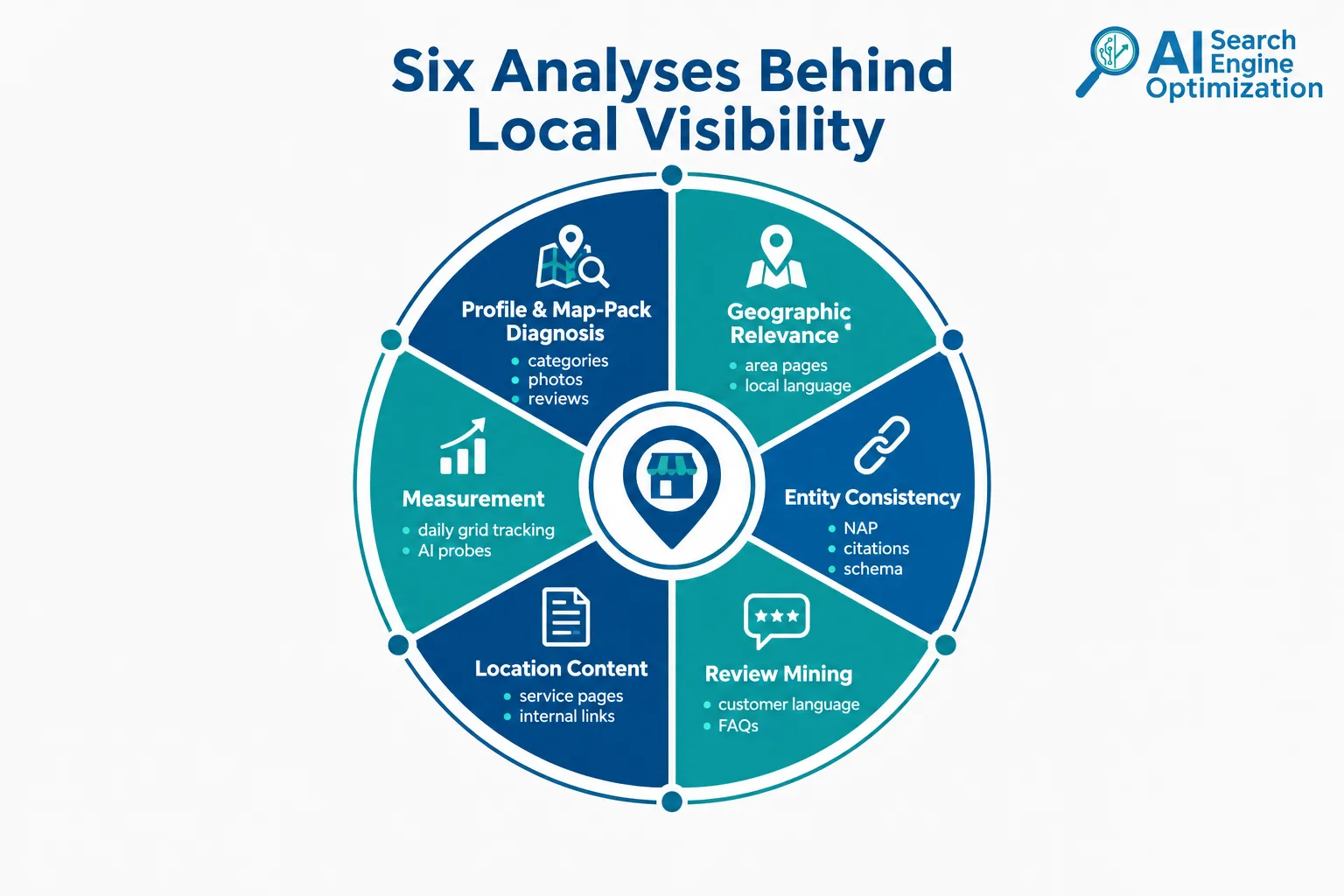
A thorough local AI SEO assessment examines your Google Business Profile, your geographic relevance against the businesses already ranking, your consistency across citation sources, your review language, your location content, and your current measured position in both the map pack and AI answers. Each of these feeds the next, so they're assessed together rather than as separate reports.
Profile and map-pack diagnosis
This checks seven elements of your Google Business Profile: categories, services, hours, photos, Q&A, review response, and posts, plus whether your profile and website describe the same business. A grid diagnostic maps where across your service area you appear in the three visible map pack positions and where you don't.
Geographic relevance, scored against the top three
This scores how strongly your site and profile are tied to your area across thirteen dimensions, benchmarked against the three competitors already holding the map pack for your target terms.
Entity consistency across every listing
This compares your name, address, phone number, services, and hours across your website, Google Business Profile, Apple Maps, directories, and review platforms, since AI assistants reconcile these sources before naming anyone in an answer. Tools built for this kind of cross-source checking are increasingly common; Google's local ranking documentation and Search Engine Land's local SEO guide both cover citation consistency as a 2026 priority category.
Review mining for customer language
This pulls verified reviews from your business, your local competitors, and the broader niche to extract the questions, concerns, and phrases real customers use, which then feed FAQs and service page copy.
Location content built from competitor gaps
This builds pages for areas you genuinely serve, based on what's already ranking and where your grid diagnostic shows gaps, following the same keyword mapping discipline used to avoid pages competing against each other.
Measurement by point, platform, and date
This tracks map pack position daily from fixed points, organic rankings alongside them, and AI answers per platform and question, so results in one channel are never reported as results in all of them. See AI search visibility metrics for the specific KPIs a local report should show.
Local SEO services: pricing and costs
Local SEO pricing is usually a monthly retainer, not a one-time fee, because ranking maintenance requires ongoing profile, content, and review work. Costs vary by market competitiveness, number of locations, and how far a business sits behind the top three map pack competitors.
Factors that move price up or down:
- Number of locations: multi-location work costs more per location but less per location than running separate engagements.
- Competitive density: a law firm in a mid-size city competes against more established profiles than a plumber in a smaller town.
- Starting condition: a business with a clean, long-standing profile and strong reviews needs less foundational work than one with scattered citations or thin content.
- Scope: whether Google Business Profile management, website content, and AI answer tracking are bundled or sold separately.
Google's guide on hiring an SEO notes that software-only approaches tend to be cheaper but leave the profile, citation cleanup, and content work to the business owner, which is often where results stall.
Decision rule: choose a retainer model with a written scope defining markets, platforms, and deliverables over a fixed package, since local competition shifts month to month and a static package can't respond to it.
Best local SEO services for small businesses
The best local SEO services for small businesses combine Google Business Profile management, citation cleanup, review strategy, and location content under one plan tied to measurable map pack and inquiry results. Small businesses generally don't need enterprise-level platforms; they need focused, consistent execution on a handful of high-impact factors.
What to look for:
- A written scope naming your actual service area, not a generic "local SEO package."
- Reporting that separates map pack, organic, and AI answer results.
- A single point of contact who understands your trade, since a contractor, a clinic, and a law firm are judged on different signals.
- Work completed on the live site, not just described in a report.
Tools aimed at small businesses, like those covered in Search Engine Land's coverage of AI-driven local SEO tactics and Search Engine Journal's local SEO coverage, can handle routine profile posting and citation checks, but they rarely replace the strategic work of deciding which area and service pages to build first.
How to improve Google Business Profile ranking with AI
Improving a Google Business Profile ranking starts with completing every available field (categories, services, hours, attributes, photos, Q&A) and then using review and competitor data to decide what to add next. AI tools can speed up the research, but the profile changes still have to be made and verified by a person.
Practical steps:
- Audit current categories against the services you actually perform and the categories your top three competitors use.
- Add photos weekly; profiles with recent photo activity tend to show more engagement in Google's own reporting.
- Respond to every review within a few days, mentioning the specific service when possible.
- Use review language to write Q&A entries before customers ask them.
- Publish Google posts tied to services and seasons, not generic updates.
Search Engine Land's local pack ranking guide and Search Engine Journal's analysis of citations as a ranking factor both point to the same pattern: AI speeds up the auditing and drafting, but profile and citation accuracy still decide the ranking.
How to optimize a Google Maps listing for local search
Optimizing a Google Maps listing means making sure the listing matches your website and citations exactly, choosing the most accurate primary category, and building enough review volume and recency to signal prominence. A mismatch between your listing and your website is one of the fastest ways to lose trust with both Google's algorithm and an AI assistant checking your record.
Checklist:
- Primary category matches your main service, not your broadest possible category.
- Service area set to the towns you actually cover, not a wide radius for reach.
- Hours match your website and any booking tool exactly.
- Photos show your actual location, team, and work, not stock images.
- NAP (name, address, phone) matches every other listing online, down to suite numbers and formatting.
Common mistake: setting a service area radius far beyond where you'll travel. This attracts inquiries you can't fulfill and dilutes your relevance signal in the towns you actually serve.
Local SEO vs paid local ads: which is better?
Local SEO and paid local ads solve different problems and work best together rather than as alternatives. Paid ads produce faster visibility but stop the moment spending stops; local SEO takes longer to build but compounds and keeps working between campaigns.
| Factor | Local SEO | Paid local ads |
|---|---|---|
| Time to visibility | Weeks to months | Immediate |
| Cost over time | Ongoing but compounding | Ongoing and linear |
| Trust signal | High (organic, review-backed) | Lower (labeled as ad) |
| AI assistant visibility | Yes, draws on same signals | No, AI answers don't show paid placements |
| Longevity after stopping | Retained for a period | Visibility ends immediately |
Choose local SEO first if your customers research before buying and your business depends on being found consistently over months, not just this week. Add paid ads if you need to fill an immediate gap, like a new location with no review history yet.
Where do local customers find a business now?
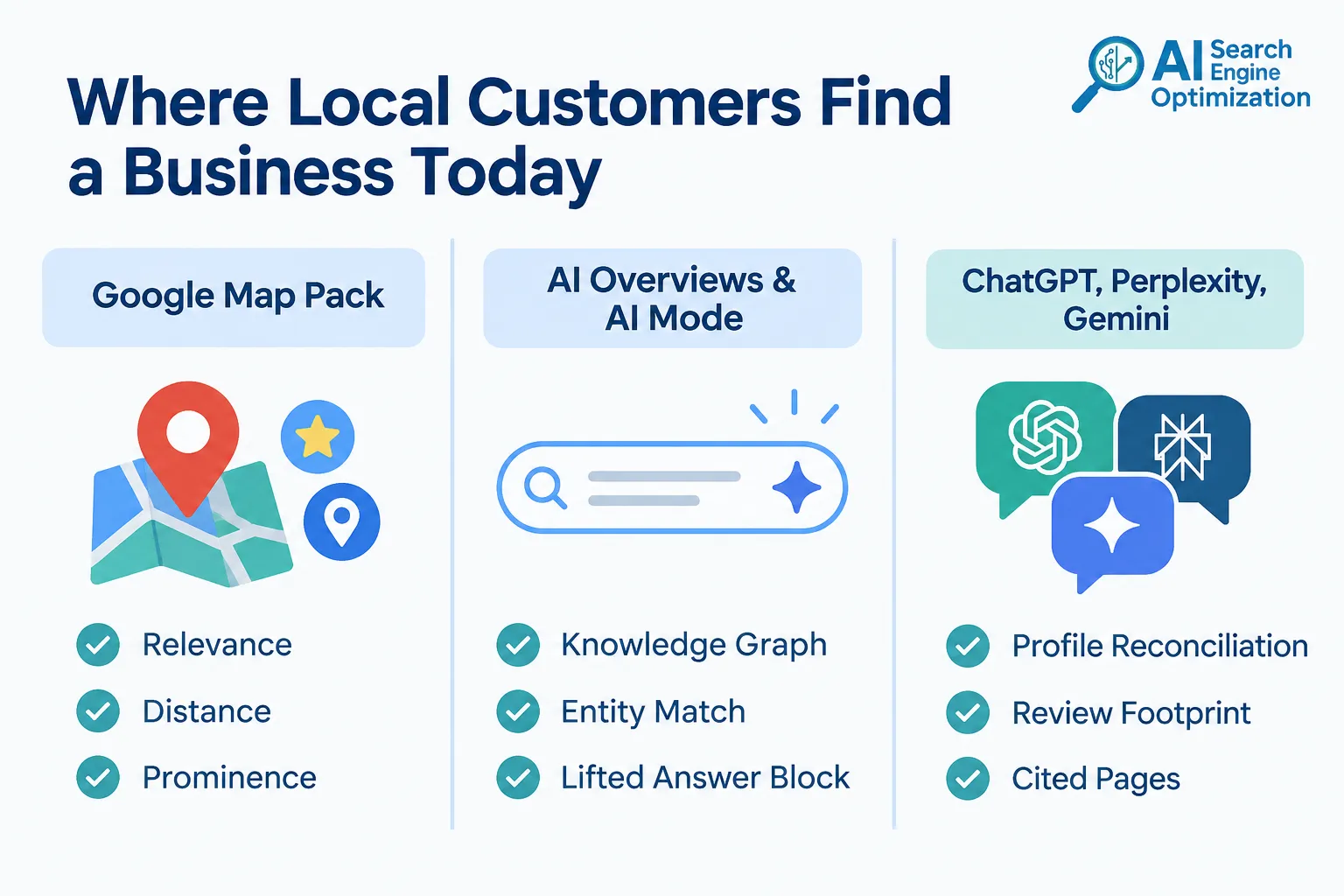
Local customers now find businesses in three places: Google's map pack and Maps, Google's AI Overviews and AI Mode, and AI assistants like ChatGPT, Perplexity, and Gemini. A strategy that only addresses the map pack leaves the other two channels open to competitors.
Google's map pack and Maps shows three visible positions, decided by relevance, distance, and prominence, which can differ street by street within the same city.
Google AI Overviews and AI Mode writes local answers above the results, drawn from Google's index, Knowledge Graph, and your business profile. These features rarely name a business the organic results haven't already placed somewhere.
ChatGPT, Perplexity, and Gemini reconcile your profile, review platforms, and trusted sources before recommending anyone, and they tend to cite pages that answer a specific local question rather than generic homepages. Entity clarity in AI search and consistent citations carry most of the weight here.
Does local SEO work for service-based businesses without a storefront?
Local SEO works for service-based businesses that travel to the customer, including contractors, mobile repair, cleaning, and home services, by using a defined service area instead of a storefront address. Google Business Profile supports service-area businesses specifically for this reason.
Key differences for service-based businesses:
- Service area should list only the towns actually covered, since overreach invites irrelevant leads.
- Reviews should mention the job location when possible, which strengthens geographic relevance.
- Location pages should describe the actual service performed in that area, not a generic "we serve X" page with no detail.
A Fort Lauderdale outboard repair business, for example, has held map pack positions 19 miles from its own address by building exactly this kind of area-specific relevance rather than relying on proximity alone.
Do I need local SEO if I have a physical store?
A physical store still needs local SEO because most customers check Google before visiting, even for in-person purchases. Foot traffic and online visibility reinforce each other: a strong profile and reviews increase the odds of being chosen online, and an in-store visit often generates the review that improves future ranking.
Stores benefit most from:
- Accurate hours, especially around holidays, since mismatched hours damage trust quickly.
- Photos of the actual storefront and interior, which help both searchers and the map pack algorithm confirm legitimacy.
- Local reviews that mention the neighborhood or nearby landmark, which strengthens geographic relevance signals.
Local SEO for multiple locations
Local SEO for multiple locations requires treating each location as a distinct entity with its own Google Business Profile, its own page, and its own review set, rather than one profile or page trying to represent all locations. Combining locations under one page is one of the most common causes of rankings competing against each other.
Rules that prevent cannibalization:
- One page, one location, one set of target keywords.
- Separate Google Business Profiles verified at each physical address.
- Internal links from each location page to relevant service pages, not to a single "all locations" page.
See multi-location AI SEO and business consistency for how this applies when AI assistants are also asked to recommend a specific location rather than the brand generally.
How long does it take to see results from local SEO?
Most local businesses see measurable movement in map pack position or organic rankings within 60 to 120 days, assuming profile, citation, and content issues are fixed early in the engagement. Full competitive positions against established competitors can take longer, particularly in dense markets.
Timeline factors:
- Profile and citation fixes often show movement fastest, sometimes within weeks, since they remove friction Google already had evidence to rank you higher.
- New location content takes longer to index and build authority, typically 2 to 4 months.
- AI assistant citations tend to lag organic ranking improvements, since AI platforms reconcile sources less frequently than Google's own index updates.
One published case: a family law firm in Bozeman moved from 4 to 53 visible map pack positions, and a Bitterroot Valley wellness spa tripled its 3-pack positions in twelve weeks. Timelines like these depend heavily on starting condition and local competition, so they shouldn't be read as a guarantee.
Local SEO mistakes to avoid
The most common local SEO mistake is expanding visibility into areas or services a business doesn't actually cover, which produces traffic that never converts and confuses both Google and AI assistants about where the business operates.
Other frequent mistakes:
- Letting the website and Google Business Profile describe the business differently.
- Building one page to cover multiple towns instead of separate, specific pages.
- Ignoring reviews on secondary platforms while over-focusing on Google reviews alone.
- Tracking only map pack position and ignoring organic rankings and AI answer visibility.
- Treating local SEO as a one-time project instead of ongoing maintenance as competitors change their own profiles and content.
Local SEO services near me: how to choose
Choosing a local SEO service shouldn't depend on physical proximity to the provider, since most local SEO work (profile management, content, citation cleanup, and AI answer tracking) is done remotely. What matters is whether the provider has a written scope that names your actual market, platforms, and deliverables.
Questions to ask before signing:
- Does the scope name the specific towns and services included?
- How are map pack, organic, and AI answer results reported, and are they kept separate?
- Is Google Business Profile work included, and what access does it require?
- Who implements website changes, and are they verified live before being reported as done?
For a structured comparison of what to evaluate, see how to choose an SEO agency for AI search.
Local SEO alternatives to hiring an agency
A business can run local SEO independently using software tools for profile management, citation checking, and rank tracking, though this requires ongoing time investment that many owners don't have. Search Engine Land's guide to hiring an SEO agency and Search Engine Land's SEO budgeting guide both cover options suited to in-house management.
Alternatives to a full agency engagement:
- DIY with tools: software handles profile posting, citation audits, and basic rank tracking, but strategic decisions (which pages to build, which reviews to request) still fall to the owner.
- Freelancer or consultant: lower cost than an agency, useful for a single-location business with a narrow scope.
- Hybrid: agency handles strategy and implementation, owner handles review requests and day-to-day profile posting.
Choose DIY if you have a single location, time to spend weekly on the profile, and limited competition. Choose an agency if you're in a competitive market, have multiple locations, or need the profile, website, and AI answer tracking coordinated as one plan.
Giving interested customers a stronger website experience
Once a customer finds a business through the map pack or an AI answer, the website has to confirm the offer, coverage, and next step clearly, or the visibility doesn't convert into an inquiry. WordPress implementation matters here because area pages, structured data, and profile-to-website consistency all need to be installed and verified live, not just described in a strategy document.
A page that converts local traffic typically shows:
- The specific service and area stated in the first screen, not buried in copy.
- Clear next-step action (call, form, booking link) above the fold.
- Reviews or proof specific to the area being targeted, not generic testimonials.
Measuring the relevance of the opportunity
A useful local SEO report separates Google search and map results from sampled AI appearances, and weighs inquiry quality against service and geography fit rather than raw traffic volume. The same ranking improvement means something different to a contractor, a clinic, and a firm serving an entire county, so reporting should reflect the business type being measured.
Engagements typically run month to month with a written scope defining markets, services, platforms, and deliverables agreed before paid work begins. This approach is documented further in published case studies covering businesses from single-location firms to multi-location companies needing every location kept distinct.
Frequently asked questions
What is local AI SEO?
Local AI SEO makes a business the relevant choice for nearby customers across the map pack, Google's AI Overviews and AI Mode, and AI assistants like ChatGPT, Perplexity, and Gemini. It covers the Google Business Profile, website, citation consistency, and reviews that all these systems read from.
Who is local AI SEO for?
It fits service businesses with genuine local coverage, including contractors, home services, healthcare, and professional services, from single-location businesses to firms with several offices.
How do you measure local visibility?
Map pack positions are tracked from fixed points and only the top three visible positions are counted. Organic rankings are tracked alongside them, and AI answers are checked per platform, question, and date.
Does local SEO include Google Business Profile work?
Most comprehensive local SEO engagements include profile assessment and improvements alongside website work, since the profile and the website's local pages decide map pack rankings together.
Will a local SEO provider create content for towns I don't serve?
No reputable provider should. Content and profile service areas should represent only the locations and services a business genuinely covers.
Is local SEO worth it for a small, single-location business?
Yes, if customers in a defined area search for the service before buying. Single-location businesses often see the fastest relative improvement since competition for hyper-local terms is thinner than in multi-location markets.
How often should local SEO reporting happen?
Monthly reporting is standard for active engagements, with a baseline measurement at the start and re-measures on the same metrics so progress is comparable over time.
Related reading
- AI search visibility metrics: the KPIs a report should show
- Local AI search and lead quality
- Multi-location AI SEO and business consistency
- How to choose an SEO agency for AI search
- AI SEO vs traditional SEO
References
- Search Engine Land, What Is AI SEO?
- Google Business Profile Help, Improve Your Local Ranking on Google
- Search Engine Land, What Is Local SEO?
- Google Search Central, Do You Need an SEO?
- Search Engine Land, How to Boost Local SEO: 4 AI-Driven Tactics That Get Results
- Search Engine Journal, Local SEO: The Definitive Guide
- Search Engine Land, What Is the Google Local Pack? How to Rank in the 3-Pack
- Search Engine Journal, Are Local Citations (NAP) a Google Ranking Factor?
- Search Engine Land, How to Hire an SEO Agency: The Definitive Guide
- Search Engine Land, 8 Strategic Steps for Setting and Overseeing Your SEO Budget