AI Visibility Audit:
Who Does the AI Name Instead of You?

Last updated: October 14, 2026
Quick answer
An AI visibility audit tests which business ChatGPT, Google AI Overviews, and other assistants recommend for your buyers' questions, then shows you the facts those assistants can verify about the competitor they named instead of you. We test crawler access, business-fact consistency, answer readiness, and citations on at least six AI platforms, then compare your results with your three closest competitors.
Key takeaways
- An AI visibility audit measures whether ChatGPT, Gemini, Perplexity, and Google AI Overviews name your business, not just whether you rank on Google.
- AI assistants recommend businesses whose facts they can verify across multiple sources, not just the business with the best backlinks.
- A free AI visibility checker gives you a one-time score; a real audit tracks dated answers over weeks and shows why the gap exists.
- Google SEO and AI visibility share some signals (structured data, authority, content clarity) but AI platforms weigh verifiable facts and brand mentions more heavily.
- Service businesses whose buyers research before they call (law firms, specialty contractors, consultancies, clinics) see the biggest impact from closing AI visibility gaps.
- Fixing AI visibility starts with crawler access, then fact accuracy, then content an assistant can quote, then internal linking, in that order.
- Most AI visibility work shows measurable movement in citation counts within 8 to 12 weeks, with inquiry volume following over 3 to 6 months.
As seen in

What is an AI visibility audit, and how does it differ from an AI SEO audit?
An AI visibility audit records what ChatGPT and other assistants say when buyers ask who to hire. It then investigates why an assistant can verify one business more easily than another. It is not a ranking report and it is not a one-time score from a free tool.
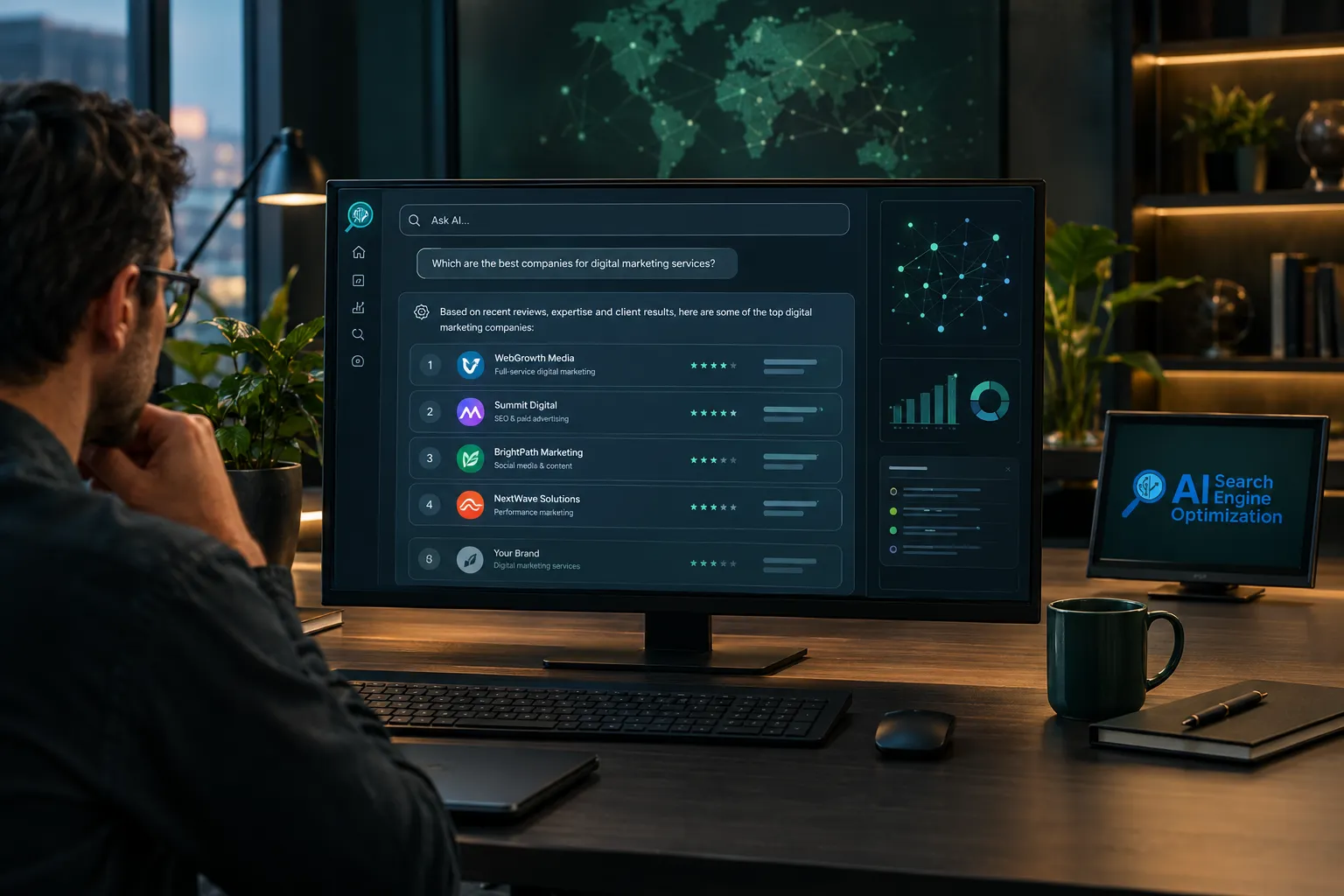
We run the same buyer questions on several AI platforms and record the date, the answer, and the business named. Then we trace the supporting evidence, including authorship, matching business details, and sources the assistant can check. According to Search Engine Land's AI search optimization framework, identifying the exact authority gap between a business and its AI-cited competitor is the step most generic SEO audits skip entirely.
A proper audit also benchmarks your site against three real competitors the assistants are already naming, scoring each one against yours on the same scale. That comparison is what turns a vague "we're not showing up in AI" complaint into a fixable list.
Why do I need an AI visibility audit for my business?
You need an AI visibility audit if your buyers research services before calling you, because AI assistants are increasingly the first stop in that research, and Google rankings alone don't guarantee a mention there. Without the audit, you're guessing at why a competitor gets named instead of you.
Consider what changes when a business closes its AI visibility gap:
- An immigration law firm serving Seattle and Vancouver went from 4 ChatGPT visits a month in July 2026 to 75 by September, after a content rebuild that added named authorship and sourced its claims against official government references.
- A special education law firm in California saw website inquiries rise from 41 to 74 over the same four-week window year over year, tracked in its own Google Analytics.
- A wellness spa in Montana went from 34 AI citations on July 1, 2026, to 137 by October 11, measured across every major AI platform in Ahrefs.
None of these businesses changed what they sell. They changed what the AI could verify about them.
How does ChatGPT affect my Google rankings and sales?
ChatGPT does not directly change your Google rankings. It can, however, shape the shortlist before a buyer visits your site, which affects the inquiries you receive even when your rankings stay the same. A buyer who gets a confident, cited answer from ChatGPT may never run a Google search.
This matters more every quarter. Search Engine Land's GEO measurement analysis found that the large majority of businesses still have no visibility into how often AI assistants mention them, even as buyer behavior shifts toward asking an assistant first. If an assistant names your competitor, that inquiry never reaches your contact form, your Google ranking never gets the chance to compete for it.
Our cell tower lease consultancy case makes that connection concrete. Monthly Google clicks rose from 71 in July 2026 to 111 by September, and the business held top-three map placement in 43 of 47 tracked local searches that August. Google visibility and AI visibility improved together because the underlying fixes (clearer content, verifiable facts, consistent business details) serve both.
What's the difference between Google SEO and AI visibility?
Google SEO optimizes for ranking position in a list of links; AI visibility optimizes for being the fact an assistant chooses to state and cite in a direct answer. The mechanics overlap, but the scoring doesn't.
| Factor | Traditional SEO | AI visibility |
|---|---|---|
| Primary goal | Rank on page one | Get named in the answer |
| Key signal | Backlinks, keyword match | Verifiable facts, named authorship, brand mentions |
| Measured by | Position tracking | Citation counts across AI platforms, dated |
| Content format | Optimized for search intent | Optimized to be quoted directly |
| Local signal | Map pack position | Business profile consistency across the web |
One research study of 75,000 brands found that brand mentions across the web tracked AI Overview visibility more closely than backlinks did, a signal traditional SEO audits rarely measure. For a deeper look at how these two disciplines diverge in practice, see this comparison of AI SEO versus traditional SEO.
If your main question is "why does ChatGPT recommend someone else," start with an AI visibility audit. If the question is "why don’t we rank higher on Google," start with a standard SEO audit.
What makes an AI assistant recommend a firm?
AI assistants recommend a business when they can check its facts against multiple sources, both on the business's own site and across the wider web. They look for a named person behind the content, matching details across directories and reviews, and mentions of the brand elsewhere online.
The immigration law firm case shows this in detail. Across its whole website, it pointed to official government sources behind its content just 3 times before its August 2026 rebuild. In one week, it added named authorship and the structured data that tells Google who wrote each page. By the end of that week, source references across the site had grown to 69. Google AI Overviews citations for the firm rose from 21 on July 1, 2026, to 90 by October 11.
The same pattern shows up outside legal services:
- A paint protection film specialist in England went from 21 AI citations on July 1, 2026, to 89 by October 11, with Google AI Overview citations climbing from 2 to 18 in the same window.
- A bathtub reglazing company in Los Angeles grew website form inquiries from 12 to 21 across the same July-to-September period year over year.
A crawler that can't reach your pages can't check any of this. The audit tests each major AI crawler by name against your key pages, because an assistant can't quote a page its crawler never saw. This firm's own page passed that test for all 8 tracked AI crawlers plus a standard browser on October 11, 2026.
Which businesses need AI visibility audits the most?
Service businesses whose buyers research before they call, law firms, medical and dental practices, specialty contractors, consultancies, and e-commerce stores selling considered purchases, benefit most from an AI visibility audit. If your buyer compares options before reaching out, an AI assistant is likely already part of that comparison.
Businesses with less to gain include:
- Businesses competing purely on price, where buyers don't ask an assistant for a recommendation.
- Businesses that only serve walk-in or impulse demand with no research phase.
- Businesses already guaranteed the work through contracts or referrals, with no open buyer search to influence.
For a local business with multiple locations, consistency across every listing matters even more. See how multi-location businesses manage AI search consistency across locations, since one mismatched address or phone number can quietly undercut an otherwise strong AI visibility profile.
What should an AI visibility audit include?
A complete audit includes at least nine checks against your three closest competitors. We examine crawler access, business facts, content readiness, and actual citation counts across multiple AI platforms. A tenth check covers local map visibility if you serve a defined area.
The nine core checks should cover:
- Crawler access. Whether each major AI crawler, tested individually, can actually reach your key pages.
- Keyword cannibalization. Where two of your own pages compete for the same search, and which one should own it. See how keyword cannibalization gets diagnosed in more detail.
- Fact consistency. Whether your business details and credentials match across your site, directories, and review platforms.
- Answer readiness. How clearly your content answers buyer questions and how easily an assistant can quote it, judged against a fixed set of checks. This overlaps with answer engine optimization services.
- Citation sources. Which pages, yours or a competitor's, the assistants actually cite for your buyers' questions.
- Site architecture. Gaps in internal linking that keep an assistant from reaching the pages that bring you work.
- Conversion scoring. Pages that get visits but don't turn them into inquiries, scored against a fixed benchmark. This is the same lens used in a conversion rate optimization audit.
- Named mentions. How often ChatGPT and other assistants name your business, your competitors, or neither, across a fixed question set.
- Competitive benchmarking. A score out of 50 on verifiable facts, for you and each of your three competitors, showing the exact gap.
Search Engine Land's brand visibility measurement guidance notes that the audits getting results treat AI visibility as a measurement discipline with dated evidence, not a single pass/fail score. That matches what this firm's own case data shows: every count here is tied to a specific date and source, not a one-time snapshot.
Phil Belleville, the person you'll talk to
Phil Belleville, founder of AI Search Engine Optimization, has worked in SEO every working day since 1995. Your audit is the first step of his Rank Intelligence Engine, the system he built to diagnose why a WordPress website misses both Google's top results and AI recommendations.
Phil reads the evidence behind every finding personally and decides what it means before it goes in your report. He led the diagnostic work behind every result cited here, from the immigration firm's Google AI Overview citations to the AI answer counts for the Montana spa and the paint protection film specialist in England. You talk to him directly on the strategy call, and he leads your audit from there. A USA-based team of nine installs any approved changes, with every page checked by Phil before it goes live.
How much does an AI visibility audit cost?
An AI visibility audit's price depends on the size of your website and how many buyer questions and AI platforms get tested, and you get that number in writing after a free strategy call, before paying anything. There's no published flat rate because a five-page local business site and a 400-page e-commerce catalog require very different testing scope.
What the quote covers, specifically:
- The key pages that bring you work, named individually.
- The three competitors you're benchmarked against.
- The delivery schedule for the final report.
- The search engines and AI assistants included in testing.
If a provider quotes you a flat number before seeing your site or naming your competitors, that's worth questioning. For context on how pricing conversations should work, see this breakdown of AI SEO pricing and proposals.
Can I do an AI visibility audit myself, or do I need help?
You can ask ChatGPT a few questions about your industry yourself, but that single-day test won't tell you what's actually driving the result, and a real audit needs dated, repeated testing across platforms to produce a usable finding. A DIY check is a starting point, not a substitute.
Here's the gap in practice. We recently ran 26 fixed questions on six major AI platforms over the seven days to September 16, 2026. The answers named 18 agencies, including 5 that were not on our original competitor list. A single manual query would have missed most of that picture entirely, and the same question asked again the next day from a different account can return a different answer.
Do it yourself if you just want a rough sense of whether your name comes up at all. Get help if you need to know why a specific competitor gets named, what facts about your business the assistant can't verify, and what to fix first. Search Engine Journal's guidance on auditing a brand in AI search about a brand generally recommend exactly this layered approach: quick manual checks to spot a problem, structured testing to diagnose it.
What happens if my business doesn't show up in ChatGPT results?
If buyers cannot find your business in those answers, they may contact a competitor before your website has any chance to make its case. This is a silent loss: no referral traffic, no bounce in analytics, just inquiries that never arrive.
Before the gap closed, the immigration law firm received only 4 ChatGPT referral visits a month through July 2026. By September, after the fact and authorship fixes, that figure had reached 75 a month. Every month that gap stays open is a month of inquiries routed somewhere else.
How do I get my website to appear in AI search results?
Three things have to be true before your website can appear in AI search results. The crawler must be able to read your pages, your business facts must agree across the web, and your content must provide answers an assistant can quote directly. All three need to be true at once; missing one undermines the other two.
The fix order matters:
- Fix crawler access first. A page an AI crawler can't reach can't be cited, no matter how good the content is.
- Fix facts second. Mismatched addresses, unverifiable credentials, or inconsistent business details give an assistant a reason to distrust everything else on the page. One audit of a Fort Lauderdale mobile outboard repair business found an industry award and a certification, appearing 582 times across the site, that no public source could back up; removing both was the first fix. For more on why this matters, see E-E-A-T's role in AI search.
- Fix content third. Rewrite key pages so they answer buyer questions directly, with named authorship and sourced claims. This is the core of generative engine optimization services.
- Fix internal links last. Once the facts and content are right, internal linking makes sure an assistant's crawler can actually find the pages that matter.
Google's AI search guidance follows a similar sequence: fix access before content, because content fixes on unreachable pages produce nothing measurable.
How long does it take to see results from AI visibility improvements?
Most businesses see measurable movement in AI citation counts within 8 to 12 weeks of implementing fixes, with inquiry volume typically following over 3 to 6 months as the changes compound. Citation tracking tends to move faster than inquiry volume because assistants re-crawl and re-evaluate sources on a shorter cycle than buyers take to act on a recommendation.
Checkpoints matter more than a single end date. A sound program measures:
- 6 weeks: early signal on whether AI citation counts are moving at all.
- 12 weeks: a clearer read on ranking movement and citation trend, not just a single data point.
- 6 months: inquiry volume and revenue impact, measured against your own analytics.
The paint protection film specialist's climb from 21 to 89 AI citations over roughly 14 weeks (July 1 to October 11, 2026) sits inside that normal window, not an outlier result.
How do I know if my competitors are winning in AI search?
A competitor is winning when the same dated set of buyer questions names it more often than you across several platforms. We also check whether the facts an assistant can verify about that competitor are stronger than yours. A single ChatGPT query isn't evidence; a repeated, dated test is.
A proper competitive check includes:
- The same question set asked across six or more AI platforms, not just ChatGPT.
- A score out of 50 for you and each of your top three competitors on verifiable facts.
- A log of which sources the assistant cited for each competitor's answer.
Research on optimizing visibility in generative engines points to the same conclusion: businesses that win citations consistently are the ones whose facts are checkable across multiple independent sources, not the ones with the most content volume. That's the gap this kind of benchmark is built to expose.
How to start, and what stays yours
Start with the audit as a standalone paid project, then decide on ongoing work once you've seen the findings; there's no obligation to continue. Pricing and timing depend on your site's size and the number of questions and platforms tested, quoted in writing after a free call, before you pay anything.
This fits WordPress-based service businesses and online stores whose buyers research before they call. It's not built for businesses shopping purely on price or looking for a guaranteed ranking position, since no legitimate provider can guarantee that an AI will mention you.
What you get and what you keep:
- A written report naming the page and the fix for every finding, in the order the work should happen, plus workbooks your team or developer can follow.
- The full audit report stays yours whether or not you hire the firm for implementation.
- If you do move forward, you keep your logins and account access, and every changed page gets a before-and-after record so anything can be rolled back.
- Work runs month to month with no long-term contract and 30 days' notice to stop.
- Every change in scope gets installed and checked on your live site, including structured data, though no one can guarantee a specific AI mention in return.
Frequently asked questions
Can't I just ask ChatGPT myself?
You can, but the answer ChatGPT gives you on a given day may be inaccurate or incomplete, even describing services a business never offered. A real audit runs a fixed question set across six AI platforms on recorded dates and counts how often each competitor gets named, which is a different, more reliable signal than one manual query.
Why does ChatGPT give me a different answer every time?
ChatGPT and similar assistants personalize answers per user and can change their answer from one day to the next for the same question. That's why a credible audit keeps every answer dated and only calls something a finding once it shows up repeatedly.
What if I already have an SEO provider?
Keep your current provider for Google rankings and traffic diagnostics, and hand them the AI visibility report to work from. This audit is an independent second opinion on whether AI assistants recommend your business, separate from traditional ranking and traffic audits.
Does the audit include the fixes?
No. The audit hands you the page and the recommended fix for every finding. Making the changes is a separately agreed next step, and Phil leads that implementation work if you choose to move forward.
Are AI search results replacing Google search?
Not entirely, but AI assistants are increasingly the first stop for buyers comparing options before they search Google directly. Businesses that show up in both places capture buyers at every stage of that research.
What's the difference between SEO and AI optimization in practice?
SEO improves ranking position through relevance, content, links, and technical accessibility. AI optimization, also called GEO or AEO, makes your business easier for an assistant to verify and cite through clear authorship, consistent details, and sourced claims.
Do you guarantee my business will be mentioned by ChatGPT?
No. Every change within the agreed scope gets installed and verified on your live site, including structured data, but no legitimate provider can guarantee that ChatGPT or any other AI will choose to mention a specific business.
What happens after the audit is delivered?
Phil walks you through the roadmap on a review call, explaining what each finding means and the order fixes should happen in. From there you decide whether to implement the changes yourself, hand them to your existing developer, or have the audit team install and verify them.
References
- Search Engine Land, How to Optimize Content for AI Search Engines: A Step-by-Step Guide
- Search Engine Land, Measuring GEO: What's Trackable Now and What's Still Missing
- Search Engine Land, How to Measure Your AI Search Brand Visibility and Prove Business Impact
- Search Engine Journal, Brand Protection in AI Search: How to Audit and Defend Your Brand's Identity
- Google Search Central, Top Ways to Ensure Your Content Performs Well in Google's AI Experiences
- Princeton University, GEO: Generative Engine Optimization (arXiv)