

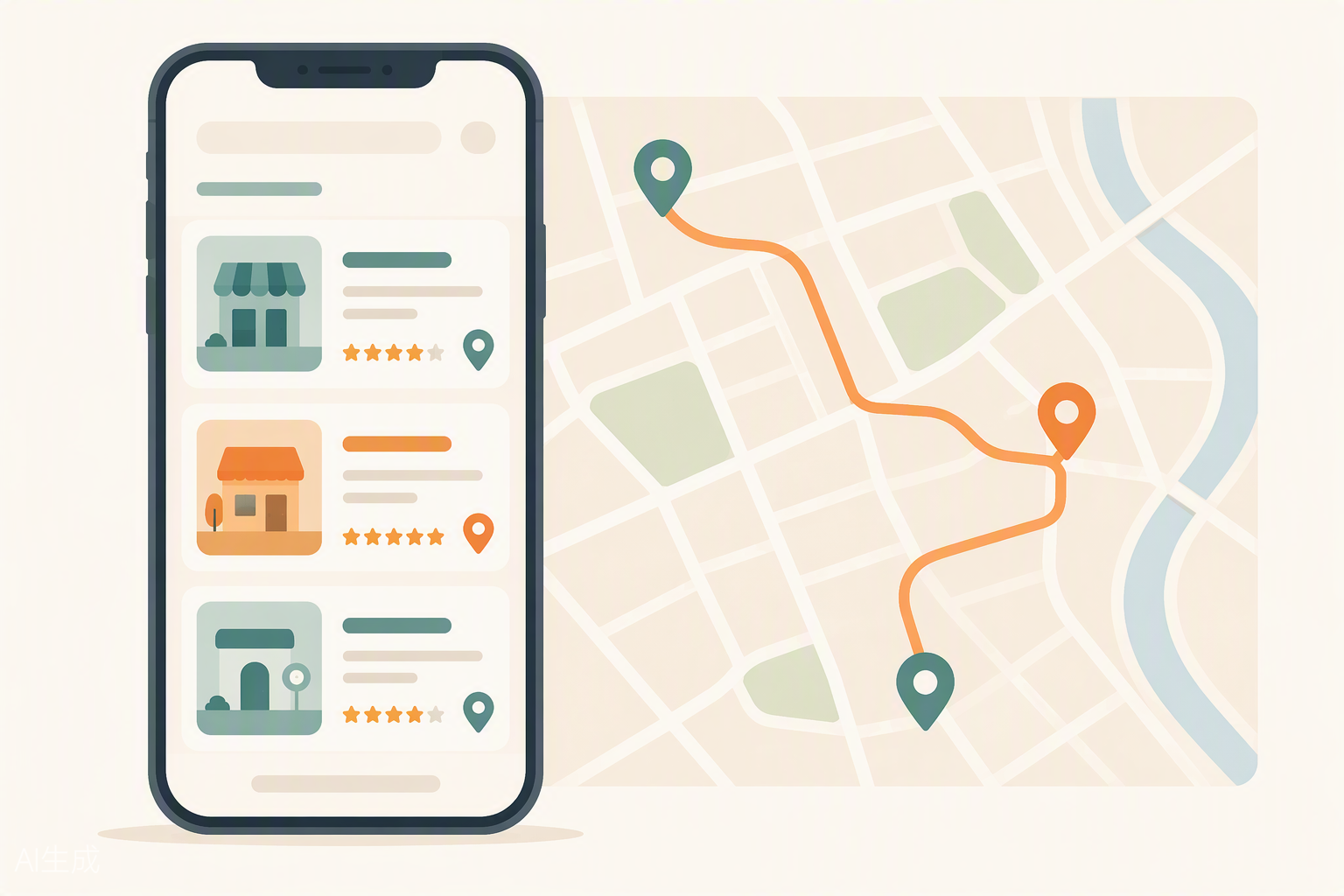
When a nearby customer asks Google Maps, ChatGPT or an AI Overview who to call, they get two or three names. If yours is not one of them, that customer never knew you existed. The competitor being named is not better than you. Their business is easier for the machines to verify, and that is a fixable problem.
Led by Phil Belleville, in search since 1995. Every engagement measured monthly against real map pack positions and real AI citations. Month to month, no contracts. Nothing built for places you do not serve.
Book a free AI SEO strategy call or start with an AI SEO audit.
Local AI SEO services get a local business named when a nearby customer searches on Google Maps or asks an AI assistant such as ChatGPT, Google AI Overviews, Gemini or Perplexity who to call. The work verifies the business facts machines check, builds service pages that can be quoted, adds the review and citation signals that prove them, and measures map pack positions and AI citations every month. It is led by Phil Belleville, an SEO practitioner since 1995, for service businesses across the United States.
Why Local Businesses Disappear From AI Answers and the Map Pack
The search your customers run has changed shape. A few years ago they scrolled a page of ten links and a three-business map. Now they ask, and they are answered with a shortlist: two or three businesses, a sentence on why each was chosen, and a button to call. Everyone else is invisible at the exact moment the customer decides. As one remodeler learned at a conference breakfast this year, seeing your own company in your own ChatGPT results proves nothing; the assistant on the customer’s phone is the one that counts.
The businesses being named are not the biggest or the cheapest. They are the ones the machines can verify. When an assistant checks a plumber’s website, Google profile, reviews and directory listings and finds the same name, the same services and the same phone number everywhere, it can recommend that plumber with confidence. When it finds three phone numbers, a services list that changed in 2021 and a city page for a suburb the plumber has never worked in, it moves on. Verification is the ranking factor now, and most local businesses have never been told.
Most owners have also already paid for the wrong fix. The reviews of local SEO agencies across the country tell the same story: a twelve-month contract, reports full of activity, and no change in the phone. One Seattle owner wrote that after working with a few SEO companies and wasting money she was hesitant to give another agency a try. An Atlanta owner described paying money, promises not kept, and a website that ended up going completely down. A Nashville owner said the service was bad and the costs continued to increase. Those agencies were selling tactics that AI assistants now treat as noise: directory blasts, purchased links and stacks of city pages.
That last tactic deserves its own warning. A site with fifty near-identical city pages for places the business does not serve is not invisible despite them; it is invisible because of them. Google’s systems rate the whole site down when most of its pages exist for search engines rather than customers, and an AI assistant that reads a page claiming presence in a city where the reviews show none stops trusting everything else on the site. If your last agency built those pages, they are the first thing that has to go.
The Shortlist Method: Local AI SEO Built to Get You Named
Our clients describe the change the same way the reviews above describe the disappointment, in reverse: the phone rings for the service they wanted, the calls come from the areas they serve, and they can see why. That is the outcome the Shortlist Method is built for. It has four parts, and every part produces something you can read, check and keep.
- Verify. We audit every place a machine can read about your business: your website, your Google Business Profile, your directory listings and the structured data behind your pages. Conflicts get corrected and gaps get filled, so that the assistant checking your facts finds agreement everywhere it looks.
- Answer. We map the questions your customers actually ask to the pages that should answer them, then build one page per service that answers plainly enough to be quoted. Existing pages that confuse the machines are rewritten, merged or removed.
- Signal. We build the evidence that proves the answers are true: reviews on the surfaces assistants read, citations on the directories that matter for your category, and the schema that describes your services, your area and your people to machines.
- Measure. We record your map pack positions, your Google rankings and your citations across seven AI engines every month, against a baseline taken before any work started, and we report the movement in plain English.
The pivot is simple: stop asking how to rank a page and start asking what an assistant would need to see before it could recommend your business to a stranger. Everything in the method follows from that question. Here is how it compares with the local SEO package most owners have been sold.
| Dimension | The typical local SEO package | Local AI SEO with the Shortlist Method |
|---|---|---|
| What gets measured | Activity: posts published, links built, tasks completed | Outcomes: map pack positions, Google rankings and AI citations across seven engines, against a pre-work baseline |
| City pages | One page per city, near-identical, for places the business never serves | One page per service, written to be quoted; a location page only where you actually operate |
| Links | Monthly directory blasts and purchased links | Citations on the directories assistants read, and mentions earned by being worth mentioning |
| Who does the work | An account manager relays tasks to a rotating team | Phil Belleville leads every engagement and writes the plan you read |
| Contract | Twelve months, cancellation fees | Month to month; you keep everything built if you leave |
| Reporting | Dashboards and ranking screenshots | A written report you can read in ten minutes, with the queries so you can check the answers yourself |
| Verification | Ratings and reviews claimed in code that do not exist on the page | Every fact on the site has a visible twin and matches every profile; nothing is claimed that cannot be checked |
Local AI SEO Services We Provide
Google Business Profile optimization for AI answers
Your profile is the first source the map pack and the AI assistants read. We rebuild it around the services you want, the categories that match how customers ask, and the weekly activity that keeps it trusted.
Service pages built to be quoted
One page per service, written to answer the question a customer asks an assistant, with the facts an assistant needs to cite you. This is the page type that earns local AI citations; a city page that repeats it does not.
Local citation and entity cleanup
Assistants cross-check your name, address, phone and services across the web. Conflicting listings, old phone numbers and abandoned profiles cost you the shortlist. We find and fix them, then stop new ones from appearing.
Review signals AI assistants read
Reviews are evidence, and assistants weigh what reviewers say, not just the star count. We build a review process that asks the right customers the right questions at the right moment, on the platforms that feed AI answers.
AI SEO audit for local businesses
If you want the diagnosis before the program, the audit shows where your business stands in Google and in each AI engine, what is blocking it and what it would take to fix, in an action plan you can execute yourself. Read more about AI SEO audit.
Local answer engine optimization
The question-and-answer layer of local visibility: the questions people ask AI Overviews, ChatGPT and voice assistants about your service, answered on your site in the form assistants lift.
Local AI visibility tracking and reporting
Monthly citation counts across seven AI engines, map pack tracking and Search Console reporting, written so an owner can read it in ten minutes. Available as a standalone service for businesses that do their own work. Read more about how we track and report local AI visibility.
AI content optimization for existing local pages
Pages that already rank but are never cited usually need structure, not rewriting. We add the extraction blocks, entity clarity and schema parity that make an existing page quotable. Read more about AI content optimization.
How the Local AI SEO Process Works, Month by Month
The first month is research and foundation. We map the searches worth winning to the pages that should own them, profile what currently ranks and gets cited for each, and correct the facts that stop machines from trusting the business. The pages start in month two, and the measurement starts before anything else does, so month one’s report already shows the baseline you are moving from.
- Step 1: Verify. We audit every place a machine can read about your business: your website, your Google Business Profile, your directory listings and the structured data behind your pages. Conflicts get corrected and gaps get filled, so that the assistant checking your facts finds agreement everywhere it looks.
- Step 2: Answer. We map the questions your customers actually ask to the pages that should answer them, then build one page per service that answers plainly enough to be quoted. Existing pages that confuse the machines are rewritten, merged or removed.
- Step 3: Signal. We build the evidence that proves the answers are true: reviews on the surfaces assistants read, citations on the directories that matter for your category, and the schema that describes your services, your area and your people to machines.
- Step 4: Measure. We record your map pack positions, your Google rankings and your citations across seven AI engines every month, against a baseline taken before any work started, and we report the movement in plain English.
Each month ends with a written report and a scheduled call. You see what was built, what moved in the map pack and in AI citations, and what comes next. Book the free strategy call to get the baseline for your business.
Proof Behind the Shortlist Method You Can Check Before You Call
This page makes no claim you cannot verify. The founder, Phil Belleville, has worked in search engine optimization since 1995 and founded Omaha SEO the same year; that agency is a Google Partner with an A+ rating from the Better Business Bureau and still serves local service businesses as its core clients. He once built and sold a website that held more than nine hundred top Google rankings. The agency sites he runs rank at the top of their own city markets for the searches an agency needs to win, which is the test we suggest applying to anyone selling this work.
The method is written down, above, in four parts you can hold us to. The measurement produces numbers you can reproduce on your own phone. And the person on the strategy call is the person who writes your plan. Read more about Phil Belleville or about the agency.
Who Local AI SEO Services Are For
- You run a service business with a real location and real customers nearby, and you want the phone to ring for the services you actually want to sell.
- You have paid for local SEO before and can no longer tell what you were paying for.
- You have asked an assistant for your own service in your own city and were not one of the names it gave.
- You want to read the plan, check the evidence and see the numbers, without learning a new vocabulary to do it.
- You would rather fix the reason you are not being named than buy a shortcut around it.
It is not a fit if you need guaranteed positions by a date, if the business has no location and no local customers, or if the plan is to rank a site that has nothing real behind it. In those cases we will say so on the call, and we will point you at what would actually help.
Local AI SEO by Business Type
The shortlist works the same way in every category, but the verification problems differ, and so does the question the customer asks. These are the three patterns we see most.
Home services: the phone number problem
Symptom: a roofer or plumber with strong reviews is never named. Cause: three phone numbers across the web, a tracking number on the profile and a different one on the site, so the assistant cannot confirm the business is one business. Resolution: one number everywhere, a profile rebuilt around the services the owner wants, and one page per service written to be quoted.
Clinics and practices: the name problem
Symptom: a dental or physical therapy practice is confused with the practitioner’s personal listing or with a former partner’s practice. Cause: the practice name, the doctor’s name and the building name all appear as the business in different places. Resolution: a single canonical name and structure, practitioner pages that resolve to the practice, and schema that tells machines which entity is which.
Law firms and professional services: the credibility problem
Symptom: the firm ranks for its name but is never recommended for its practice areas. Cause: pages that describe the firm instead of answering the client’s question, and proof that lives in a brochure rather than on the page. Resolution: practice-area pages that answer plainly, named attorneys with verifiable credentials, and the third-party mentions assistants use to confirm a firm is real.
Where We Provide Local AI SEO
We work with local service businesses across the United States, and the work runs entirely online: a scheduled call each month and email in between, with pages, listing corrections and reports delivered in writing. We do not publish pages claiming a presence in cities where we do not operate, because that is the pattern that gets sites demoted, and we will not build them for you either. Your location pages are built only for places you actually serve, with the proof that shows it.
What Your Google Business Profile Needs in the AI Era
Assistants read your profile before they read your website. The categories have to match how customers ask, not how the industry names itself; the services list has to be the list you want to be known for, in the words a customer uses; the description has to state who you help and where, without slogans; and the profile has to show weekly life through posts, photos and answered questions, because a silent profile reads as an uncertain business. Reviews matter for what they say, so the review process asks for the service and the outcome, not just the stars.
What the Shortlist Method Measures Every Month
Map pack positions for your target searches. Google rankings for each service page. Search Console impressions and clicks by page. Citation counts across seven AI engines: ChatGPT, Google AI Overviews, Google AI Mode, Gemini, Perplexity, Copilot and Grok. The status of your business facts across your profile, your site and your listings. All of it against the baseline recorded before any work started, in a report an owner can read in ten minutes.
Local AI SEO Questions Owners Ask Before Starting
What are local AI SEO services?
Local AI SEO services get a local business named when a nearby customer searches on Google Maps or asks an AI assistant who to call. Traditional local SEO stopped at the map pack. Local AI SEO covers the map pack plus the answers that ChatGPT, Google AI Overviews, Google AI Mode, Gemini, Perplexity and Copilot give for local questions. The work has four parts: verify the business so machines trust it, answer the questions customers actually ask, build the signals that prove the answers are true, and measure whether the business is being named. We track all seven AI engines alongside Google, every month, so the answer to the question that matters is a number, not a feeling. Want to know where you stand today? That is what the free call is for.
How is local AI SEO different from regular local SEO?
Regular local SEO optimizes for a list of ten blue links and a three-business map pack. Local AI SEO optimizes for a shortlist. When someone asks an AI assistant for a roofer in Dallas, they get two or three names with a sentence of reasoning, and the assistant chose those names by cross-checking the business’s profile, website, reviews and third-party mentions for agreement. That makes consistency and verifiability the ranking factors, not keyword repetition. A business can hold position four on Google and never be named by an AI, or hold position eight and be named every time because its facts line up everywhere. Local AI SEO works on the second outcome without giving up the first. Ask us to run the query for your business and we will show you who gets named today.
Do AI assistants really send customers to local businesses?
Yes, and the share is growing. Google now places an AI Overview on top of most service searches, and in our own captures this month every commercial query we tested carried one. ChatGPT, Perplexity and Gemini answer where-should-I-go questions with named businesses and links. The customer who asks an assistant tends to be further along than the one who scrolls a results page: they have described the job and the location and want two or three options they can call. Being one of those options is worth more than a position on page one used to be, because the assistant has already done the comparison. If you are not sure whether this is happening in your market, ask your own phone for an HVAC contractor in Kansas City, then for your own service in your own city, and count who gets named.
Which businesses benefit most from local AI SEO?
Service businesses whose customers search when they have a problem: plumbers, roofers, HVAC contractors, electricians, dentists, chiropractors, physical therapy clinics, law firms, accountants, cleaners, landscapers and remodelers. These are the categories where a customer asks an assistant for a recommendation and acts on it the same day. Businesses with a physical location and a Google Business Profile see the fastest movement because the map pack and the AI answer draw on the same verified facts. Multi-location businesses benefit too, one location page at a time. A business that sells nationally with no local footprint needs our AI SEO services rather than the local program. Book a call and we will tell you plainly which one fits.
What does a local AI SEO engagement include?
Every engagement includes the four parts of the Shortlist Method: verification of your business facts across your website, your Google Business Profile, your directories and your structured data; answer pages built for the questions your customers ask, including one page per service that gets quoted rather than skimmed; the signals that prove the answers, from reviews and citations to the schema that describes you to machines; and monthly measurement of map pack positions and AI citations. Deliverables arrive as written pages you can read and a report you can understand in ten minutes, whether you are a chiropractor in Charlotte or a roofer in Tampa. You are never asked to approve a strategy you cannot see the evidence for. The first month is research and foundation; the pages start in month two.
How long does local AI SEO take to work?
Foundation fixes show in weeks; rankings and citations compound over months. Verification corrections, schema and Google Business Profile changes are typically reflected in Google within two to four weeks. New service pages usually begin earning impressions inside eight to twelve weeks of going live. AI citations lag behind because assistants draw on third-party sources that have to notice you first; the first citations usually appear within two quarters and become steady after that. A plumber in Denver with a clean profile and thin pages moves faster than a dentist in Atlanta whose business name conflicts with two other listings, because verification problems have to be resolved before anything else can be credited. We give you a timeline for your situation on the first call, and we report against it every month.
How much do local AI SEO services cost?
Local AI SEO is priced as a monthly program with a starting point we state on the first call, and the audit that precedes it is a fixed-price project. You will see the number before you commit to anything, in writing, after the strategy call, because the price depends on how many services and locations you need covered and on how much verification cleanup your business needs first. Engagements run month to month. There is no twelve-month contract, no setup fee hidden in month one and no charge for the strategy call itself. Compare that with the typical local SEO package, which locks you in for a year and reports on activity rather than results. If a quote is outside your budget, we will tell you which pieces to do yourself first.
What do I need to provide to get started?
Three things: your website address, the list of services you actually want more of, and access to your Google Business Profile so we can correct and verify it. Most owners also send their reviews and any prior SEO reports so we can see what was tried. You do not need to write anything; every page, every question and answer and every line of structured data is written for you and shown to you before it goes live. Most engagements need about one hour of your time in the first two weeks, mostly to confirm facts about your business that the web cannot confirm on its own. After that, a thirty-minute call each month is enough.
Will this replace my Google Business Profile work or my ads?
It replaces neither; it makes both work harder. Your Google Business Profile is the single most important source AI assistants and the map pack read, so it sits inside the program rather than beside it. Paid ads keep bringing calls while organic visibility builds, and many owners reduce ad spend once the shortlist work matures, but that is a decision you make from the monthly numbers. What this does replace is the old package of directory blasting, keyword-stuffed city pages and monthly link purchases. Those tactics now hurt more than they help. A cleaning company in Nashville that had fifty near-identical city pages was invisible to Google because of them, not despite them. We remove that kind of weight before we add anything.
How do you measure whether AI assistants are naming my business?
With real counts, every month. We record your map pack positions for your target searches, your Google rankings for the service pages, and the number of times each of seven AI engines cites your site or names your business for the prompts your customers use. The baseline is measured before any work starts, so the report shows movement, not activity. You also get the queries themselves, so an electrician in Columbus can run them on his own phone and see the same answers we report. If a number moves the wrong way, the report says so and says what we are doing about it. That is the difference between a program measured against citations and one measured against how many blog posts were published.
Why should a business trust an agency to do this?
Because the work is verifiable and the person doing it is named. Every claim on this page is one you can check: the founder has worked in search since 1995, the method has four parts you can see in writing, and the measurement produces numbers you can reproduce on your own device. Look for those three things from any agency you consider. Then look for what they will not do: no city pages for places they do not serve, no bought links, no reviews or ratings that exist only in code. Those shortcuts are exactly how businesses lose their visibility, and an agency that still sells them is selling you the problem. Ask hard questions on the call; that is what it is for.
What happens after the first three months?
By month three the foundation is in place, the first service pages are live and the first measurable movement has usually appeared in the map pack and in Search Console impressions. From there the program shifts to expansion: the next services, the next locations if you have them, the answer content that earns AI citations, and the third-party mentions that make assistants confident enough to name you. Each month you get the same report with the same numbers, so you can see the trend and decide whether to continue. Most clients stay because the numbers keep improving, not because a contract says they must; a landscaper in Indianapolis does not need a contract to see that the phone rings more in month six than it did in month one. If you ever want to stop, you keep every page, every listing correction and every line of schema we built.
Get On the Shortlist in Your Market
The outcome is simple to state: when a nearby customer asks who to call, your business is one of the names, in the map pack and in the AI answer, for the services you want. The risk is on our side: month to month, no contract, and you keep every page, every listing correction and every line of schema if you ever leave.
Book your free strategy call. Prefer to see the diagnosis first? Order an AI SEO audit. Or write to hello@aisearchengineoptimization.com with your website and the service you want more of.
New to the subject? Read what AI search engine optimization is and how it works, or the AI SEO blog for the tool reviews and tracking guides.