

Here’s a question I’ve been getting from fellow marketing consultants constantly for the past year: “Phil, my clients are asking about ChatGPT and AI search. How do I even start reporting on this?”
If that sounds familiar because everyone is talking about AI visibility. Whether your brand shows up when someone asks an AI model a question about your industry or AI Visibility has become the metric that clients expect to see in their monthly reports. And most agencies are still winging it.
I’ve spent 25 years in digital marketing. I’ve run SEO campaigns since the AltaVista days, built multiple agencies, and spent the last year testing every AEO (Answer Engine Optimization) tool I could get my hands on. My agency, Omaha SEO, works primarily with local service businesses; plumbers, roofers, electricians, HVAC companies, the kind of businesses where a phone call is worth real money. So when I talk about AI visibility reporting, I’m not talking about theoretical dashboards for Fortune 500 brands. I’m talking about reports that help a small business owner understand whether AI is sending them customers or not.
This guide covers the full picture on which AI models matter, what AI visibility actually means as a metric, the reports that land with local business clients, and the tools that make all of it scalable for agencies.
What Is AI Visibility and Why Should Your Agency Care?
Let’s start with the fundamental concept, because I still talk to agency owners who are confused about what we’re even measuring.
AI visibility is simply this: how often does your client’s brand get mentioned, cited, or recommended when someone asks an AI model such as ChatGPT, Gemini, Perplexity, or others a question related to your client’s services?
That’s what is happening right now in the SEO game. If someone in Omaha types “who’s the best roofer near me” into ChatGPT and your client’s company name appears in the answer, that’s AI visibility. If their name doesn’t appear, they’re invisible in AI search. Being invisible in AI answers is the new version of not being on page one of Google. The stakes are exactly the same except this time, there aren’t even 10 spots to compete for.
This is where AEO comes in. Answer Engine Optimization is the practice of improving your client’s AI visibility and making sure the LLMs are seeing, understanding, and recommending your client’s brand when relevant prompts come through. It’s the new service line every agency needs to offer, and it starts with being able to track and report on it.
The AI Models That Matter for Local Business Clients

Not every AI model matters equally for every client. One of the first things I do when onboarding a new AEO client is figure out which models their customers are actually using. Here’s how I think about it for small business and local service clients:
ChatGPT: is where you start. It has the largest user base, it’s the model your clients have heard of by name, and it drives the most AI referral traffic for local businesses. This is your baseline for AI visibility tracking. Every client gets ChatGPT monitoring, no exceptions.
Perplexity: is the one agencies should be paying more attention to. It functions as a true search replacement when people use it instead of Google, not alongside it. And because Perplexity cites its sources with links, brands that show up in Perplexity answers often see direct, trackable referral traffic. For local businesses running strong content strategies, Perplexity AI visibility can translate directly into website visits and phone calls.
Gemini: matters because Google’s own AI model is increasingly powering the search experience your clients already depend on. AI Overviews, the way Google is reshaping its results pages, well that’s all Gemini under the hood. If your clients live and die by Google traffic (and most local businesses do), Gemini AI visibility is a leading indicator of where their Google presence is headed.
Claude: is more niche for local businesses, but it’s relevant for clients whose customers do heavy research before buying businesses like law firms, medical practices, high-end home renovation contractors. The people using Claude tend to be more deliberate researchers making bigger purchasing decisions. If your client’s average job is $15,000+, Claude visibility is worth tracking.
DeepSeek: is the same story. Not a priority for most local shops, but worth a look for clients in technical or specialized service verticals where the customer base trends more tech-savvy.
The key takeaway for agencies: match the AI models you track to the models your client’s actual customers use. That’s the AEO strategy that produces results not just tracking everything for everyone.
How AI Visibility Is Measured in Percentages
If there’s one mental shift that separates agencies doing AEO well from agencies fumbling through it, this is it. And I’ll be honest it didn’t click for me right away either.
Connor Kimball over at Cairrot put it in terms that finally landed. He talked about “search impression share” as the native metric for AI visibility, and once I heard him frame it that way, I couldn’t unsee it. I’d been trying to force traditional ranking logic onto a system that doesn’t have rankings, and that’s why my early AEO reports felt off. They were answering a question nobody was asking.
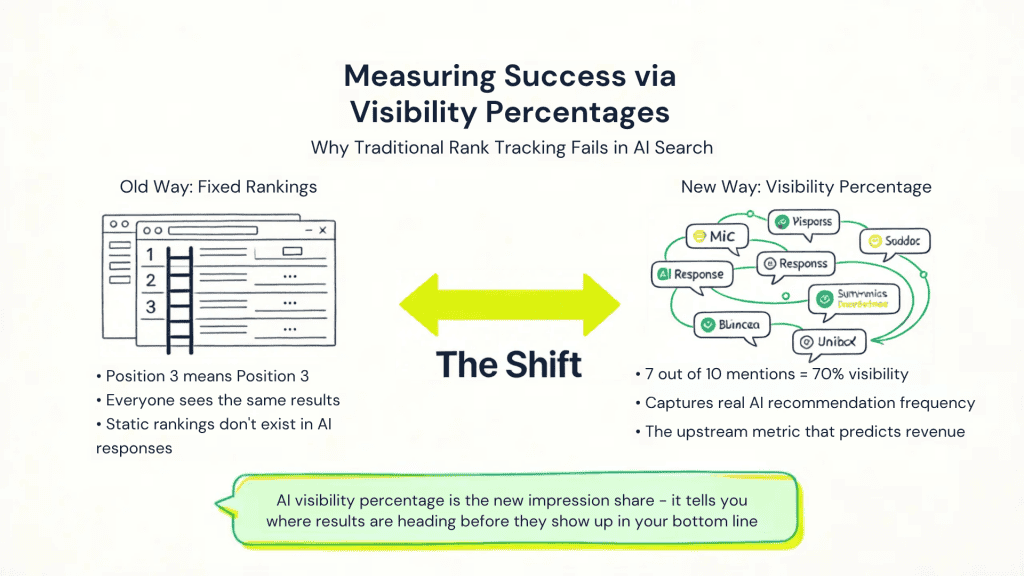
Think about what rank actually meant in traditional SEO. Position 3 was position 3. You searched a keyword, you saw ten results, and everybody got more or less the same page. The number told a clean story. You could track it month over month and it meant something concrete.
AI search threw that entire model out. ChatGPT doesn’t have a position 1 through 10. There’s no results page. The model builds a brand-new answer from scratch every single time someone asks a question. A plumber in Omaha might get named in 8 out of 10 ChatGPT responses on Tuesday and only 2 out of 10 by Friday — not because anything changed on their website, but because that’s how generative models work. Trying to assign a “rank” to that experience is like trying to measure wind speed with a ruler. Wrong tool for the job.
Visibility percentage is the right tool. It measures the share of AI-generated responses that include your client’s brand for a given prompt topic. That single number — expressed as a percentage, broken out by each LLM — gives you a clear, honest picture of where your client stands. You can immediately see which models they’re winning on, which ones they’re losing on, and exactly where competitors are pulling ahead. No ambiguity, no false precision.
And here’s what stays the same: the outcomes your clients are paying for. Calls. Jobs. Revenue. None of that changes because the measurement layer changed. What’s different is the upstream signal you watch to predict those outcomes. AI visibility percentage is that signal — the leading indicator that tells you where a client’s pipeline is heading weeks before it shows up in their bank account.
AI Visibility Reports That Actually Land With Clients
I’ve delivered hundreds of SEO reports over 25 years. The ones that work are the ones that tell a story a business owner can follow without needing a marketing degree. AEO reporting is no different, you just need the right report types assembled in the right order.
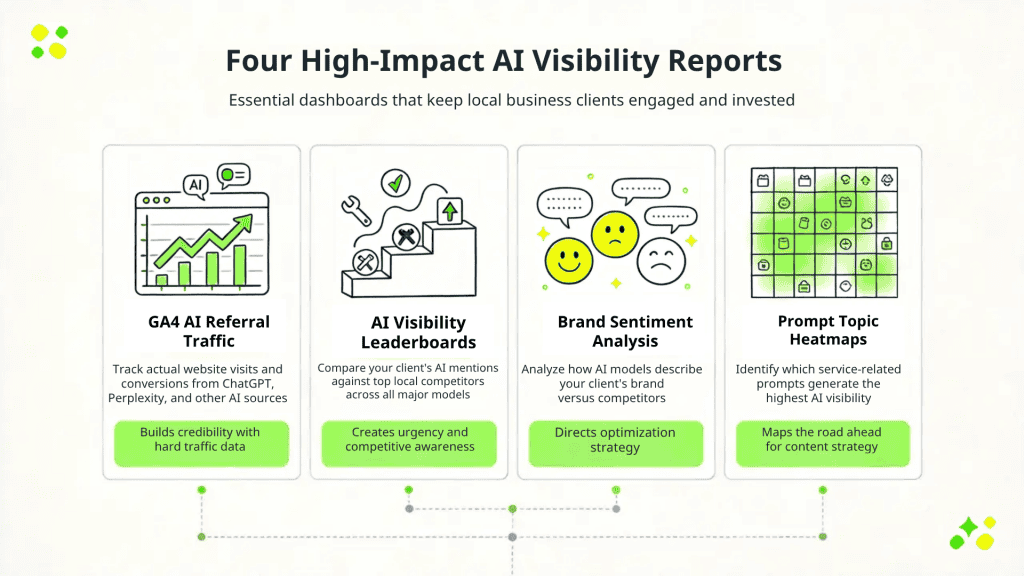
Here are the four AI visibility report types I use for my local business clients at Omaha SEO:
GA4 Traffic Dashboards for AI/LLM Referrals: are where I ground the entire conversation. Before I show a client anything about visibility scores or competitive positioning, I show them the numbers they already understand: website sessions, form submissions, and phone calls that came from AI-driven referrals. This is the report that earns you permission to talk about everything else. When a roofing company owner sees that 47 website visits last month came from ChatGPT and Perplexity, and 9 of those turned into booked estimates, you don’t have to convince them that AI visibility matters. The data already did it for you. Start here, and the rest of your AEO report has a foundation that speaks the client’s language.
Leaderboard Reports: tap into something every local business owner already feels in their gut: competition. For any prompt topic, how does your client’s AI visibility compare to the other companies in their market? Share of voice, broken out by LLM model. I pull these into every quarterly review because nothing motivates a small business owner faster than seeing a competitor’s name above theirs. When your electrician client sees that the shop across town is getting mentioned in 18% of ChatGPT responses while they’re sitting at 6%, that’s not a data point, that’s a call to action. The leaderboard is what turns AI visibility from an abstract concept into a race they want to win.
Sentiment Comparisons: answer the question that leaderboard reports leave open: “Okay, we’re both getting mentioned, but what is the AI actually saying about us?” This is the layer that separates surface-level AEO tracking from real strategic intelligence. If Perplexity is recommending your client’s plumbing company but consistently noting the competitor has more five-star reviews and same-day availability, that’s not just data coming in, it is a roadmap ready for use. Sentiment analysis from AI visibility tracking tells you exactly what to fix: the client’s review generation strategy, their service page messaging, their response time claims. It takes the competitive picture from the leaderboard and turns it into a specific action plan.
Heatmap Reports: bring the full picture together in one visual. They show AI visibility intensity across every prompt topic and every tracked LLM in a single color-coded grid. Hot spots where the brand is consistently mentioned. Cold spots where they’re invisible. After walking the client through traffic data, competitive positioning, and sentiment, the heatmap is the strategic map that plans the next 90 days. I can’t count how many times a client has looked at a heatmap cold spot and said “why aren’t we showing up for that?” and just like that, we have our AEO priorities locked in. It’s the visualization that converts a report into a plan.
The way I sequence these in a client meeting is deliberate: GA4 data builds credibility, the leaderboard creates urgency, sentiment directs the strategy, and the heatmap maps the road ahead. That’s an AI visibility reporting package that keeps local business clients engaged, invested, and retained.
Free AI Visibility Tracking: Where to Start on a Budget
Before I get into paid tools, I want to acknowledge reality: not every agency is ready to invest in dedicated AEO software on day one. I wasn’t. Here are the approaches I used before committing to a platform:
Manual prompt testing in spreadsheets: Open ChatGPT, Gemini, and Perplexity. Run through 20-30 prompts related to your client’s industry and location. Log whether the brand was mentioned, what competitors appeared, and any notable sentiment. Track it monthly. This is tedious and time-consuming, but it gives you real AI visibility data. The problem is that it doesn’t scale past two or three clients before it starts eating into your profitability.
GA4 custom channel groupings: Set up channel groupings in Google Analytics 4 that isolate referral traffic from chatgpt.com, perplexity.ai, gemini.google.com, and other AI sources. This shows you how much AI-referred traffic your client is actually getting. It’s free, it’s valuable, and it belongs in your reporting regardless of what other AEO tools you use.
Looker Studio dashboards: Connect GA4 to Looker Studio and build a visual dashboard specifically for AI referral traffic metrics. This gives you a client-facing view of the traffic side of AI visibility without paying for any additional software.
Custom API scripts: If you have technical resources, you can build automated AI visibility tracking using the LLM APIs directly. Parse responses for brand mentions, log data over time, generate reports. It works until an API update breaks your scripts and your developer spends a week rebuilding instead of producing billable work.
Every one of these methods works. I’ve used them all. But I’ll be direct with you: once you have 5+ clients and you’re trying to deliver consistent, professional AI visibility reports every month, the manual approach becomes a margin killer. That’s when you need a dedicated AEO tool.
The AEO Tool I Recommend for Agency-Scale AI Visibility Tracking

I’ve tested more than a dozen AEO and AI visibility platforms over the past year. I’ve published detailed reviews of Gumshoe AI, Scrunch AI, Peec AI, and several others. I also put together a full comparison of the best AEO tracking tools for agencies if you want the complete breakdown.
Each tool has a niche. Gumshoe is excellent for project-based AI visibility audits at a low one-time cost. Scrunch is technically ambitious but overbuilt for most local business agencies. Semrush’s AI Toolkit is convenient if you’re already deep in their ecosystem, but expensive to add on. Profound is strong for e-commerce.
The tool I chose for daily use at Omaha SEO, and the one I consistently recommend to other agencies is Cairrot. Here’s why it works specifically for agencies tracking AI visibility across a roster of local business clients:
- White-label AI visibility reports: Every report I send to a client has Omaha SEO branding on it. Not Cairrot’s logo. Not some third-party watermark. My brand. That’s non-negotiable for agency credibility, and Cairrot’s white-label system handles it cleanly.
- Multi-client management from one dashboard: I manage all my AEO clients from a single login. Flip between accounts instantly. No logging out and back in for each client. When you’re running AI visibility tracking for 10+ local businesses, this workflow efficiency directly protects your margins.
- Wholesale pricing that rewards growth: Most AEO tools get more expensive per client as you scale. Cairrot’s wholesale model works in the opposite direction; the more clients I add, the lower my per-client cost. That means I can offer competitive AI visibility reporting packages to small businesses without destroying my own profitability.
- A free, robust API plus MCP integration: Some of my clients want AI visibility data flowing into their own dashboards or BI tools. The API makes that possible. The MCP (Model Context Protocol) integration is pointing toward automated AEO workflows, and agencies that get ahead of that curve will have a significant edge.
- Fully customizable reporting dashboards: Different clients need different views of their AI visibility data. A plumber and a law firm have different priorities and different questions. Cairrot lets me build custom dashboard views for each client so the reporting speaks directly to their business.
- GA4 and Google Search Console integration: This is the feature that turns AI visibility tracking into a complete AEO reporting system. By correlating AI visibility data with actual traffic and conversion data from GA4, I can show clients the direct line between “ChatGPT is mentioning you more” and “your phone is ringing more.” That’s the connection that makes AI visibility reporting stick.
How Often Should Agencies Report on AEO/AI Visibility
I learned this lesson the hard way: report too frequently and your clients start micromanaging every fluctuation. Report too infrequently and they start wondering what they’re paying you for. After a year of dialing this in across my local business clients, I’ve found the cadence that keeps everyone happy, including my team’s bandwidth.
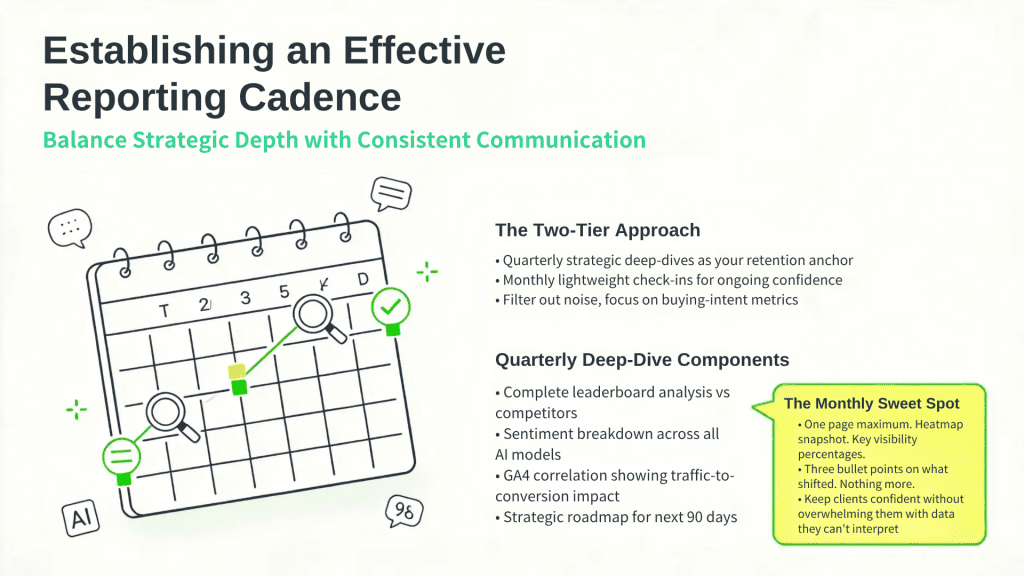
Start with the quarterly deep-dive as your anchor. This is the report that does the heavy lifting for your agency. Every 90 days, you sit down with the client and lay the full picture on the table. Leaderboard reports showing exactly where they rank against competitors in AI mentions. Sentiment breakdowns revealing how ChatGPT and Perplexity are positioning them versus the other guys in town. GA4 dashboards proving that AI visibility is translating into real website traffic, real form submissions, real phone calls. Then you close with your AEO game plan for the next quarter; what you’re going to optimize, which prompt topics you’re targeting, and what results to expect. This quarterly session is your retention engine. Clients who see this caliber of strategic thinking don’t shop around.
Between those quarterly sessions, send a lightweight monthly check-in. Think of this as a temperature reading, not a deep diagnosis. One page. Heatmap snapshot showing AI visibility across the tracked LLMs. The key visibility percentages. A few bullet points on what shifted and whether it’s worth paying attention to. Nothing more. The whole point of the monthly report is to keep the client confident that you’re on top of things without burying them in data they don’t know how to interpret. I build these in Cairrot’s templating system and once they’re set up, each client’s monthly report takes minutes, not hours.
What you leave out of both reports matters just as much as what you put in. Top-of-funnel informational prompts, things like: “how often should I replace my furnace filter” bounce around constantly in AI answers. That’s just the nature of how LLMs regenerate responses. If you include that volatility in your reporting, your electrician client is going to call you every month asking why the numbers are jumping around, and you’ll spend your time managing anxiety instead of doing actual AEO work. Filter your reporting down to the prompts that map to buying intent. “Best HVAC company in [city].” “Emergency electrician near me.” “Who should I hire to replace my roof?” Those AI visibility metrics hold steady enough to show real trends, and they’re directly connected to the outcomes your clients actually write checks for.
Stop Waiting And Track Your AI Visibility
Twenty-five years in this industry has taught me one thing about transitions: the agencies that move first set the terms. Everybody else reacts. I watched it happen with local SEO, with mobile optimization, with content marketing. The pattern is always the same.
AI visibility is that inflection point right now. The agencies adding AEO reporting to their service stack today are going to own these client relationships for years. The shift isn’t complicated: from rank tracking to AI visibility percentages, from keywords to prompt topics, from Google-only dashboards to multi-LLM analytics. Your clients still care about calls, jobs, and revenue. You’re just tracking a new upstream signal that predicts those outcomes.
If you want to learn more about how we approach AI visibility tracking and AEO at Omaha SEO, or if you need help building AI visibility reporting into your own agency’s services get in touch with us at Omaha SEO. We help agencies and local businesses get found in AI search, and we’re happy to show you exactly how we do it.