

Key Summary
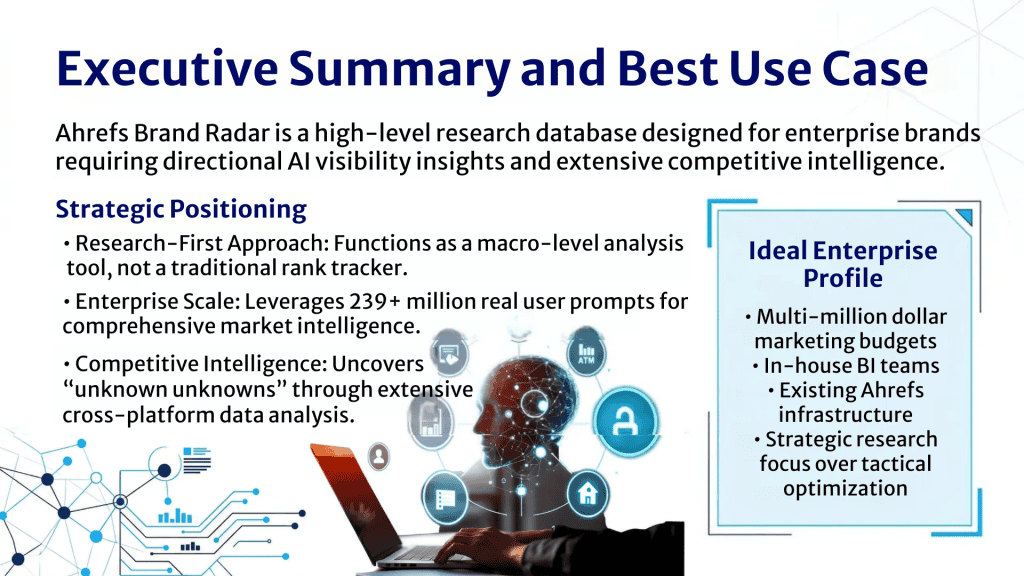
How does Ahrefs Brand Radar compare to the other AI brand monitoring tools on the market, according to our team of AEO experts and influencers? Here’s our opinion in a nutshell:
- Best Use Case: Enterprise brands already deeply invested in the Ahrefs ecosystem who need a massive research database for directional AI visibility insights and high-level competitive intelligence.
- Pricing Snapshot: Extremely expensive. Brand Radar is an add-on to a base Ahrefs plan (starting at $129/mo), costing an additional $199/mo per AI index or a bundled $699/mo for all six platforms, bringing the minimum effective cost to $828 per month.
- Standout Feature: The sheer scale of its prompt database (over 239 million prompts) and its ambitious, though still developing, goal to unify AI, web, YouTube, and Reddit visibility tracking in one platform.
- Main Limitation: The prohibitive cost for most businesses and agencies, coupled with significant, documented accuracy issues in its AI tracking modules and a lack of actionable optimization guidance, makes it a poor value proposition compared to specialized tools.
- My Experience Testing Ahrefs Brand Radar and Competing Visibility Tools
If you’re in marketing today, you’re staring into the same black box I am: AI search. For years, we mastered the rules of Google. Now, with tools like ChatGPT, Perplexity, and Google’s own AI Overviews, our customers are getting answers without ever seeing a list of blue links. Our brands are being mentioned, compared, and recommended, or ignored, inside a system we can’t easily measure. This is the core challenge of Answer Engine Optimization (AEO), a field I navigate daily for my enterprise clients.
As someone who has spent the last 12 months testing a wide array of AEO reporting and optimization tools, from early (and expensive) solutions like Scrunch AI to agile, fast-growing newcomers like Cairrot and Gumshoe AI, I’ve been searching for a tool that provides clarity without an exorbitant price tag. When Ahrefs, a respected pillar of the SEO world, entered the market with Brand Radar, I was naturally intrigued.
After extensive hands-on testing, my verdict is clear. Brand Radar is an incredibly ambitious and powerful research tool, boasting the largest prompt database I’ve seen. However, its eye-watering price, questionable accuracy in key areas, and agency-unfriendly model make it a niche solution for a very specific type of user. For most marketers, there are far more practical and cost-effective alternatives available.
Brand Radar’s Capabilities
Ahrefs Brand Radar Is More Research Database Than Rank Tracker
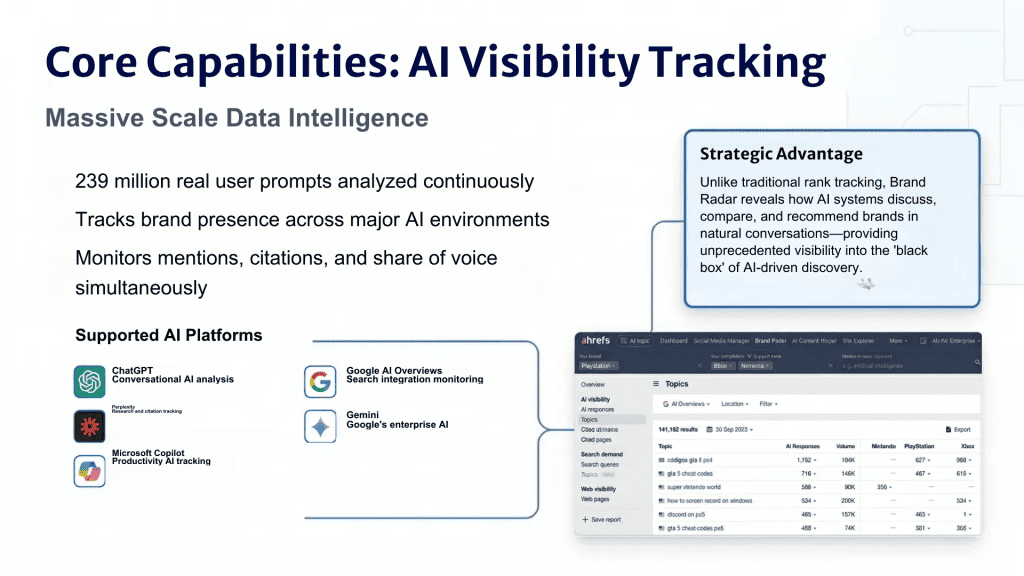
To understand where I’m coming from with the rest of this review, it starts with this: I consider Brand Radar a research database first and an AI/LLM visibility monitor second. It functions more like a massive, searchable research database for brand presence across the entire modern discovery landscape. It’s less about tracking a handful of specific, high-intent prompts and more about macro-level analysis.
Unlike tools that focus on a “seed list”; of prompts you provide, Brand Radar leverages its enormous database of over 239 million real user prompts. You input your brand and competitors, and the tool shows you where you appear across this vast ocean of queries. This is excellent for uncovering your “unknown unknowns”—the topics and questions you didn’t even know you should be tracking. This approach is fantastic for high-level strategic analysis but can be frustrating if you just want to monitor performance on a specific set of commercial prompts.
Brand Radar is positioned as a comprehensive research database, covering AI Share of Voice, Search Demand, and multi-platform tracking.
AI Visibility Tracking and Its Blind Spots
This is the heart of the product. Brand Radar aims to provide a single dashboard for your Large Language Model (LLM) visibility across multiple platforms. The coverage is decent, but has some notable gaps.
It currently tracks mentions across six AI environments: ChatGPT, Perplexity, Google AI Overviews, Google AI Mode, Gemini, and Microsoft Copilot. The main metrics you’ll work with are AI Mentions, AI Citations, and AI Share of Voice. The ability to see not just when you’re mentioned, but which domains are being cited as the source, is genuinely useful for understanding the information ecosystem around your brand.
However, the lack of native tracking for Anthropic’s Claude and xAI’s Grok is a significant omission in 2026, especially at this price point. Many competitors, including my preferred tool Cairrot, have been tracking these for some time. For Ahrefs to charge a premium while ignoring key parts of the ecosystem is a major flaw.
Beyond AI: Tracking the Entire Discovery Ecosystem

This is where Brand Radar gets really interesting and ambitious. Ahrefs understands that demand is often created on social and community platforms before it ever becomes an AI prompt. To that end, they’ve added beta tracking for YouTube, TikTok, and Reddit.
- YouTube: Scans video titles, descriptions, and transcripts for brand mentions.
- TikTok: Similar mention tracking for the fastest-growing discovery platform.
- Reddit: Monitors not just mentions on Reddit, but when Reddit threads appear in Google’s search results.
In theory, this is a game-changer. Connecting upstream demand creation on YouTube with downstream visibility in AI Overviews is the holy grail of modern marketing analytics. However, in practice, these features are still in beta. During my tests, the insights were directional at best. It’s a compelling vision, but it doesn’t yet provide the clear, actionable value needed to justify the platform’s high cost.
A Critical Look at Accuracy and Methodology
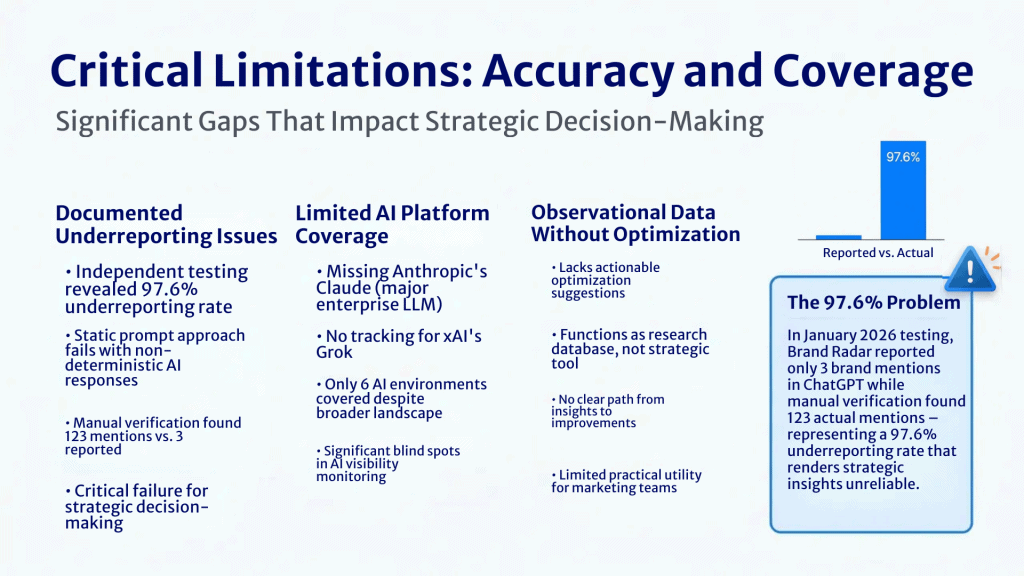
The most significant issue I encountered with Brand Radar is its data accuracy. The tool’s methodology relies on running its static library of prompts against AI platforms at timed intervals—a “snapshot” approach. The problem is that AI responses are non-deterministic; the same prompt can yield different answers just hours apart. A single snapshot represents only one possible version of reality.
Independent testing has revealed the scale of this problem. One review from January 2026 found that when testing Brand Radar’;s ChatGPT module, it reported only 3 brand mentions while manual verification found 123. That’s a 97.6% underreporting rate. For teams making strategic content and budget decisions, this level of inaccuracy is not just a minor flaw—it’s a critical failure that can lead to misguided strategy.
Pricing & Plans: Is Brand Radar Worth the Investment?
Here’s where the dream of a unified visibility dashboard meets the harsh reality of budget allocation. Ahrefs Brand Radar’s pricing is, to put it bluntly, brutal for anyone outside of a Fortune 500 marketing department. It’s not a standalone product but a series of expensive add-ons layered on top of a required base subscription.
Brand Radar Add-On Pricing Explained
First, you need a base Ahrefs subscription. Then, you must pay for Brand Radar’s AI tracking capabilities, which are priced per AI platform, or “index.”
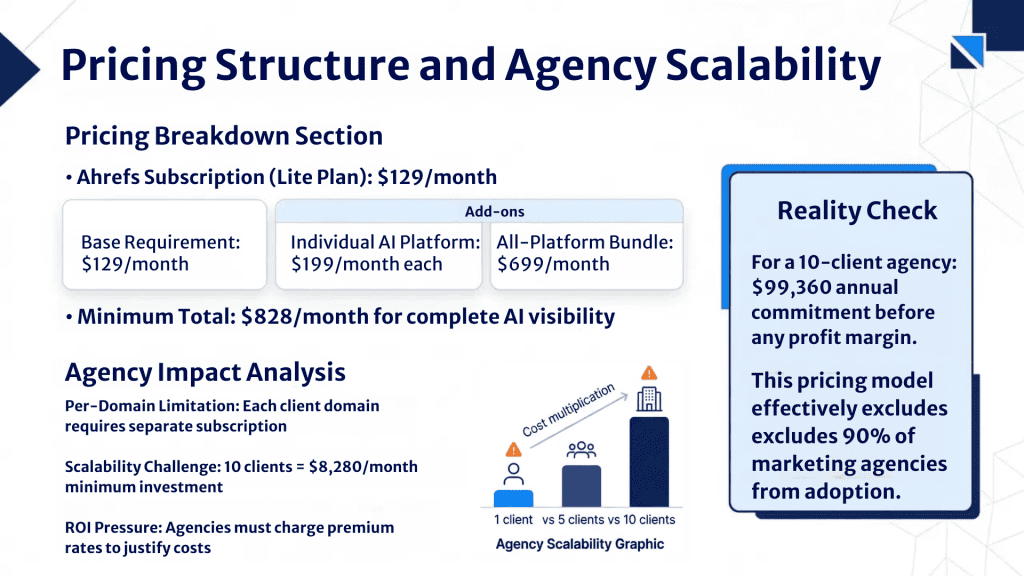
- Base Ahrefs Subscription: Starts at $129/month for the Lite plan.
- Per AI Index Add-on: $199/month for each AI platform (e.g., ChatGPT, Perplexity).
- All-Platform Bundle Add-on: $699/month for the bundle of all 6 AI indexes.
This means to get full AI visibility tracking on the most basic plan, you’re looking at a minimum of $129 (Base Plan) + $699 (Bundle) = $828 per month. As an agency owner, the math is even worse. This pricing is per-domain. Providing this service for just 10 clients would result in a software bill of over $8,000 a month. It’s simply not a scalable model for agency work.
| Plan | Monthly Cost | Annual Cost (20% Savings) | Key Limits | Users Included |
| Lite | $129 | $1,290/year | 750 tracked keywords | 1 |
| Standard | $249 | $2,490/year | 2,000 tracked keywords | 1 |
| Advanced | $449 | $4,490/year | 5,000 tracked keywords | 1 |
User Experience and Integrations
If you’re an Ahrefs veteran, the Brand Radar interface will feel familiar. It’s clean, data-dense, and follows the same design language as Site Explorer. However, its function as a research database rather than a simple tracker can be confusing at first. It took me a few days to figure out the most effective workflows, particularly how to use filters to move from macro trends to specific, actionable insights.
The platform’s greatest integration strength is its API. For an enterprise client with a custom business intelligence (BI) platform or a sophisticated Looker Studio setup, this is a significant advantage. You can programmatically pull data on mentions, impressions, cited domains, and competitor metrics, allowing you to pipe Brand Radar’s data directly into your existing analytics ecosystem. This is a level of integration that many smaller, standalone tools can’t offer.
The robust API is a key strength for enterprise teams, allowing AI visibility data to be integrated into custom dashboards and BI tools.
Customer Support and Resources
Ahrefs has a well-earned reputation for excellent educational content, and this extends to Brand Radar. Their blog is one of the best in the industry, and they’ve published numerous deep-dive articles and use-case guides. This commitment to education is a major asset for any team trying to get up to speed on AEO.
Support is primarily through live chat and email, with response times typically within a few hours. However, it’s worth noting the company’s track record. The decision in 2022 to end grandfathered pricing plans and force loyal users onto more expensive systems created significant backlash and damaged trust among many long-term professionals. While their support is good, this history makes it hard to feel confident that you won’t be hit with unexpected price hikes down the line.
Pros & Cons of Ahrefs Brand Radar
| Pros | Cons |
| Unmatched data scale with access to the industry’s largest database of real user prompts. | Prohibitively expensive add-on pricing model makes it one of the costliest AEO tools. |
| Ambitious vision to track brand presence across AI, web, YouTube, and Reddit in one tool. | Documented accuracy issues with significant underreporting of mentions. |
| Powerful API for enterprise clients needing to integrate AI data into custom BI dashboards. | Not agency-friendly due to the per-domain pricing model. |
| Strong for competitor research and gap analysis using the “Others only” filter. | Limited LLM coverage, with no native tracking for important platforms like Claude or Grok. |
| Familiar interface and seamless integration for existing Ahrefs power users. | Provides observational data but lacks actionable optimization suggestions. |
| Excellent educational content and research to help users understand the AEO space. | Beta features (YouTube, TikTok) lack proven ROI to justify the high cost. |
Head-to-Head Comparison: Brand Radar vs. The Competition
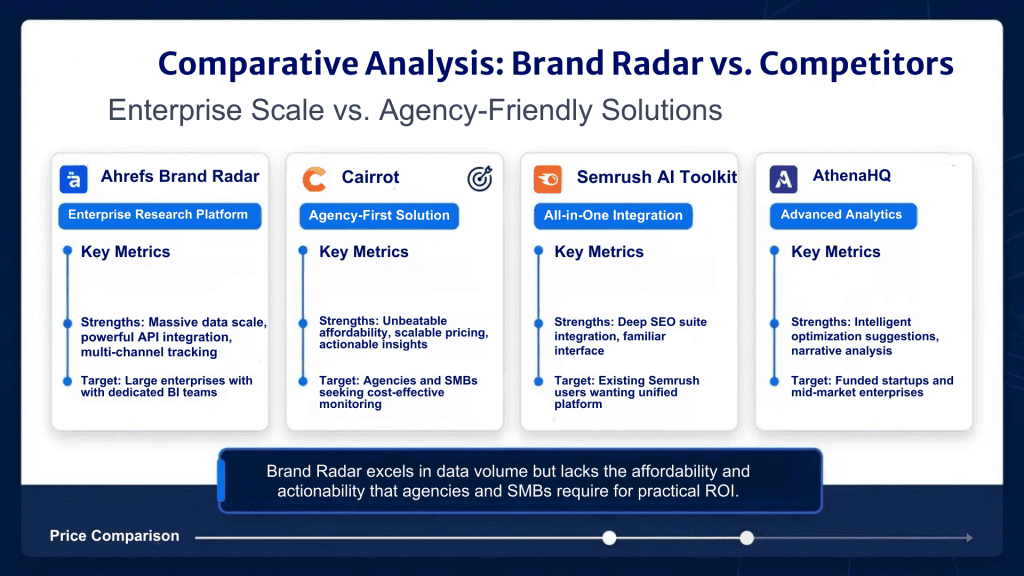
No tool exists in a vacuum. To truly understand Brand Radar’s value, you have to see how it stacks up against the other major players in the AI visibility space. When you do, its weaknesses become even more apparent.
| Factor | Ahrefs Brand Radar | Cairrot | Semrush AI Toolkit | AthenaHQ |
| Best Suited For | Enterprise research & BI integration | Agencies &; SMBs needing affordable, actionable AEO | Existing Semrush users wanting an all-in-one tool | Funded startups & enterprises needing deep analytics |
| Normalized Monthly Cost | ~$828+ (Base plan + bundle) | $39 – $99 | ~$265+ (Base plan + add-on) | $295+ |
| Unique Differentiator | Massive prompt database & multi-channel (web/video) view | Unbeatable affordability, free API, and agency-first features | Deep integration with a comprehensive SEO/marketing suite | AI-driven recommendations and advanced narrative analysis |
| LLMs Tracked | ChatGPT, Perplexity, Gemini, Copilot, AI Overviews, AI Mode | ChatGPT, Perplexity, Gemini, Claude, DeepSeek, Grok (add-on) | ChatGPT, Google AI, Gemini, Perplexity | 8+ including ChatGPT, Gemini, Perplexity, Claude, Copilot, Grok |
| Agency Friendliness | Poor (Per-domain pricing) | Excellent (Scalable pricing) | Poor (Per-domain pricing) | Fair (High fixed cost) |
Real-World Use Cases for Ahrefs Brand Radar
Despite its flaws, there are scenarios where Brand Radar’s unique strengths make it the right tool for the job. These are almost exclusively at the enterprise level.
Use Case 1: Enterprise Brand Monitoring Across Product Categories
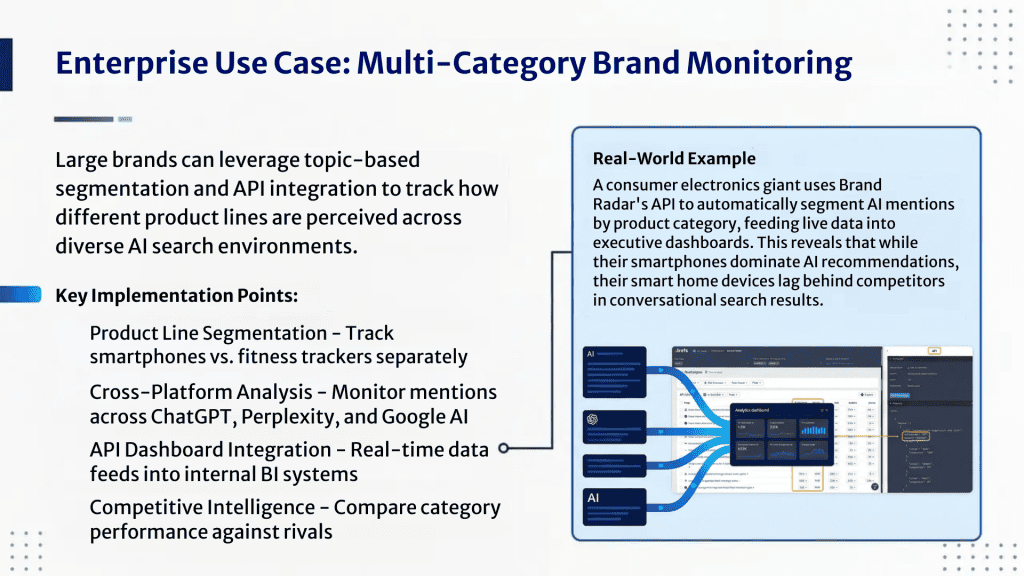
Company Profile: A large consumer electronics brand with multiple product lines (e.g., phones, laptops, wearables).
Challenge: The marketing team needs to understand how their brand is perceived differently across these categories in AI search. An aggregate “brand visibility” score is useless because it mixes signals from their smartphone division with their fitness watch division.
How Brand Radar Solves It: Brand Radar’s topic-based segmentation is perfect for this. The team can create separate analyses for “smartphones” and “fitness trackers.” By filtering the massive prompt database by these topics, they can see which competitors are being mentioned in each vertical, what features are being highlighted, and how their AI Share of Voice changes from one product category to the next. The API then allows them to feed this segmented data into their internal dashboards for each product manager.
The ‘Topics’ report allows enterprise brands to segment AI visibility by product category or niche, providing granular competitive insights.
Use Case 2: Uncovering Competitor Content Strategies for AI
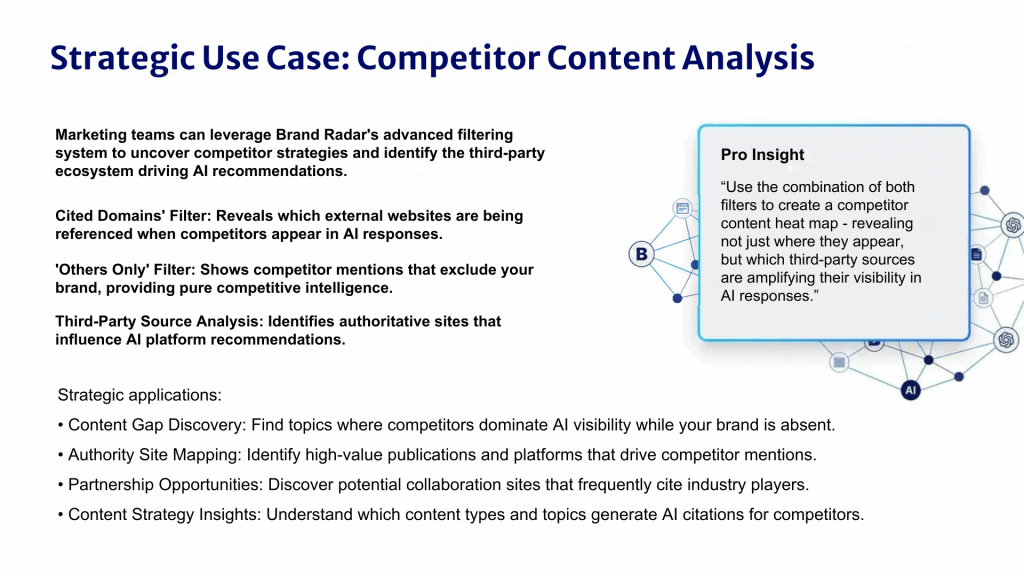
Company Profile: A B2B SaaS company in a competitive space like project management or CRM.
Challenge: They are losing ground to a fast-moving competitor and suspect the competitor is optimizing for AI search, but they don’t know how.
How Brand Radar Solves It: The marketing team uses the “Cited domains”; and “Cited pages” reports, focusing exclusively on their main competitor. They can quickly identify that the competitor is being cited heavily by AI platforms from a series of “alternative to [our brand]” articles on third-party review sites. They also use the “Others only” filter to find unbranded, problem-aware prompts where the competitor is recommended. This provides a clear roadmap for a counter-strategy.
Final Verdict: A Powerful but Flawed Compass for the AI Era
Ahrefs Brand Radar is a tool I desperately want to love. The ambition is undeniable, and the sheer scale of the data Ahrefs brings to the table is impressive. It offers a tantalizing glimpse into the future of marketing analytics—a world where we can connect the dots between a Reddit thread, a YouTube video, and a mention in a ChatGPT response.
However, in its current form, it’s a solution in search of the right problem. Its identity is split between being a high-level research database and a brand monitoring tool, and it doesn’t fully excel at either for the average user. The foundational accuracy issues and the astronomical price tag are impossible to ignore.
Who Should Buy Ahrefs Brand Radar?
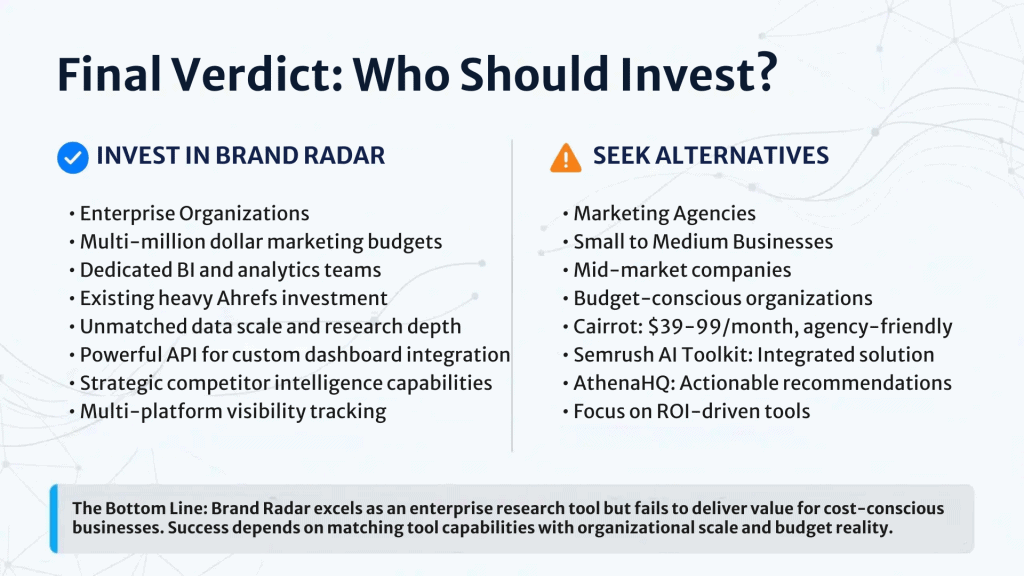
You should consider Brand Radar if you are an enterprise-level company that is already heavily invested in the Ahrefs ecosystem, has a multi-million dollar marketing budget, and possesses an in-house data science or BI team that can leverage the API to its full potential. For you, the cost is a rounding error, and the directional insights from the massive database are worth it for high-level strategy.
Who Should Look for Alternatives?
Nearly everyone else. If you are a marketing agency, an SMB, or even a mid-market company, the cost is unjustifiable, and the lack of agency-specific features makes it a non-starter. You will get far more actionable insights and a much better return on investment from more focused, affordable tools. My primary recommendation is Cairrot, which provides 80% of the value for 10% of the price in an agency-friendly package. For those already in the Semrush ecosystem, their AI Visibility Toolkit is a more logical and cost-effective choice.
Ultimately, Ahrefs Brand Radar is a powerful compass. It can point you in the right direction. But at this price, I need a full GPS with turn-by-turn directions, and Brand Radar isn’t there yet.